
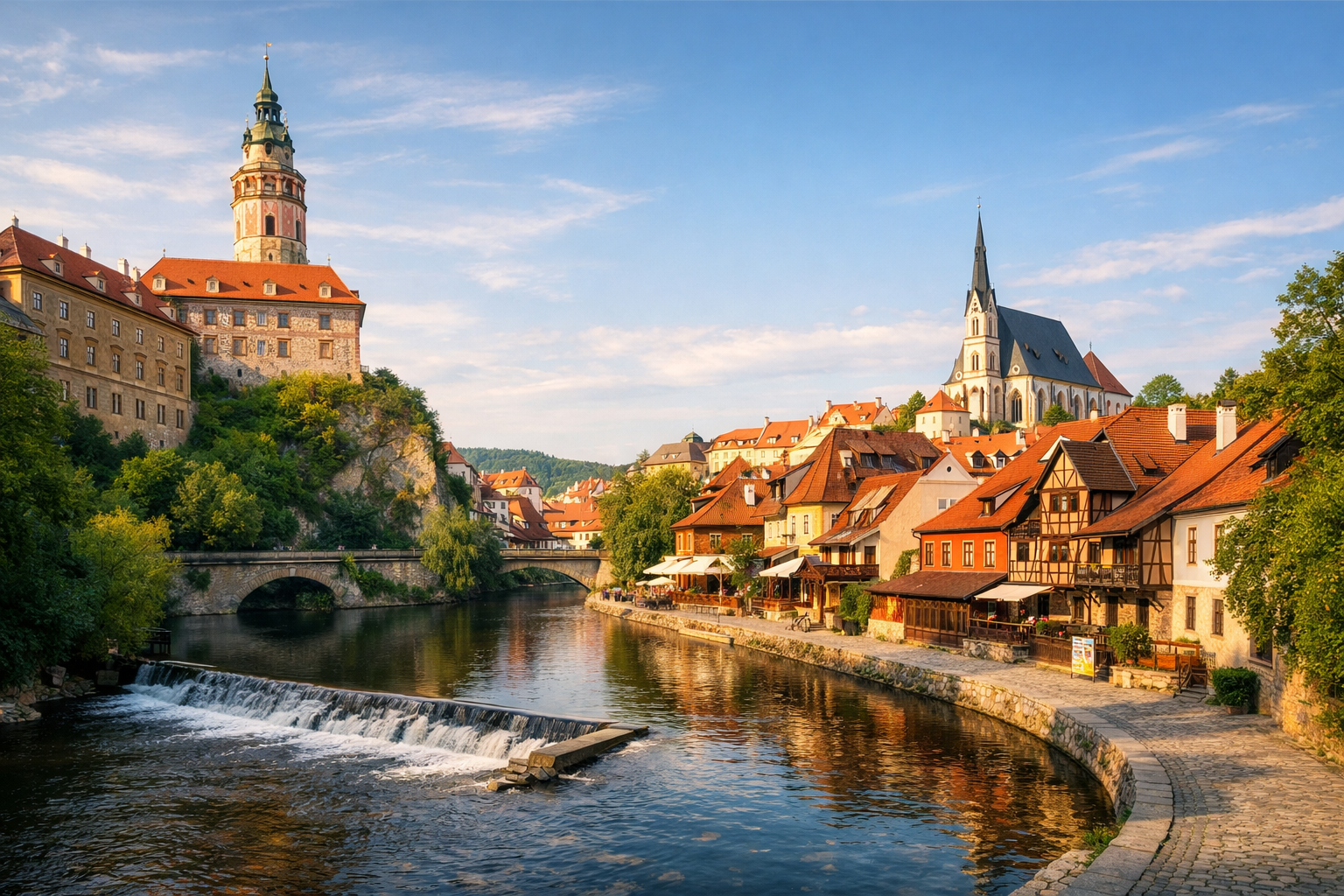
Day 1 — Arrival, Český Krumlov Castle, and an evening in the historic center
🚆 It’s best to plan your arrival in Český Krumlov for the first half of the day or around lunchtime so the itinerary doesn’t feel overloaded. From Prague, the most convenient option is a direct bus: the journey usually takes about 2.5–3 hours. Traveling by train is also possible, but it most often requires a transfer in České Budějovice and takes roughly the same total time, about 2.5 hours. For a compact weekend trip, the bus is usually more practical, especially if you want to arrive closer to the center and start walking almost immediately.
🏨 After checking in, don’t rush to fill the day with museums: the main impression of Český Krumlov comes from the atmosphere itself. This is one of those towns where it’s enough just to step onto a bridge, turn into an archway, walk a few cobbled streets — and in front of you a nearly theatrical set slowly unfolds, made up of red roofs, painted facades, old signs, and the curve of the Vltava. The historic center is compact, so a weekend route here feels easy: almost all the highlights are within walking distance, without tiring transfers or constant changes of transport.
🏰 The main highlight of the first day is the State Castle and castle complex of Český Krumlov. This is not just a single landmark but a huge multi-level ensemble that took shape over centuries on a rocky spur around which the Vltava bends from the south. It is precisely because of this terrain that the city panorama looks so cinematic: the castle seems to rise above the river and the old town, while the transitions between courtyards, towers, terraces, and gardens constantly change the perspective. Even if you don’t take a long interior tour, simply walking through the courtyards, viewpoints, and bridges already feels like a major historical journey.
🚶 Start with an outdoor walk through the castle courtyards and be sure to climb to the famous castle tower and museum section if they are open on your dates. The tower is the best way to understand the layout of the town at a glance: the loop of the Vltava, the dense medieval fabric, the roofs of Latrán, church spires, and the green hills of South Bohemia come together in a panorama that is rare in its unity. In the warm season, if the gardens are open, it’s worth walking there as well: this creates a contrast between the tight streets of the center and the more open, almost aristocratic space of the Baroque composition.
🌉 A special pleasure is to walk through the Latrán district and reach the Cloak Bridge, one of the most striking elements of the complex. Its multi-tiered structure with arches looks almost like the set of a historical play and is especially impressive in person, when you can feel the changes in elevation, the scale of the stone, and the fact that the whole town really was built as a complex system of passages, bridges, and defensive levels.
🍽️ Leave the second half of the day for a leisurely walk through the old town: Svornosti Square, narrow side streets, small courtyards, vaulted passages, craft shop windows, and descents to the water. Český Krumlov is wonderful precisely because it doesn’t require you to run from point to point. It’s better to choose short stretches, stop for coffee or an early dinner, and let the town reveal itself gradually. In the evening, when the daytime groups leave, the center becomes especially beautiful: the stone takes on a golden light, and the river begins reflecting facades and bridges with hardly any bustle.
🌙 End the day with a walk along the Vltava. The embankments and little bridges here do not look like a strict urban frontage — rather, they feel like a sequence of postcard views, where the houses seem to lean toward the water and the current gently flows around the old town. An evening walk along the river is the best finale to the first day: it brings calm after the road and lets you feel the true rhythm of South Bohemia without rushing.