
Buy PDF guide

Buy PDF guide — 10.71 USD

PDF — 10.71 USD

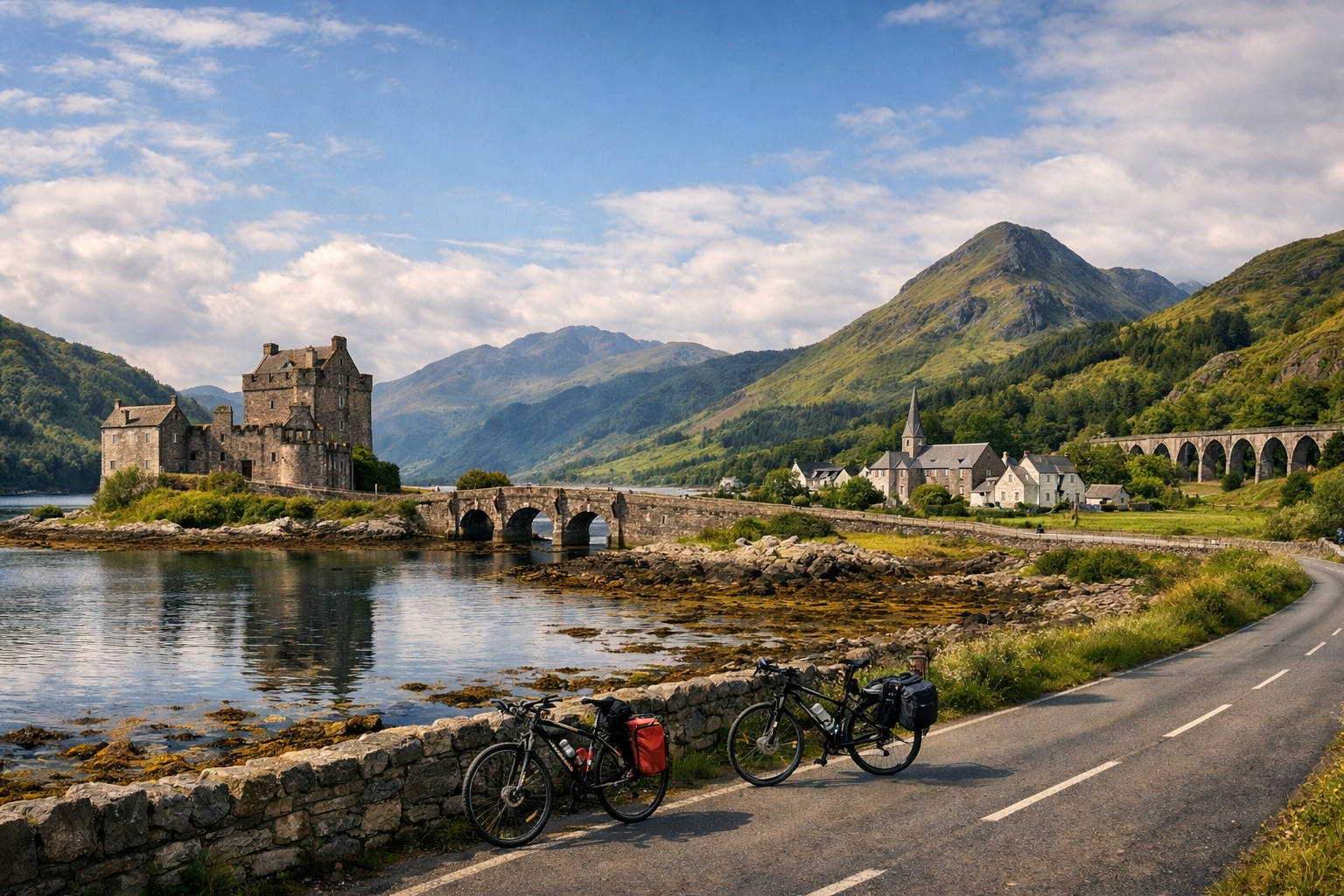
Bicycle tour of Scotland

Bicycle tour of Scotland

Pedal through Scotland from the historic streets of Edinburgh to the harbours of Oban, following a route of canals, lochs, and wide Highland views. Along the way, pass through Falkirk, Balloch, and Tarbet, where lively towns give way to quiet waters and dramatic mountain scenery.

🚲 DAY-BY-DAY ROUTE

Ready-made country and city routes with daily plans, sights, transport and accommodation. Buy PDF guides for independent travel.

🚲 DAY-BY-DAY ROUTE


Day 1 — Edinburgh → Falkirk: starting out along canals and green corridors

  • 🚲 Start in Edinburgh, finish around Falkirk/The Helix. About 52–58 km, riding time ≈ 3.5–4.5 hours, with little elevation gain, around 180–250 m. The main logic of the day is to get onto a safe and very easy-to-follow corridor along the Union Canal and then continue via national network links to the Falkirk Wheel and The Helix. The surface is mostly even: canal towpath, urban asphalt, sections of shared-use path, some compacted gravel, and short urban transfers. Difficulty: easy–moderate. Main stops along the way: Linlithgow with its palace and loch shore, the Falkirk Wheel, and The Helix park with the Kelpies. For water and food, it is convenient to stop in Linlithgow and then again in Falkirk: there are services along the canals, but it is better to take 1–2 bottles in advance because there are quieter stretches between towns. An overnight stay in Falkirk makes sense: after a flat canal stage, there is no need to drag the day out with extra kilometers. Road nuances: on Scottish canals, the paths are shared with pedestrians, sometimes narrow, and can be wet after rain; near bridges, blind bends, and road crossings, it is better to slow down and sometimes get off the bike. The day is realistic for an average cycle tourist because almost the entire route follows a flat, legible corridor without hard passes and without needing to ride on fast roads.


Day 2 — Falkirk → Balloch: a long but very logical transfer along the Forth & Clyde Canal and NCN 7

  • 🚲 Start from Falkirk, finish in Balloch by Loch Lomond. About 63–68 km, riding time ≈ 4.5–5.5 hours, elevation gain about 180–260 m. This is one of the most convenient transit days of the tour: first comes the Forth & Clyde Canal towpath, then the route leads onto the Clyde and Loch Lomond Cycle Way — part of NCN 7, which almost all the way to Balloch follows a very tourist-friendly combination of traffic-free and quiet urban sections. Surface: canal towpath, paved cycle paths, old railway corridors, separate urban links. Difficulty: moderate because of the distance, but the profile is generally flat. Main stops: the Falkirk Wheel on the way out, the canal around Kirkintilloch or the Clydebank area for lunch, and the final stretch by Balloch Castle Country Park. Water and food are easy to restock in Falkirk, the Kirkintilloch/Glasgow corridor, and then in Balloch; on a long day it is worth carrying an extra snack. It is best to stay overnight in Balloch: there are services there, access to the loch, a railway station, and a convenient start for the next day. Road nuances: on the towpath, you need to respect pedestrians and anglers; after rain, muddy edges and puddles are possible; in urban sections, it is important not to miss the NCN 7 wayfinding. The day is realistic because the long distance is offset by low elevation gain and safe infrastructure, and if tired, part of the route can be shortened by train through Scotland’s Central Belt.

Day 3 — Balloch → Tarbet: a relaxed day along the western shore of Loch Lomond

  • 🚲 Start from Balloch, finish in Tarbet. About 28–32 km, riding time ≈ 2.5–3.5 hours, elevation gain around 150–220 m. This is a beautiful loch day along the West Loch Lomond Cycle Path: the route is especially good for an average tourist because it delivers wow views without a big distance. The surface is mixed but friendly: asphalt, separate traffic-free stretches, promenade/shoreline path, short sections next to the A82, and several shared minor roads near villages. Difficulty: easy. Main stops: Loch Lomond Shores and Balloch Castle Country Park at the start, the village of Luss for coffee and photos, then shoreline viewpoints near Inverbeg and the finish at Tarbet Pier. Water and food are easy to get in Balloch, Luss, and Tarbet; there are picnic points along the way, but not on every section. Overnight stay — Tarbet or nearby, so that the next day you can do a beautiful combined boat-and-bike stage. Road nuances: on the National Park path there are short sections next to the road and a final stretch on the pavement beside the A82; in windy and rainy weather, the loch shore feels cooler than down in the towns. The day is realistic thanks to the short distance, modest elevation gain, and plenty of places to pause, so even with a late start it remains comfortable.

Day 4 — Tarbet → Inversnaid by waterbus → Callander: loch, quiet roads, and service at a bike center

  • 🚲 Start from Tarbet, then a short safe water link across Loch Lomond to Inversnaid, followed by a bike finish in Callander. Total cycling distance after the boat ≈ 38–45 km, riding time ≈ 3–4.5 hours, elevation gain around 350–550 m depending on the quiet roads chosen and the final approach into town. Difficulty: moderate. The main idea of the day is not to force a ride along dangerous or inconvenient sections north of the loch, but to use a real tourist combination of waterbus + bike, which the park recommends in the summer season. After the crossing, the route follows quiet roads and regional links through the eastern side of the national park, with beautiful forest and loch sections, toward the more convenient base in Callander. Main stops: Tarbet Pier before boarding, Inversnaid as a dramatic natural spot, then a break by Loch Venachar or in small settlements before entering Callander. Water and food should be bought in advance in Tarbet; after the crossing, services are less frequent, so one proper snack is essential. In Callander, it is convenient to do small repairs, buy a tube, chain oil, or check the brakes at the local bike center. It is better to stay overnight in Callander precisely because there are shops, cafés, bike service, and a wider range of accommodation. Road nuances: waterbus and similar boat services are usually seasonal and weather-dependent; the timetable needs to be checked in advance. After rain, secondary roads and forest edges may be damp, and a headwind on open loch sections noticeably slows the pace. The day is realistic because the difficult northern bypass of the loch is replaced by a safe water connection, while the cycling stage itself remains within reasonable limits for a regular traveler.

Day 5 — Callander → Crianlarich → Oban: a beautiful finale through the Highlands with a backup train option

  • 🚲 Start from Callander, finish in Oban. This is the most ambitious day of the route, so it is designed as a hybrid touring stage: 33–38 km by bike from Callander to Crianlarich via NCN 7 and quiet roads, then a safe rail connection with the bike to Oban. Riding time ≈ 2.5–3.5 hours, elevation gain around 300–450 m to Crianlarich. If you ride the whole way only by bike, it becomes too hard for an average tourist in one day, so the train here is not a compromise but a sensible measure for safety and comfort. Surface of the cycling section: quiet roads, asphalt, separate cycling route sections, and in places narrower rural roads. Difficulty: moderate on the cycling section. Main stops: Loch Lubnaig or viewpoints in the Trossachs, Strathyre or service villages toward Killin along the way, then Crianlarich as a transport hub. Water and food are easy to top up in Callander before departure and in Crianlarich before the train; on rural sections early in the morning or out of season, some services may be closed. In Oban, you can then take a walk to the harbor, have dinner, and if desired return a rental bike or take it to a workshop. Road nuances: in the Highlands the weather changes quickly, and on open sections a headwind and rain make average speed lower than usual; that is why an early start is especially important. For taking a bike on the train, it is best to reserve bike space in advance, especially on popular routes. The day is realistic because it preserves the true cycle-tour character, but avoids overload and potentially unpleasant long road sections at the finish.

Flight tickets

eSIM for travel

Buy PDF guide

Buy PDF guide — 10.71 USD

PDF — 10.71 USD