
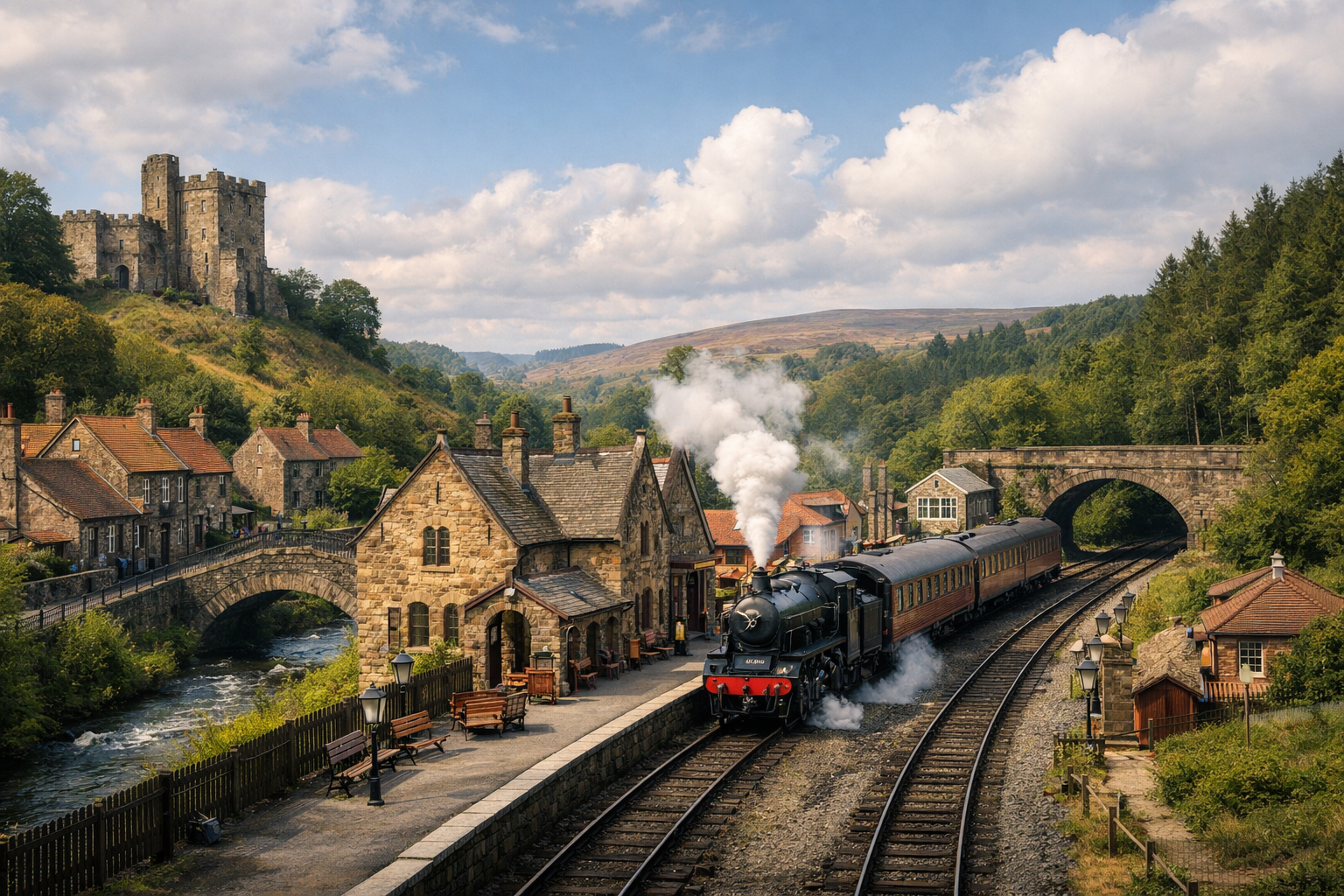
Day 1 — York → Pickering → Goathland: Hogsmeade in real life
🚆 In the morning, head from York toward Pickering. The most realistic public transport option without a car is to take a train to Malton, then a bus to Pickering, or a direct regional bus via Malton. Allow about 1 hr 45 min – 2 hr 30 min for the transfer and journey depending on the service you choose. This is a convenient start for a “train and walk” format because Pickering is the southern base of the historic North Yorkshire Moors Railway.
🚆 Transfer: Pickering → Goathland on the North Yorkshire Moors Railway. On operating days during the season, trains on the line usually run from morning to evening, and the journey through heather moorland and valleys takes about 35–50 minutes depending on the specific service and stops. It is best to book tickets in advance on the official website and обязательно check the timetable for your date: the season and frequency change.
🚶 Goathland Station is the main cinematic point of this short tour and one of the most atmospheric railway locations in England. This Victorian station served as the screen version of Hogsmeade in the film “Harry Potter and the Philosopher’s Stone.” What is especially pleasant here is that you are not looking at a stylized attraction or a newly built set, but an authentic historic station with an almost untouched appearance: neat platforms, canopies, signs, brick architecture, and the feeling that a train might bring students to the school of wizardry at any moment. For film fans, this is a rare case where the location is instantly recognizable while still remaining a living transport site rather than a museum copy.
🚶 It is important to understand the difference between a filming location and a set: in this route, Goathland is included precisely because it is a confirmed filming site. We do not add “inspired by” villages, abstract magical streets, or places that people simply like to call “Harry Potter-like” to the program. Here you are visiting a real screen location where the film crew actually worked, and that is what makes the route accurate and honest to the theme.
🚶 After arrival, it is worth walking along the platform, looking at the historic details, and taking photos at a relaxed pace. But it is important to follow the rules: this is not a closed film set, but an operating heritage railway site, so you must not go onto the tracks, enter staff areas, or interfere with passenger boarding. Accessibility and the specific viewing areas may change depending on station works, events, and the railway’s operating mode.
☕ If the station tea room is open, take a leisurely break here. This is one of those rare moments when the impression is built not on the number of locations, but on the depth of presence: steam locomotive smoke, wooden benches, travel trunks, the quiet creak of the platform, and the Yorkshire wind turn the visit into an almost theatrical scene. In high season, Goathland can be busy, so for a calmer atmosphere it is better to arrive closer to the first or, conversely, a later daytime train.
🚶 In the second half of the day, take a walk around the village of Goathland. Although the village itself is widely known for other screen projects as well, we include it in the “Harry Potter” route only as context for the confirmed station, not as a separate magical location. This is an important clarification: the village is pleasant for a walk, but the central object for the route’s theme remains Goathland Station itself. The walking format here is easy: short distances, gentle terrain in the village center, and many opportunities to sit down and rest.
🛏️ The most convenient overnight stay is in Goathland itself or in Pickering. If you want to fully preserve the atmosphere, stay in Goathland: in the evening you can walk to the station or around the village again without the daytime bustle. If return-trip logistics matter more, choose Pickering — from there it is easier to continue the railway part of the route the next day.