
Buy PDF guide

Buy PDF guide — 6.90 USD

PDF — 6.90 USD

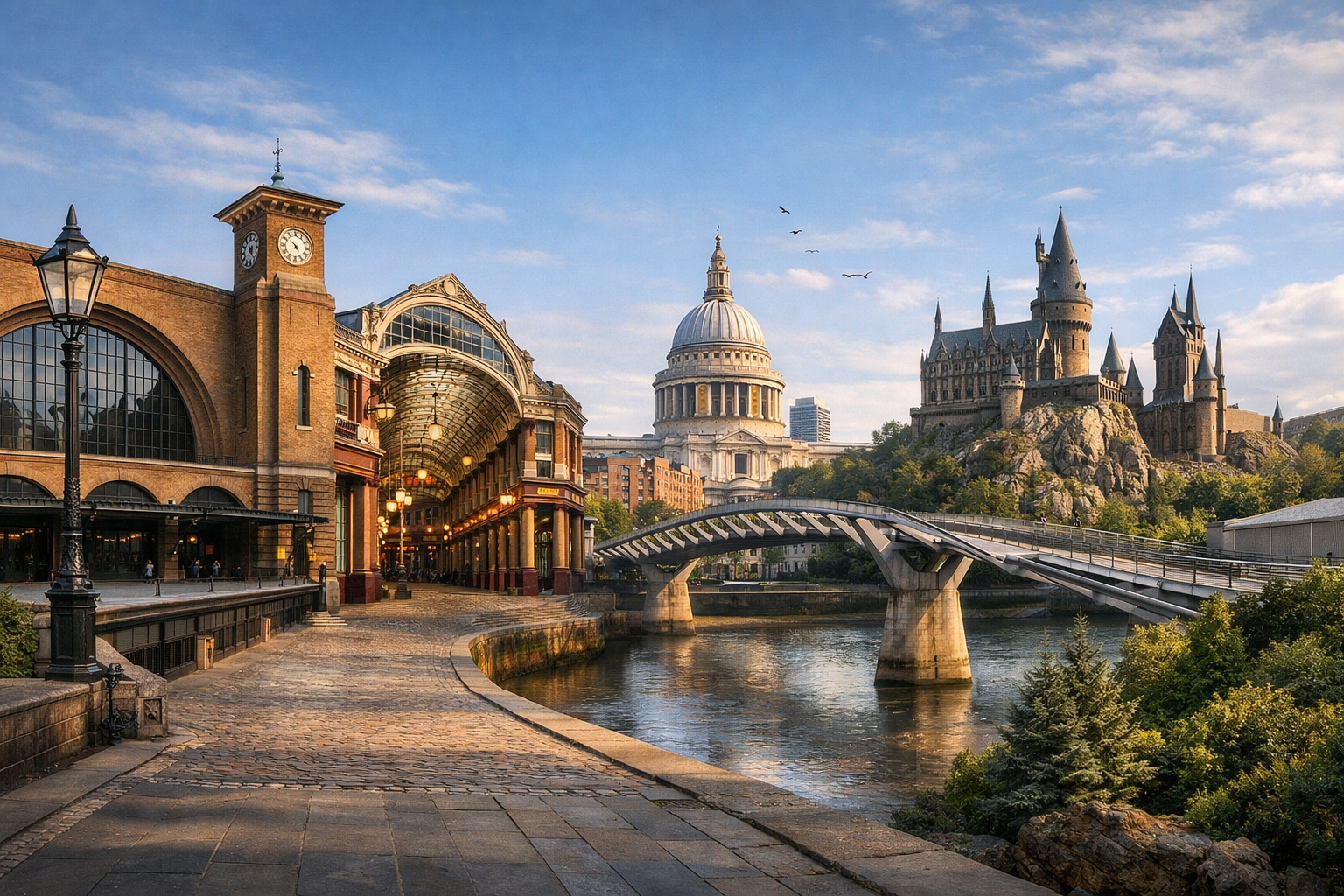
United Kingdom, London. Journey through the filming locations of Harry Potter: King's Cross Station, Leadenhall Market, Millennium Bridge, St Paul's Cathedral, and the Warner Bros. Studio Tour.

United Kingdom, London. Journey through the filming locations of Harry Potter: King's Cross Station, Leadenhall Market, Millennium Bridge, St Paul's Cathedral, and the Warner Bros. Studio Tour.

Step into London and trace the magic through real Harry Potter filming locations, from the bustle of King’s Cross Station and the charm of Leadenhall Market to the dramatic sweep of Millennium Bridge and St Paul’s Cathedral. Complete the journey at the Warner Bros. Studio Tour, where the wizarding world comes thrillingly to life.

🧭 DAY-BY-DAY ROUTE

Ready-made country and city routes with daily plans, sights, transport and accommodation. Buy PDF guides for independent travel.

🧭 DAY-BY-DAY ROUTE


Day 1 — King’s Cross and central London: a magical introduction

  • 🚶 Start your journey at King’s Cross Station, home to the famous Platform 9¾ photo spot. This is not the actual working railway platform from the active train area, but an officially designed point inside the station with a luggage trolley “disappearing” into the wall and the adjacent branded shop. For fans, this is an important place not just as a literary symbol, but as an official London site connected with the franchise’s screen history. At the same time, it is important to understand the difference: scenes of the magical train departure were filmed not only here, and many interiors and railway episodes were also created on studio sets. So in this route, King’s Cross is a confirmed screen location and a cult fan stop, but not a “Hogwarts set” in the literal sense.
  • ⏰ Practical tip: the trolley photo spot itself is accessible during station opening hours, and the professional photo setup at the platform usually operates daily from around 09:00 to 21:00. It’s best to come by 08:00–08:30 while the queue is still moderate. Allow 1–1.5 hours for photos, choosing a house scarf, buying prints, and a short visit to the shop. If you want a calmer experience without crowds, don’t schedule this stop for the middle of the day.
  • 🚇 Then head toward the City. From King’s Cross St Pancras to the Bank/Monument area by Tube usually takes about 15–20 minutes, then another 7–10 minutes on foot to the market. Including going down to the metro, waiting for the train, and coming back up to street level, it is sensible to count the full transfer as 25–35 minutes.
  • 🚶 The next major stop is Leadenhall Market, one of London’s most beautiful covered markets with Victorian metalwork, a glass roof, and elegant polychrome decoration. For Harry Potter fans, it matters as a confirmed filming location: this is where the exterior approach to the Leaky Cauldron was filmed in the first movie. It is not the “real Diagon Alley” and not just a place that inspired the creators, but an actual recognizable city location used in the film. Today it is a lively public space with office crowds, restaurants, and shops, so it is best to come during the day when the market is open and the architecture can be seen at its best.
  • ⏰ Allow 1–1.5 hours at Leadenhall Market: walk under the arches, find the corner familiar from the film, photograph details, and enjoy a relaxed coffee. Keep in mind that this is not a museum site but a functioning public space, so individual shops keep their own schedules, and activity is lower in the evenings and on weekends. Personal photography is usually not a problem, but commercial photo and video filming in places like this requires separate approval.
  • 🚶 After lunch, move on to the St Paul’s Cathedral and Millennium Bridge pairing. On foot from Leadenhall Market to the cathedral it’s about 20–25 minutes at an easy pace through the City; if you’re tired, you can do one short hop on the Tube, but walking is more atmospheric here. The huge dome of St Paul’s gradually appears between the streets, and the route starts to work like a cinematic reveal — as if the city itself is building the set.
  • 🚶 St Paul’s Cathedral matters in this route in two ways. First, it is one of London’s architectural landmarks and a magnificent historic space for a meaningful pause. Second, its surroundings are directly connected to the screen episode from Harry Potter and the Half-Blood Prince: it is precisely in the area around the cathedral and the bridge that the famous destructive flight of the Death Eaters through the city unfolds. It is worth distinguishing this clearly: the cathedral functions as a real urban location next to a confirmed filming reference point, not as an “interior set” of the magical world. For the interior, crypt, and climb to the galleries, if the cathedral is open for sightseeing, allow 2–2.5 hours.
  • 🚶 End the day at Millennium Bridge, the modern pedestrian bridge across the Thames linking the City and the Tate Modern area. It became one of the most recognizable London spots in the sixth film, where the bridge is dramatically destroyed in the opening scene. This is a confirmed filming location, especially interesting because in the film the bridge is shown as a real city object, while the dramatic effect is enhanced by visual effects. Walk across toward the south bank and be sure to turn back: the panorama with the dome of St Paul’s is one of the most cinematic in London. Allow 45–60 minutes for the walk, photos, and a rest by the water.
  • 💤 Keep the evening light. From the bridge to a hotel in the King’s Cross, Blackfriars, Temple, or City areas it is usually 15–30 minutes depending on your base. After a packed first day, it’s better not to overload the program: you will already have covered almost the entire “urban” block of confirmed Harry Potter locations, and the next day can be devoted to a calmer studio and museum rhythm.


Day 2 — The City, museum context, and the fan’s official London

  • 🚶 The second day is deliberately planned to be gentler so that, after the long walks of the first day, the trip does not turn into a race. Start the morning by returning to the St Paul’s / Millennium Bridge area or Leadenhall Market — depending on where there were more people the day before or where the light was worse. This repeat does not duplicate the route, but gives you a chance to see the locations in a different rhythm: the early City is much quieter, facades read more clearly in photos, and the bridge and dome look more cinematic without dense pedestrian traffic.
  • 🚶 If you did not go inside yesterday, today it makes sense to visit St Paul’s Cathedral as a full cultural site. For sightseeing, the cathedral is usually open Monday to Saturday; doors most often open around 08:30, and the last entry for visits is usually around 16:00, though times may change due to services and special events. This is especially important for planning: the cathedral is not a “set for photos,” but a functioning religious space where you need to respect quiet, restrictions in certain areas, and the special Sunday schedule.
  • 🏛️ After that, switch to the context of London as a city of screen stories. A good addition to the route is the London Transport Museum in Covent Garden. It is not a Harry Potter location, but it is a very useful museum stop for understanding how London itself works as a cinematic city: stations, maps, carriages, signs, environmental design. The trip from St Paul’s/Blackfriars to Covent Garden usually takes 15–25 minutes including the Tube and a short walk. Allow 1.5–2 hours for the museum.
  • 🏛️ Another good stop is The Postal Museum near Farringdon/Clerkenwell. It is not directly connected with Potter, but it lies within a logical radius of the route and adds excellent “London” depth to the trip: an underground postal railway, the history of urban logistics, the sense of a hidden layer of the metropolis. From Covent Garden to the museum by Tube and on foot usually takes 20–30 minutes. If you take a ticket with the Mail Rail ride, allow 1.5–2 hours.
  • 🛍️ In the second half of the day, you can return to the King’s Cross area and stroll through the neighboring quarter without rushing: the Platform 9¾ photo spot, the branded shop, the modern public space around the station, cafés, and convenient places for dinner. This is a good moment for souvenirs, because by the third day you already understand which images and scenes have become the most important to you. Allow 1–2 hours for this “fan finale of the city.”
  • 💡 An important distinction in the route: on the second day we do not add disputed spots that often appear in unofficial lists as places that “inspired” Diagon Alley or Hogwarts if there is no clear filming connection or official status. This tour is based on confirmed filming locations, official sites, and real public spaces. That is why the day looks more selective, but also more honest and suitable for a real trip.
  • 💤 In the evening, rest early: the third day is the main block of the trip, Warner Bros. Studio Tour London, which requires an early departure, a booked time slot, and several hours for the visit. It’s better to prepare your tickets in advance, charge your phone, and avoid a late night.

Day 3 — Warner Bros. Studio Tour London: the heart of screen magic

  • 🚆 Devote the third day to Warner Bros. Studio Tour London – The Making of Harry Potter — this is the main official site of the entire route, where you can see not street locations but authentic sets, costumes, props, visual concepts, and the filmmaking craft behind the films. Unlike the city stops, where you encounter the outer reality of London, here you enter the inner world of how the franchise was created: the Great Hall, platform scenes, magical interiors, graphics, animatronics, models, and the work of costume and production designers.
  • ⏰ It is very important to understand the status of the site: this is an official studio tour, not an amusement park and not an improvised exhibition. Visits are by ticket with a specific entry time. Opening hours vary by date, but on many days the studio opens around 09:30, first entries begin from about 10:00, and final entry times and closing depend on the calendar. Tickets often sell out in advance, so for this kind of trip it is best to book as early as possible.
  • 🚆 How to get there: from central London, the easiest way is to take a train from London Euston to Watford Junction — the direct train takes about 20 minutes. From Watford Junction to the studio, an official shuttle operates and is included with the ticket; the journey takes about 15 minutes, and buses run regularly, usually at least every half hour. If you are staying near King’s Cross, first add 10–15 minutes for a short transfer to Euston on foot or by Tube. In total, from a hotel in central London to the studio entrance, it is reasonable to count 1–1.5 hours.
  • 🚶 Allow at least 4–5 hours for the tour itself, and if you truly love the franchise, better 5–6 hours without rushing. This is a place where an overly tight schedule works against the experience: you will stop for costume details, read the placards, compare sets with scenes from the films, photograph props, and will almost certainly spend longer than planned in the shop area.
  • 🎬 This is where it becomes especially important to distinguish types of “magical places.” King’s Cross, Leadenhall Market, Millennium Bridge, and the surroundings of St Paul’s are real city locations used in the films. Warner Bros. Studio Tour London is official access to the world of sets and production heritage, where you see not simply filming spots in the city, but elements created for the films themselves. This combination makes the three-day route very coherent: first you see how the magical world was woven into real London, and then how that world was built inside the studio.
  • 🍽️ The studio is a convenient place to take a long lunch break inside the complex, and at the end leave time for the shop. After the tour, the return by the same route via shuttle and train to Euston usually takes 1–1.5 hours. If you still have energy, you can finish the final evening with a short walk around King’s Cross and symbolically say goodbye to the route where it all began — at Platform 9¾.

Flight tickets

eSIM for travel

Buy PDF guide

Buy PDF guide — 6.90 USD

PDF — 6.90 USD