
Buy PDF guide

Buy PDF guide — 10.90 USD

PDF — 10.90 USD

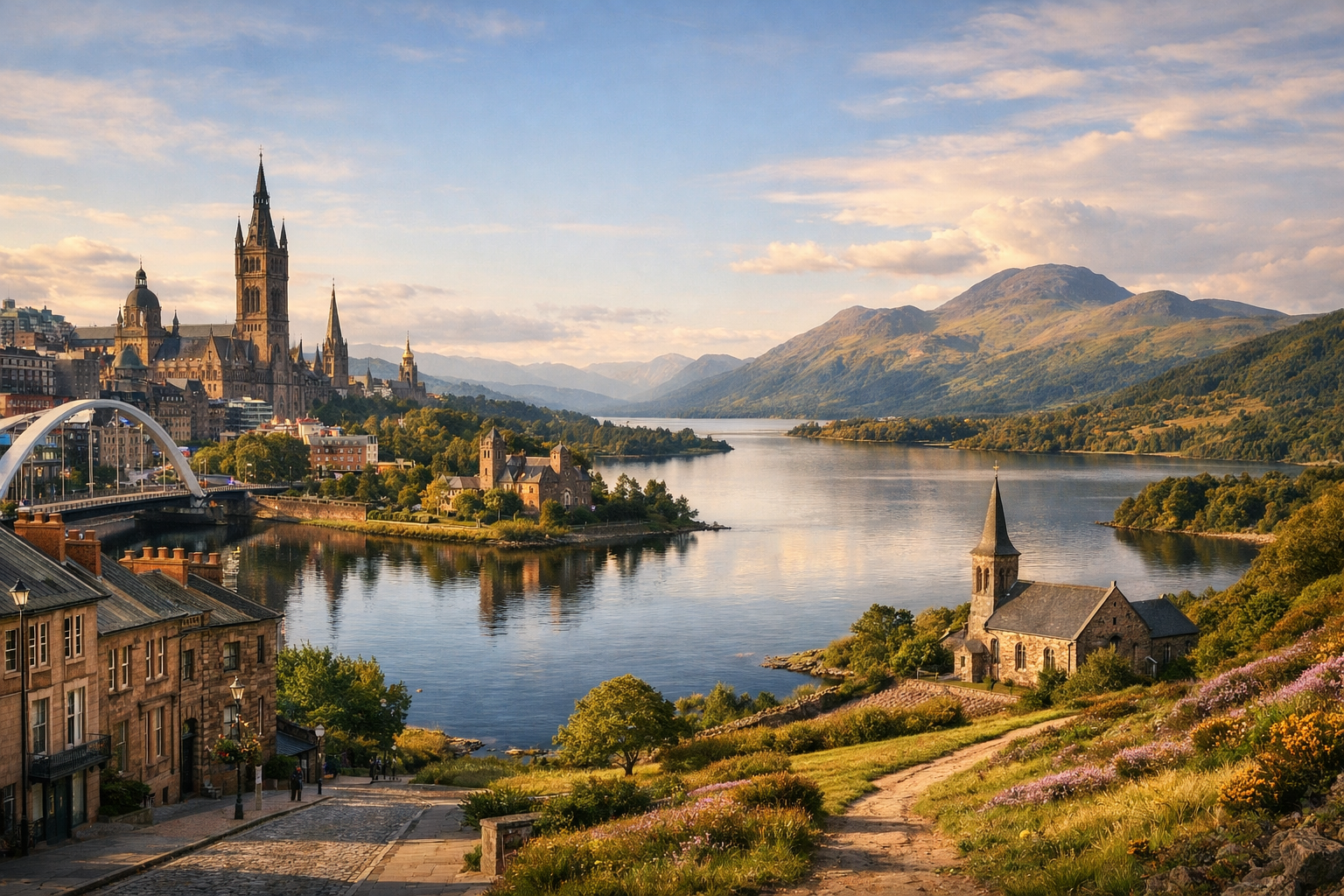
United Kingdom, Glasgow and Loch Lomond. A budget-friendly introduction to Scottish architecture, free museums, music districts, and the nature of the national park.

United Kingdom, Glasgow and Loch Lomond. A budget-friendly introduction to Scottish architecture, free museums, music districts, and the nature of the national park.

Discover the United Kingdom through Glasgow and Loch Lomond, where grand Scottish architecture, free museums, and buzzing music districts come without the big-city price tag. Wander from the West End to Finnieston and Merchant City, then slip away to Balloch for fresh air, loch views, and an easy taste of national park beauty before returning to the city.

🧭 DAY-BY-DAY ROUTE

Ready-made country and city routes with daily plans, sights, transport and accommodation. Buy PDF guides for independent travel.

🧭 DAY-BY-DAY ROUTE


Day 1 — Glasgow: city centre, George Square and the Gallery of Modern Art

  • 🚶 This route is specially designed as a budget introduction to Glasgow: a city of Victorian architecture, a world-class musical reputation, and some of the strongest free museums around. On the first day, it’s best not to overload yourself with long transfers: after checking in, start with a walk through the very heart of the city — from Glasgow Central or Queen Street to George Square. Here you can especially feel the strict yet elegant urban fabric of the 19th century: sandstone facades, monumental public buildings, the rhythm of broad streets, and the sense of the industrial wealth that once made Glasgow the “second city of the empire.” It’s a good place to ease into the city’s rhythm slowly, without spending money on transport in the very first hour, and simply noticing the details: towers, pediments, old banks, municipal buildings, and the sculptural stonework of the facades.

  • 🏛️ Then walk to the Gallery of Modern Art, Royal Exchange Square, Glasgow G1 3AH. Entry is usually free, and the building itself is already part of the experience: a neoclassical mansion with columns and a city square in front of it, where classical architecture unexpectedly blends with a contemporary art programme. This is one of the best places for a budget traveller, because here you can shelter from the rain, see changing exhibitions, and feel how Glasgow knows how to speak about modernity through historic interiors. After the museum, it’s worth wandering around Buchanan Street, Princes Square, and the neighbouring streets without rushing: even if you buy nothing, central Glasgow is wonderful precisely as an urban stage — with street musicians, shop windows, old arcades, and a constant sense of movement.

  • 🍲 For a budget dinner, stick to food courts, supermarkets with ready-made meals, inexpensive Asian cafés, and simple pubs with early set menus. A realistic daily food budget in economy mode is about £12–25 per person if you have breakfast at a bakery, lunch with soup/sandwich/noodles, and choose something simple in the evening without alcohol. In the evening, it’s useful to go to bed early: the next day is better spent walking a lot, and Glasgow noticeably shines in the format of a slow stroll.


Day 2 — Glasgow: West End, university, Hunterian and Kelvingrove

  • 🚇 Today is devoted to Scottish architecture and museums, with almost no serious spending. In the morning, head to the West End — one of the city’s most beautiful and atmospheric districts. The easiest way is to take the Subway to Hillhead or Kelvinhall, or a bus, depending on where you are staying. The area itself is valuable in its own right: shady streets, terraces of pale and honey-coloured sandstone, old residential buildings, bookshops, cafés, and a university atmosphere create a completely different rhythm from the business centre. The main architectural impression here is the campus of the University of Glasgow, University Avenue, Glasgow G12 8QQ. Its neo-Gothic silhouettes, inner courtyards, and viewpoints look almost cinematic, especially in the changeable Scottish light.

  • 🏛️ After your walk on the university hill, drop into the Hunterian Museum, University of Glasgow, University Avenue, Glasgow G12 8QQ. This is Scotland’s oldest museum, and one of the best free places in the city for anyone who wants to combine science, history, urban memory, and a classic museum experience. Inside, the collections are arranged in a way that lets you feel both the Enlightenment era and the university tradition, as well as Glasgow’s connection to the broader history of Britain and the world. It is especially pleasant to spend 1.5–2 hours here without rushing: the museum is not overwhelming in size, but it offers rich content.

  • 🏛️ Then walk downhill or take a short ride to the Kelvingrove Art Gallery and Museum, Argyle Street, Glasgow G3 8AG. This is one of the main free attractions in all of Scotland and perhaps the best choice for a budget introduction to the city. The building itself, in a Spanish-Baroque spirit, looks grand and very Glasgow-like: reddish stone, a complex silhouette, a park in front of the facade, and an almost palace-like presentation. Inside are art, history, arms, natural sciences, decorative collections, and a strong sense of a museum “for everyone,” not only for specialists. Even if you do not plan to see every gallery, it is worth coming here for the atmosphere, the architecture, and the feeling of generous public space.

  • 🌿 End the day with a walk through Kelvingrove Park and along the River Kelvin. This will let you pause after the museum interiors and see how natural green corridors are literally stitched into the city fabric. If you still have energy, you can continue the evening in the Finnieston area — one of Glasgow’s most musical and gastronomic quarters — but on a budget it is better to limit yourself to a walk, a coffee, or an inexpensive dinner. Daily cost guide: transport £0–8 depending on the number of trips and ticket type, food £12–25, museums — free.

Day 3 — Glasgow: Riverside Museum, Finnieston and Merchant City

  • 🚶 The third day is devoted to musical and urban districts, again without unnecessary expenses. Start with the Riverside Museum, 100 Pointhouse Road, Govan, Glasgow G3 8RS. Entry is usually free, and the museum itself is well located by the water, where Glasgow’s industrial past as a city of ships, trade, and heavy industry is especially easy to read. This place helps explain why the city looks the way it does: from bridges and docks to residential districts and business arteries. The transport and urban life exhibition works not only as a museum, but also as a key to the biography of the entire region.

  • 🎵 After the museum, walk through Finnieston — an area often seen as one of the city’s liveliest contemporary scenes. There is no need to spend money on bars or concerts to feel the atmosphere: the walk itself along Argyle Street and the surrounding area matters more, where a former working and trading zone has gradually turned into a territory of independent cafés, music venues, pubs, and urban gatherings. Glasgow is officially known as a UNESCO City of Music, and in districts like this you feel it most strongly: music here is not tourist decoration, but part of everyday urban life. If you want an inexpensive evening, check small local gig venues and early performances, but it is best to buy tickets only after checking the current programme.

  • 🏙️ In the second half of the day, move on to Merchant City. It is an excellent contrast to the university West End and the industrial riverfront line. The quarter grew on the trading wealth of the 18th and 19th centuries, and today combines historic facades, repurposed warehouses, restaurants, small squares, and noticeable evening life. For a budget traveller, Merchant City is great because its main value is the urban environment itself: arcades, cobbled stretches, old commercial buildings, and the sense of how Glasgow gradually turned its mercantile past into a modern cultural space.

  • ⛪ If you have time left, you can add Glasgow Cathedral, Castle Street, Glasgow G4 0QZ, and the neighbouring St Mungo Museum of Religious Life and Art, 2 Castle Street, Glasgow G4 0RH. This adds another layer of architectural experience: the severe medieval verticality of the cathedral and the much older, almost austere face of the city, completely unlike either the Victorian centre or the university quarters. Such a finale makes the route feel complete: in three days you will have seen Glasgow as a medieval, imperial, industrial, musical, and museum city.

Day 4 — Balloch and Loch Lomond: a budget trip into the national park

  • 🚆 Transfer: Glasgow Queen Street Low Level → Balloch on ScotRail, usually about 50 minutes, with trains running roughly every 30 minutes. This is the most logical and budget-friendly way to reach the southern end of Loch Lomond without renting a car. For an economical itinerary, Balloch is the best choice: it gives access to national park scenery, the waterfront, walking trails, and lake views without expensive transfers or complicated logistics.

  • 🌿 Balloch is a gentle introduction to the world of the Highlands without overload and without the need to travel far into the mountains. From the station, you can walk to Loch Lomond Shores and then on to Balloch Castle Country Park. What is especially pleasant here is that the beauty arrives gradually: first the small town and the water, then open lawns, wooded sections, old trees, viewpoints, and the feeling that city noise has been left far behind. This is not extreme trekking, but an accessible and very rewarding format for getting to know the nature of Scotland. In good weather, the landscape feels almost postcard-like: broad water, green shores, light that constantly changes, and distant hills that give depth to the whole panorama.

  • 🏞️ For a budget day, it is better to focus on walking, a picnic, and viewpoints rather than paid activities. Bring food from a supermarket in Glasgow in advance or buy something simple in Balloch. If you really want to see the lake from the water, you can consider a short cruise from the Balloch/Loch Lomond Shores area, but that is already an extra expense, and before the trip you should definitely check the current timetable, seasonal operation, and cost. On a rainy or windy day, it is wiser to limit yourself to the park, short walks, and an early return to the city.

  • ⚠️ The national park should not be considered a completely safe destination even on an easy route. The weather on Loch Lomond changes quickly, trails can be slippery, and wind and rain significantly increase fatigue. Before setting out, be sure to check the forecast, warnings, trail conditions, train times, and any possible restrictions. For a basic route, a waterproof jacket, footwear with good grip, a charged phone, and a small запас of water are enough. Return to Glasgow by the same train in the evening so you do not overpay for a second hotel base.

Day 5 — Glasgow: a flexible finale, music, travel shopping, and departure

  • 🚶 It is best to keep the last day flexible and inexpensive. If your flight or train is late, dedicate the morning to places you would like to revisit without rushing: this could be another visit to your favourite museum, a slow walk along Buchanan Street, coffee in the West End, a short visit to the Cathedral Precinct, or a walk along the River Clyde. This format is especially good for a budget trip because it does not require new expensive tickets and lets you adapt to the weather, how you feel, and your departure time.

  • 🎶 If you want to catch the city’s musical pulse one more time, use the morning or day for a walk through Finnieston, Sauchiehall Street, or Merchant City, where it is easiest to feel Glasgow’s everyday cultural energy. During the day the city looks less noisy, and you can better take in the architecture of former trading and entertainment streets, venue posters, independent shop windows, and old facades behind which a rich concert life is often hidden. That is one of Glasgow’s special qualities: music here is not separate from the urban fabric, but dissolved into it.

  • 🚌 If you are leaving via Glasgow Airport, the most practical option without a taxi is the official Glasgow Airport Express 500 bus, which runs between Buchanan Bus Station and the airport; journey time can be from about 15 minutes, but you should allow extra time because of traffic conditions. If your luggage is heavy, you are flying very early or very late, or it is raining heavily, you can compare the price of the official bus with a licensed taxi. For the final day, it is reasonable to allow another £8–20 for transport and food depending on your departure format.

Flight tickets

eSIM for travel

Buy PDF guide

Buy PDF guide — 10.90 USD

PDF — 10.90 USD