
Buy PDF guide

Buy PDF guide — 25.90 USD

PDF — 25.90 USD

Great Wall of China

Great Wall of China

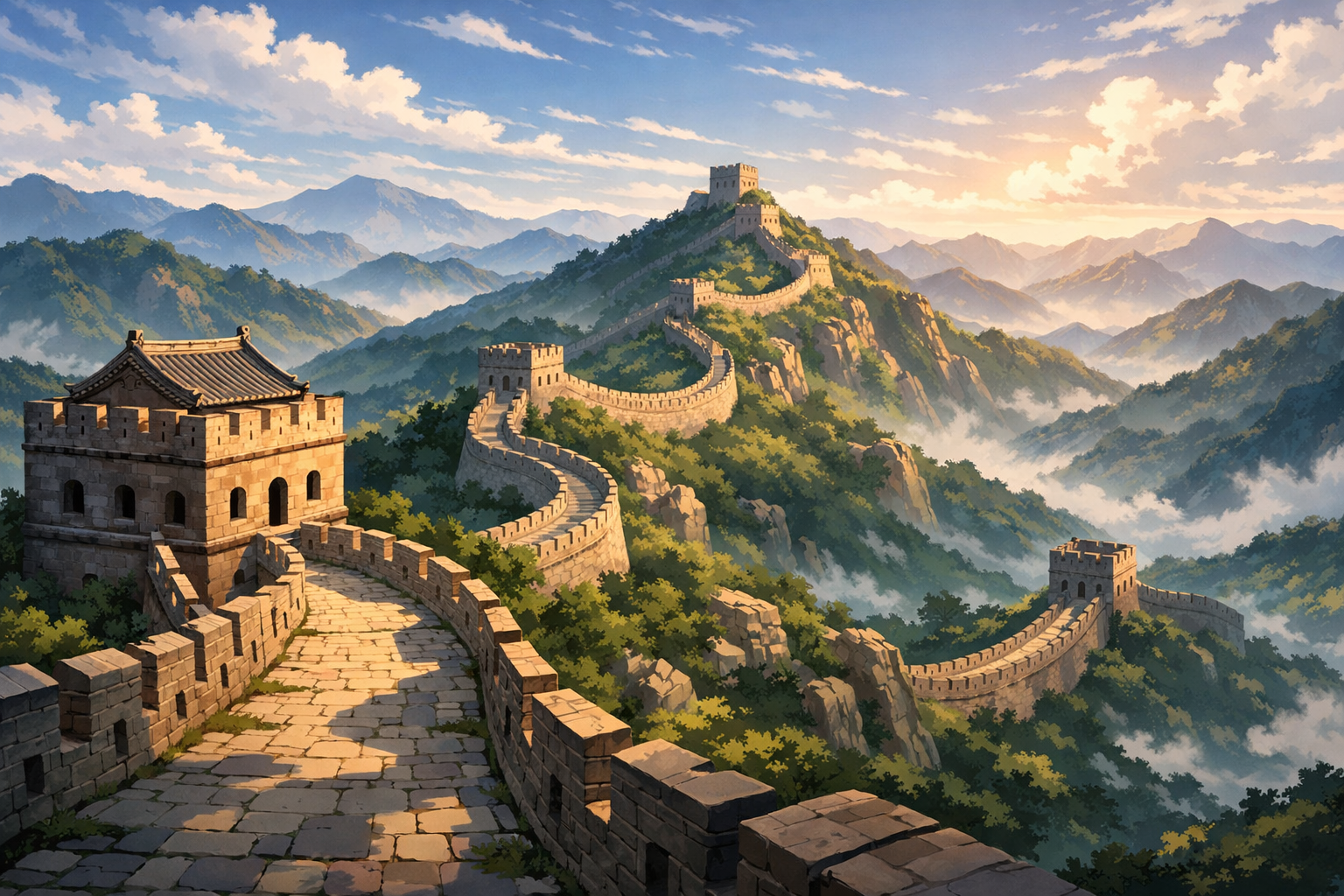
Trace the Great Wall from Beijing’s imperial heart to the Bohai Sea, crossing quiet ramparts, wild ridgelines, and lantern-lit water towns. From Badaling and Mutianyu to Jinshanling and Shanhaiguan, China’s timeless spine unfolds in stone, forest, and sky.

🧭 DAY-BY-DAY ITINERARY

Ready-made country and city routes with daily plans, sights, transport and accommodation. Buy PDF guides for independent travel.

🧭 DAY-BY-DAY ITINERARY


Day 1 — Beijing: “Enter the context of walls” (urban fortifications and the religion of space)

  • 🚶 Arrival in Beijing. Set the daytime rhythm calmly around the theme of “walls and fortifications.” Start with the Liao and Jin City Wall Museum (remains of ramparts and waterworks of the 12th–13th-century capital) and a walk in the Ming City Wall Ruins Park by Dongbianmen: the contrast of “city and wall” later helps you better “read” the logic of the Great Wall—as a system of nodes, passes, and dominant points. In the evening, take a short walk along Chang’an Avenue to Tiananmen Square: the scale of the imperial axis and the representational character of the space.


Day 2 — Yanqing/Badaling: the “gold standard” of restoration + Great Wall Museum

  • 🚆/🚶 Taking the high-speed suburban line from the center (Beijing North / Qinghe) to Badaling Great Wall station takes about 30–40 minutes; from the station it’s walkable to the wall. In the morning, walk the northern towers of Badaling: here the wall powerfully “works” with the terrain—curving ridgelines, watchtowers, crenellations, loopholes, artillery platforms. The “orchestration” of viewpoints matters: climbs to key towers give panoramas of how the wall and valleys interlock.
  • 🏛️ After lunch — the Chinese Great Wall Museum (Badaling): exhibits on the genesis of fortifications and on types of passes and watchtowers. Nearby is the Zhan Tianyou Memorial Hall, dedicated to the engineer of the Beijing–Zhangjiakou railway: the transport and logistics context shows how “strategic geography” dictated decisions. Return to Beijing.

Day 3 — Changping/Juyongguan: “a pass as the architecture of the state”

  • 🚗 Morning departure to Juyongguan, one of the “three great mountain passes” of the wall. The spatial dramaturgy is key here: the gorge’s throat, garrisons, gates, gatehouse structures, a dense “rhythm of defense” alternating walls and towers. Stone ornament, stair flights, and views into the gorge give a rare sense of the wall being “built into” the landscape.

Day 4 — Huairou/Mutianyu: “careful restoration and the perspective of towers”

  • 🚌/🚗 Transfer to Mutianyu (≈1.5–2 hours by car depending on traffic; inside the complex—a shuttle to the ascents). In the morning, take the cable car up to towers 14–15 or follow the route to towers 6–8: long curtain walls with regular restoration, joints, crenellations, loopholes— a “textbook” of Ming Wall architecture. For the descent, you can choose the toboggan run (if operating). Stay at the foot, rest.

Day 5 — Jiankou: the “wild” wall and safe viewpoints

  • 🚶 In the morning, head to the village of Xizhazi by the Jiankou section. This is one of the most scenic and steepest parts of the wall: sharp ridges, the “Eagle Flies Upward” (Zhengbeilou), jagged outlines. Important: many stretches are formally closed/unsafe—stick only to permitted trails and official viewing approaches below the ridge. Photos of these “terrain teeth” help you understand what the unrestored wall looked like. Return to the base in Mutianyu.

Day 6 — Huanghuacheng (Water Wall): “wall and water”

  • 🚗 By midday — Huanghuacheng (the Water Great Wall): sections of the wall that touch the reservoir, a rare scene of “fortification + hydrography.” Walking trails along the shore, descents to the water, views of half-submerged curtain walls. Return, rest, and an early dinner.

Day 7 — Move the base to Gubei (water town): “the wall as a nighttime silhouette”

  • 🚌/🚗 Transfer: Beijing → Gubei Water Town (Gubei Shuizhen) at the foot of Simatai. There is a direct express bus from the Dongzhimen hub (≈2–2.5 hours) or a private transfer.
  • 🚶 Evening — get to know the water town: wooden embankments, lanterns, narrow streets, and angles on Simatai’s crenellations above the rooftops. This is the best “entry” to the night wall.

Day 8 — Simatai: daytime ascent + <i>night tour</i>

  • 🚡 By day — ascent to Simatai: towers 2–10 of the East Section are open for walking; trails weave along steep ridges. The “combat logic” reads clearly: tower density, varied spans, loopholes, ledges. In daylight, a soft contrast of stone and valley.
  • 🌙 In the evening — Simatai at night (usually the illuminated stretch between towers 5–6; cable car ascent/descent required). It’s a rare experience: the wall’s “light graphic” under a starry sky and the water town’s lights below.

Day 9 — Jinshanling: “the wall’s original fabric and distant panoramas”

  • 🚗 Morning departure to Jinshanling (≈45–60 minutes by car from Gubei). This is one of the most “photogenic” sections: diverse tower roof types (domes, octagonal, “boat” roofs), a dense network of defensive elements (anti-cavalry walls, loopholes, thunder holes). A 3–5 hour route is manageable. Return to Gubei, rest.

Day 10 — Transfer to the sea: Qinhuangdao/Shanhaiguan

  • 🚄 High-speed train transfer: Beijing → Qinhuangdao (usually ≈1h 40m–2h 30m) or straight to Shanhaiguan (≈2–3h; schedule depends on date). Check in, evening walk around the old town/fortress pass district.

Day 11 — Shanhaiguan: “The First Pass Under Heaven” and the museum

  • 🚶 Morning — Shanhaiguan Pass ("The First Pass Under Heaven") and the bastion lines around the ancient city. Then — Great Wall Museum (Shanhaiguan): a panorama of the construction history, armaments, and the "strategic geography" of the wall’s eastern end. After lunch — Dragon Head (Laolongtou), where the wall "meets the sea": a rare image of "fortifications in the surf".

Day 12 — Return to Beijing: final views and taking stock

  • 🚄 Transfer to Beijing (high-speed trains from Qinhuangdao/Shanhaiguan).

  • 🚶 In the evening — a free walk and a "reassembly" of impressions: from the capital’s "city walls" to the passes and the sea finale — a living line of fortification thought from the Ming era to how we perceive the landscape today.

Flight tickets

eSIM for travel

Buy PDF guide

Buy PDF guide — 25.90 USD

PDF — 25.90 USD