
Buy PDF guide

Buy PDF guide — 29.99 USD

PDF — 29.99 USD

Samarkand, Bukhara, Khiva

Samarkand, Bukhara, Khiva

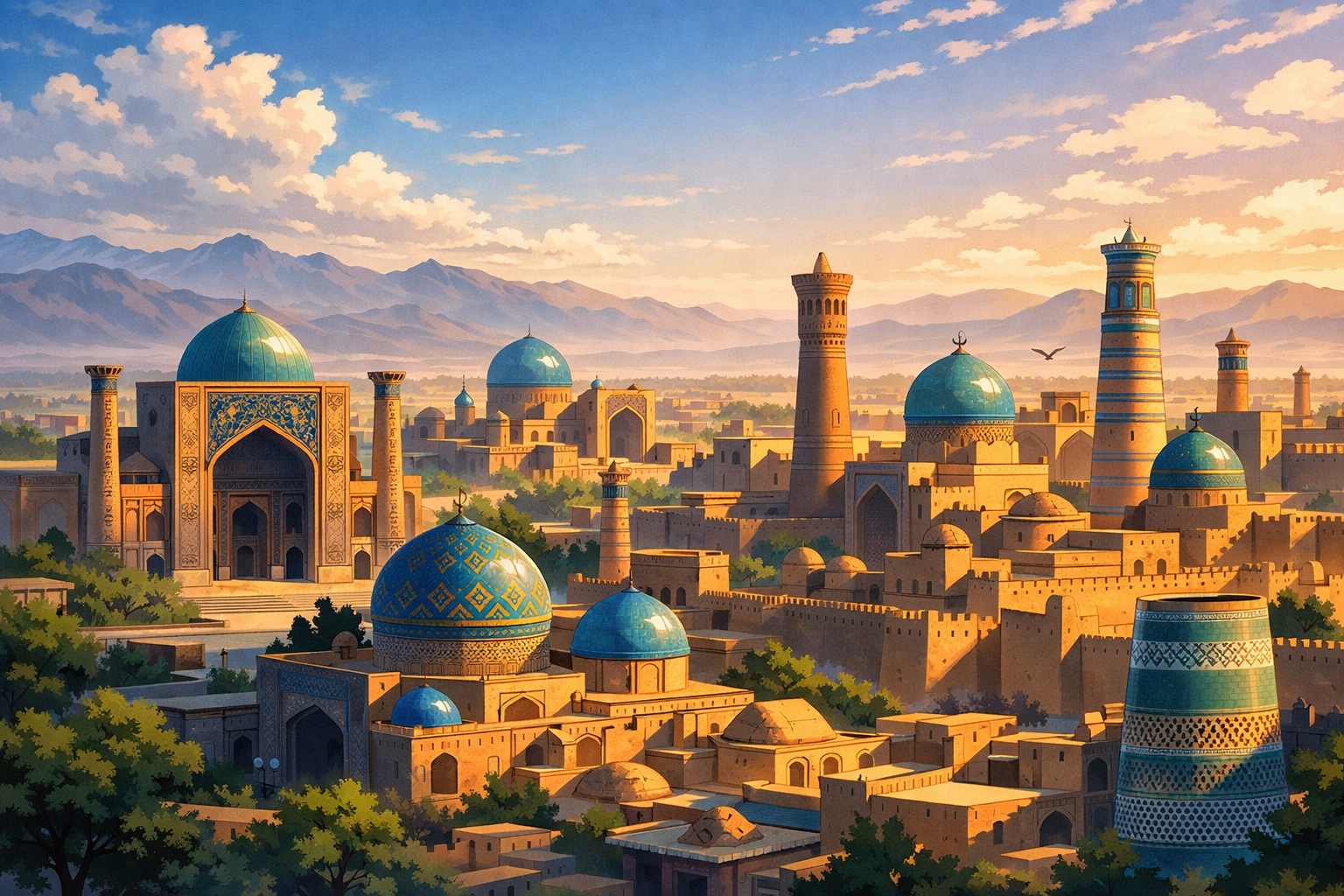
Trace the Silk Road across Uzbekistan, from Samarkand to Bukhara to Khiva, where turquoise domes, tiled madrasas, and walled old towns glow in the desert light. Wander buzzing bazaars and hushed courtyards, then linger over plov as centuries of history come alive.

🧭 DAY-BY-DAY ROUTE

Ready-made country and city routes with daily plans, sights, transport and accommodation. Buy PDF guides for independent travel.

🧭 DAY-BY-DAY ROUTE


Day 1 — Samarkand: Registan at dusk

  • 🚶 Registan is the heart of Samarkand and one of the most cinematic squares in the world. Three madrasas—Ulugh Beg, Sher-Dor, and Tillya-Kari—seem to pull back a fairy-tale curtain: azure mosaics, gilded vaults, lion “sher” motifs on the portals, the finest inscriptions. Come for the golden hour: in the rays of the setting sun, the ceramics seem to glow from within. In the evening the square grows quieter: musicians strum tender melodies, students in traditional skullcaps laugh on the steps, and the domes slowly darken against a lilac sky—an ideal “prologue” to the Great Silk Road.


Day 2 — Samarkand: Gur-e Amir, Bibi-Khanym and Siab Bazaar

  • 🚶 Start with the Gur-e Amir mausoleum—the resting place of Timur (Tamerlane) and his descendants. Inside: a violet-azure gloom, and in the center a jade slab shimmering in the lamplight. Then head to the Bibi-Khanym cathedral mosque: gigantic portals, patterns like silk fabric, legends of love and pride. Finish the morning at the Siab Bazaar: spicy non flatbreads, dried melon slices, mountains of raisins and nuts, amber dried apricots. It’s easy to feel the city’s energy here—alive, practical, welcoming.

Day 3 — Samarkand: Shah-i-Zinda + Afrasiyab and Ulugh Beg Observatory

  • 🚶 The incomparable Shah-i-Zinda ensemble is a narrow “road of life” amid a cascade of turquoise mausoleums. The ornaments are so delicate it feels like embroidery on stone. Then the Afrasiyab Museum: here, ancient Samarkand before the Mongol invasion is deciphered; frescoes of embassies and hunts transport you back fifteen hundred years. Finale: the hill with Ulugh Beg’s observatory—a gigantic marble arched sextant, star-measurements precise as the elements, and a small museum about the ruler-scholar for whom astronomy was a way to set the world in order.

Day 4 — Samarkand: “Silk Road Samarkand” and rest

  • 🚶 The Silk Road Samarkand complex is a convenient place for a leisurely day: promenades, the “Eternal City” with artisan lanes, restaurants with modern Uzbek cuisine. It’s time to catch your breath, enjoy the spa, walks by the water, and Samarkand’s soft light—there’s a transfer ahead and a new chapter of the journey.

Day 5 — Transfer: Samarkand → Bukhara + Lyabi-Hauz

  • 🚆 Transfer: Samarkand → Bukhara on the “Afrosiyob” — ≈ 1 h 30 min–2 h. Alternatives: the “Sharq” train (≈ 3.5–4 h) or a car transfer (≈ 3.5–4 h). It’s best to buy “Afrosiyob” tickets in advance online.

  • 🚶 In the evening — Lyabi-Hauz: an old water basin, mulberry trees, teahouses with baklava and green tea, soft lantern light on the old facades. The atmosphere is homely and almost intimate—an ideal first touch of unhurried Bukhara.

Day 6 — Bukhara: Ark, Bolo-Hauz, Zindan

  • 🚶 The Ark is an ancient citadel and museum complex: the gates where envoys were received, observation courtyards, traces of the emir’s power and everyday life. Nearby is the Bolo-Hauz Mosque with elegant wooden columns reflected in the water. Across the street is the Zindan, a prison with a “pit” from which Europe learned of the khanate’s harsh side. A day about a “time machine,” when the texture of brick and the smell of wood tell more than any textbook.

Day 7 — Bukhara: Poi-Kalyan, covered bazaars and the Samanids

  • 🚶 The Poi-Kalyan complex is Central Asia’s towering “lighthouse”: the Kalyan Minaret, the mosque, and the Mir-i-Arab Madrasa—monumental harmony of brick and sky. Next—three covered bazaar domes (Toki Sarrafon, Toki Telpak-Furushon, Toki Zargaron): domes, spices, ceramics, carpets. Finale—the Mausoleum of Ismail Samani in the park: perfect proportions and “woven” brickwork that seem beyond time.

Day 8 — Bukhara: Sitorai Mohi-Khosa Summer Palace

  • 🚶 The residence of the last emirs of Bukhara is Eastern romance with European influence: mirrored halls, peacocks in the park, reception pavilions. The decorative and applied arts museum helps you see Bukhara “through fabrics and craft.” Afterward—a quiet lunch in the garden and free time: contemplate, drink tea, slowly walk along the canals.

Day 9 — Transfer: Bukhara → Khiva + evening in Ichan-Kala

  • 🚆 Transfer: Bukhara → Khiva. Direct train (usually 5.5–6.5 h, the schedule may vary by day). Alternative: train to Urgench + 30–40 minutes by taxi to Khiva, or a car transfer (≈ 6–7 h).

  • 🚶 In the evening—your first loop around Ichan-Kala: clay walls in sunset gold, the pot-bellied turquoise of Kalta-Minor, quiet courtyards where workshops knock away. Khiva at night is warm, intimate, with the smell of clay and fresh bread.

Day 10 — Khiva: Kunya-Ark, Juma Mosque, Kalta-Minor

  • 🚶 Kunya-Ark is a “fortress within a fortress,” the khan’s court: the throne iwan with carved columns, walls with Ogahi’s poetry, the Ak-Sheikh-bobo viewpoint. Nearby is the Juma Mosque: a “forest” of two hundred wooden columns from different eras, half-darkness and cool air—like inside a palm. On the square—Kalta-Minor: short, powerful, with honey and turquoise bands—like a master’s unfinished phrase.

Day 11 — Khiva: Islam Khoja and Tash-Hauli

  • 🚶 The Islam Khoja Complex is Khiva’s tallest minaret and a madrasa with a Museum of Applied Arts of Khorezm. Climb to the top for a panorama of rooftops and domes. Then Tash-Hauli — the “Stone House” with a harem courtyard: blue tiles, carved wooden beams, ganch lacework — an oriental coziness where silence and shade reign.

Day 12 — Khorezm Fortresses: Toprak-Kala and Ayaz-Kala

  • 🚗 A daytime trip from Khiva to Karakalpakstan to the desert fortresses of Khorezm: Toprak-Kala (the capital of an ancient kingdom) and Ayaz-Kala (a fortress complex on clay outcrops). The road goes through Kara-Kum expanses, saxaul, a pink midday sky. Plan on 1.5–2 hours each way (with stops — 5–6 hours total). Ideally bring snacks and water; sneakers are a must: sand and clay can be treacherous.

Day 13 — Khiva at an unhurried pace

  • 🚶 Look closely at the details: clay cornices, copper embossing, carpets with desert geometry, sweets made from dried apricots and sesame. Drop into caravanserais, climb a minaret for a final view of the “museum city.” If you still have energy, take a walk along the outer walls of Dishan-Kala to the Tash-Darvaza gate.

Day 14 — Buffer for travel/rest

  • 🚆 A spare day for the road/rest: a morning transfer to Urgench for the train or the airport; a leisurely breakfast on the terrace, coffee with a view of the domes. The route is complete — may Khiva ring in your memory with turquoise, Bukhara with the whisper of irrigation channels, and Samarkand with the gold of the Registan.

Flight tickets

eSIM for travel

Buy PDF guide

Buy PDF guide — 29.99 USD

PDF — 29.99 USD