
Day 1 — Jena: university, Schiller, old Jena, and science panoramas
🚆 It is most convenient to plan your arrival via Jena Paradies or Jena West stations. From Jena Paradies, you can walk to the central part of the city and the university quarters in 10–15 minutes, and from Jena West in about 12–20 minutes depending on your hotel. This is a rare German city where, already in the first hour after arrival, you do not need to spend energy on long transfers: Jena is compact, very walkable, and almost immediately reveals itself as an intimate university center surrounded by limestone hills and the Saale valley.
🏛️ Start the day in the heart of Friedrich Schiller University Jena — one of Germany’s best-known universities. The main building on Fürstengraben and the neighboring university buildings provide not just a beautiful backdrop for a walk, but the feeling of a city that has lived for centuries through ideas, science, philosophy, and debate. This is where the special “Jena blend” is felt especially well: student energy, historical depth, and an amazingly calm rhythm. Goethe, Schiller, Hegel, Fichte, Schelling, and Novalis studied, worked, or spent time in Jena, and later the city also became one of the symbols of Germany’s scientific and technological modernization. Even if you do not go inside the faculties, simply walking through the university center gives a strong sense of a living intellectual city rather than museum scenery.
🚶 Then head to Schillers Gartenhaus — Schiller’s garden house in the lane Schillergäßchen. It is one of the most atmospheric spots in all of Jena: a small, almost intimate museum house where you especially clearly understand that German classicism was born not only in grand halls, but also in quiet studies, gardens, paths, and conversations. Schiller lived here at the end of the 18th century, worked on texts, and received friends, and the garden itself still preserves the feeling of a secluded space for thought. It is pleasant to linger here not for the sake of “checking a box,” but for the mood: the garden, old walls, light, trees, and the almost physical sense of how literary history suddenly becomes human and close.
🌿 After Schiller, it is good to take a gentle pause in the Jena Botanical Garden. It is literally woven into the city center and is ideal for slowing down. It is one of the oldest university botanical gardens in Germany, but the main thing is not only its age, but also the composition of the space: narrow paths, greenhouses, old trees, systematic plantings, and the feeling of a small green world hidden among city facades. After the intellectual route through the university and Schiller, the garden works as a visual exhale — here it is easier to switch from “looking and reading” mode to “walking and noticing” mode. For the whole block with the university, garden, and garden house, it is best to allow about 3.5–4.5 hours at a relaxed pace with a coffee break.
🔭 In the second half of the day, shift toward optical and scientific Jena. First, go to the area around the Deutsches Optisches Museum on Carl-Zeiss-Platz. It is important to consider the current status: the museum complex is in a long phase of renovation and a full visit to the exhibitions may not be possible, but this point itself remains key to understanding the city. It is here that you best realize that Jena is not only a city of poets, but also one of Europe’s most important capitals of optics, precision mechanics, glass, microscopy, and scientific instrument making. The history of Carl Zeiss, Ernst Abbe, and Otto Schott is literally built into the urban environment, and Jena’s scientific reputation is not a beautiful legend, but a real industrial and research tradition.
🌌 Next, make your way to Zeiss-Planetarium Jena — one of the city’s most legendary places. Opened in 1926, the planetarium is considered the world’s oldest operating projection planetarium and has almost symbolic significance for Jena: it is the point where engineering thought, space, education, and urban identity came together into a single image. As of July 2026, it is important to note that the planetarium had been undergoing modernization in the first half of the year for its 100th anniversary, so before your trip it is worth checking the specific program for your date. Even if you only manage an outside walk and do not make it to a show, the place is still impressive: the building looks like a monument to 20th-century scientific imagination, and the route itself from the center to the planetarium is very pleasant on foot.
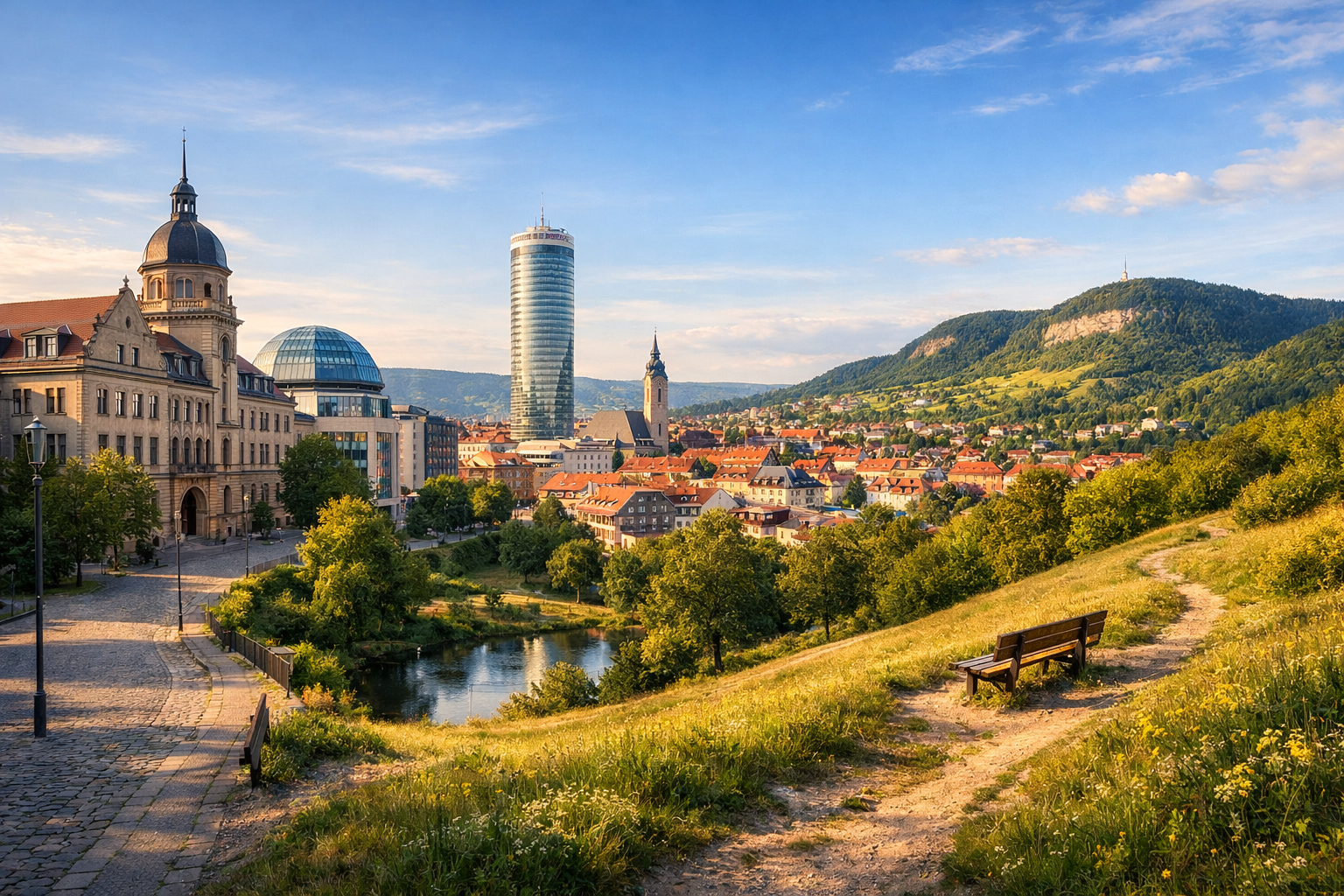
🌇 End the day with a climb to the observation level of JenTower or dinner with a view at SCALA. This is the best finale for the first day because from above Jena opens up in full: the Saale valley, green massifs, the rhythm of tram lines, university quarters, and the ring of hills that makes the city almost like an amphitheater. In the evening, when the light becomes softer, it is especially easy to see why Jena is loved not only for culture and science, but also for its sense of space. For this evening block with the viewpoint, an aperitif, or dinner, it is reasonable to allow 1.5–2.5 hours without rushing.