
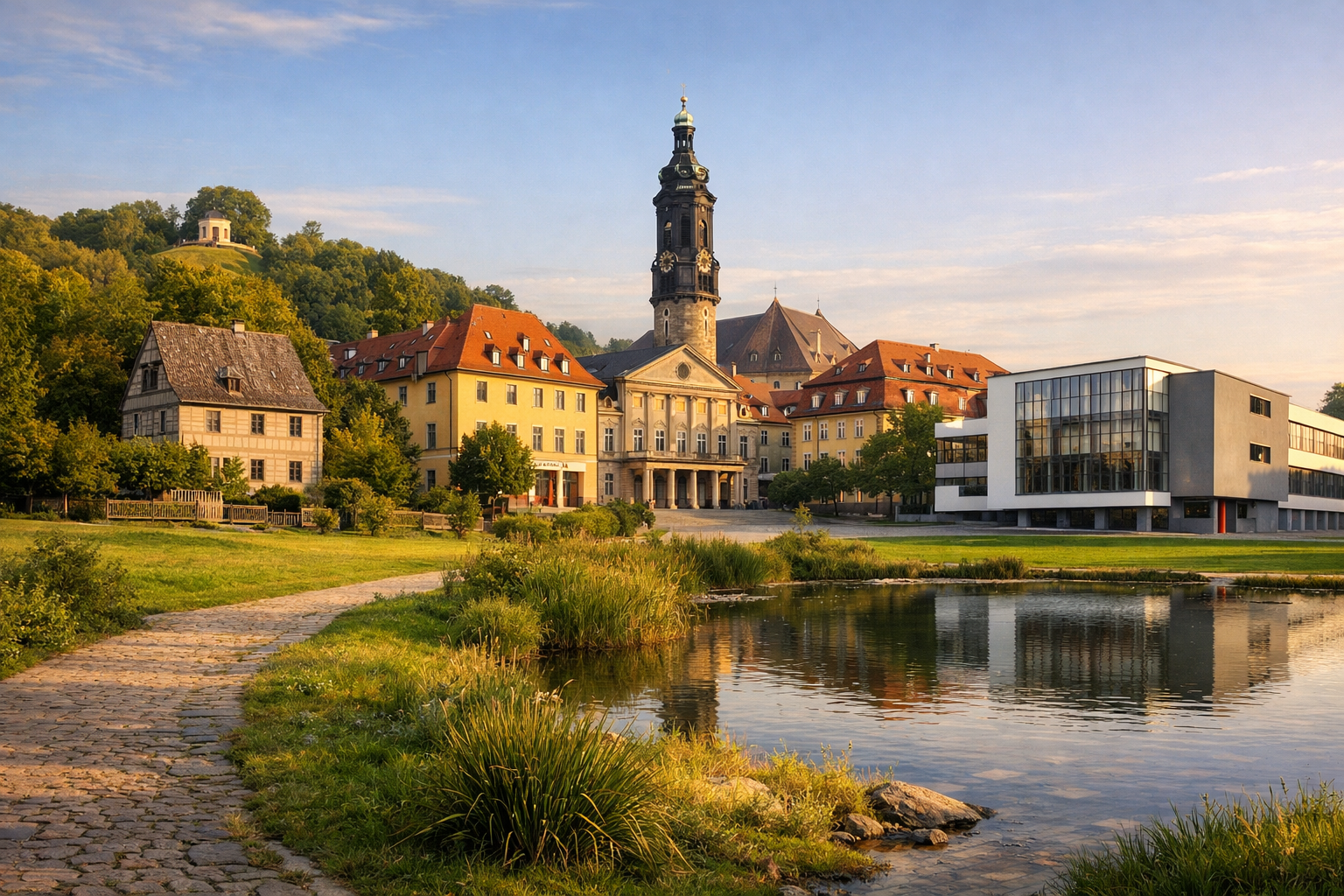
Day 1 — Weimar: the classical city of Goethe and Schiller
🚆 If you arrive via Erfurt–Weimar Airport, allow about 30–35 minutes by taxi to Weimar; if you travel by train from Erfurt, the rail journey itself usually takes about 15–20 minutes, after which you will need another 10–15 minutes for check-in and a short rest. For a two-day itinerary, it makes sense to use Weimar as your only base without unnecessary moves: the city is compact, the historic center is convenient for walking, and the key sights of classical Weimar are at a comfortable distance from one another.
🚶 Start your introduction to the city at Frauenplan and the Goethe-Nationalmuseum — the house where Johann Wolfgang von Goethe lived. This is not just a museum, but a rare space where the sense of memorial significance does not overwhelm, but instead makes everything feel astonishingly alive. Here it is easy to imagine how texts, ideas, conversations, and scientific interests were born in these rooms by the man who, in many ways, shaped the cultural image of Weimar. The special magic of the place lies in the fact that you are not walking through an abstract exhibition, but through an authentic house with the atmosphere of private life, scholarly focus, and an almost tangible intellectual density. Allow about 1.5–2 hours for the visit so you do not rush through it too quickly.
🚶 Then walk about 8–10 minutes to Schillers Wohnhaus on Schillerstraße. Unlike the more ceremonial image of Goethe, Schiller’s house feels especially intimate: here you can sense more strongly the tense creative energy of the final years of his life. The most powerful highlight of the route is the study, where great dramas were completed and where, quite literally, the nerve of the era has been preserved. The exhibition helps you see not only the “great poet,” but also a person living within the rhythms of family, debt, work, illness, and endless inner discipline. It is convenient to set aside about 60–75 minutes for the visit.
☕ After two intense memorial museums, be sure to take a break in the center — it is best to allow at least 45–60 minutes for coffee, a light lunch, or simply sitting unhurriedly in one of the central squares. Weimar does not like haste: its greatest beauty reveals itself precisely in the intervals between museums, when your gaze shifts to facades, shop windows, cobblestones, street lines, and the almost theatrical harmony of the space.
🚶 Dedicate the second half of the day to a walk through Park an der Ilm. This 48-hectare landscape park on the edge of the old town is not just a green area, but a true continuation of Weimar’s cultural biography. Here you especially clearly understand why the city is associated not only with literature, but also with the art of living among nature, views, and carefully planned perspectives. Winding paths, gentle terrain, bridges, lawns, and viewpoints create the feeling that you are walking inside a great Romantic stage set from the 18th–19th centuries. Allow 1.5–2 hours for a relaxed walk with stops.
🚶 If you still have energy, go deeper into the park toward Goethe Gartenhaus, or simply walk the route to the Roman House and back without overloading yourself with exhibitions. In the evening it is especially beautiful: historic Weimar gradually quiets down, and the park turns into a space of still air, long shadows, and a very rare European sense of cultural landscape, where nature and history truly work together. Returning to your hotel from the park within the central area usually takes 10–20 minutes on foot depending on your chosen base.