
Buy PDF guide

Buy PDF guide — 8.90 USD

PDF — 8.90 USD

THURINGIA - Thuringian Forest: hiking and nature

THURINGIA - Thuringian Forest: hiking and nature

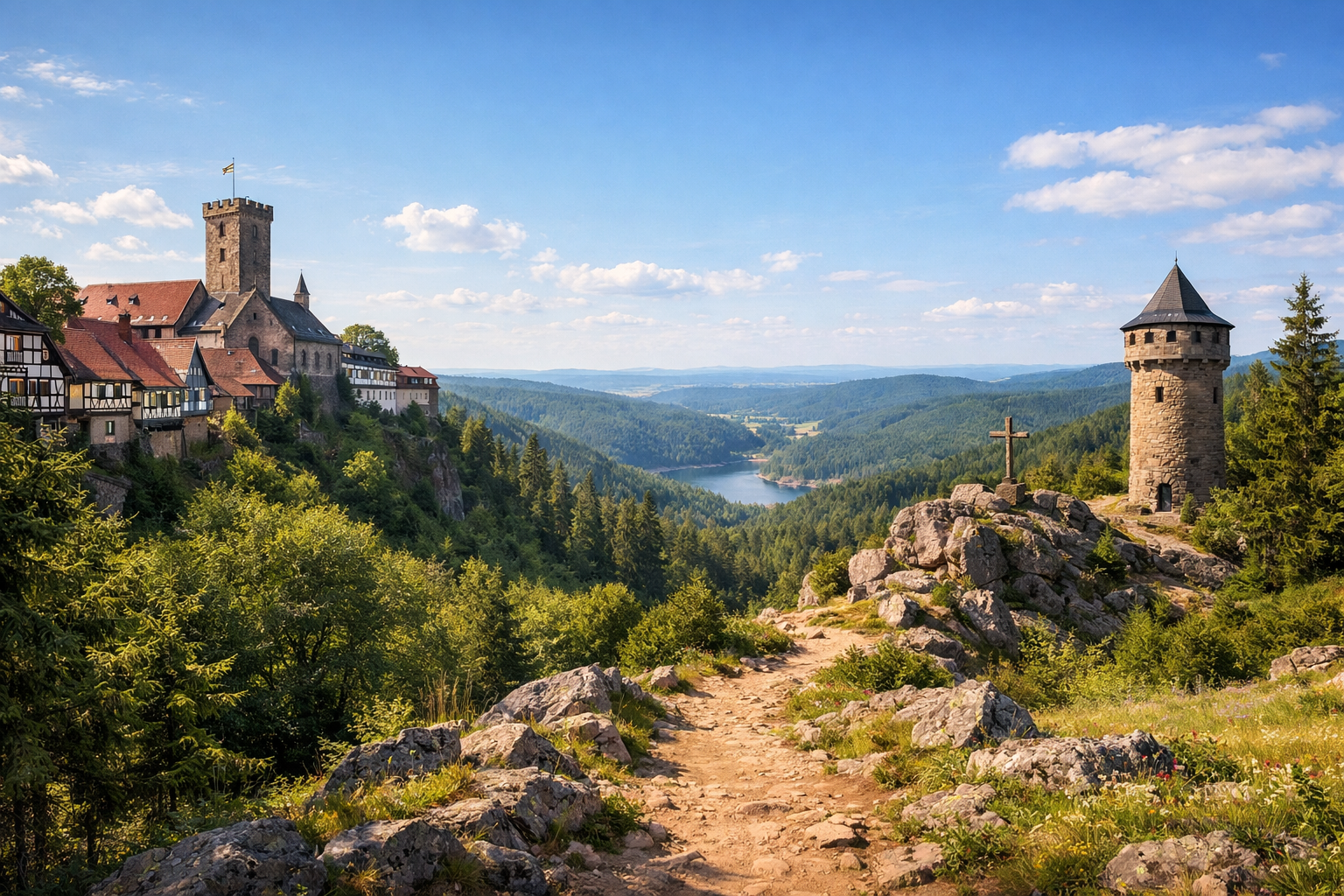
Thuringia’s Forest region is where deep green trails, ridge-top views, and fresh mountain air invite you to slow down and explore. From the charm of Erfurt to the hiking paths around Oberhof, the legendary Rennsteig, and historic Eisenach, it’s a journey made for nature lovers.

🧭 DAY-BY-DAY ITINERARY

Ready-made country and city routes with daily plans, sights, transport and accommodation. Buy PDF guides for independent travel.

🧭 DAY-BY-DAY ITINERARY


Day 1 — Erfurt: old town, Krämerbrücke, and a gentle start to the trip

  • 🚆 Arrival in Erfurt by plane or train — the most convenient gateway to a Thuringia route. The historic center is not far from the main station, and the day is designed so you don’t overload yourself after the journey: a bit of architecture, a bit of walking, and plenty of time for coffee, lunch, and an early rest before the more active days in the forest.

  • 🚶 Erfurt is striking in how naturally it combines a capital-city rhythm with an almost intimate medieval atmosphere. Its old town is considered one of the best preserved in Germany, and you can feel it in the very texture of the place: narrow streets, stone facades, church spires, quiet squares, and the rare sense that the city has not just been carefully restored, but truly lived through many centuries. The best way to start your walk is around Krämerbrücke, the famous bridge lined with houses that has become one of Erfurt’s symbols. It is not just a photogenic landmark, but a living urban scene: workshops, small shops, galleries, flower-filled windows, arches, and a gentle flow of people create the feeling that you have stepped into a neat and very friendly postcard.

  • 🚶 After the bridge, it is worth walking to the Domplatz ensemble — a space where the scale of old Thuringia is especially tangible. The huge staircase leading up to the cathedral and St. Severus Church makes the panorama feel truly theatrical, and in the evening the stone and towers take on a warm golden hue. This is the perfect place to slow down a little after the journey: sit in the square, look closely at facade details, and let the route unfold gradually, without rushing.

  • 🌿 If you want to add a bit of greenery to historic Erfurt already on the first day, you can stop by egapark — one of the region’s best-known parks. But for a short 4-day trip, it makes more sense to keep the main time for the old center, and treat the park as an option if you arrive early. The main thing on this day is a gentle introduction to the atmosphere of Thuringia: cobbled streets, cozy cafés, a calm urban rhythm, and the feeling that ahead lies not only towns, but a real forest route.

  • 💤 It is best to spend the night in Erfurt so that the next morning you can head toward Oberhof without haste. This is a realistic and convenient setup: minimal transfers on arrival day, maximum comfort, and enough energy for hiking from day two onward.


Day 2 — Oberhof: Rennsteig, mountain air, and a walk along the heights

  • 🚆 Transfer: Erfurt → Oberhof. The most practical public transport option is a train to Zella-Mehlis, then bus 422 to Oberhof Busbahnhof. In total, including the transfer, allow about 1 hr 20 min to 1 hr 50 min depending on the specific connection and bus waiting time.

  • 🚶 Oberhof is one of the most recognizable resort and sports centers in the Thuringian Forest, but in summer and the shoulder seasons it is especially good as a base for hiking. The town sits at altitude, surrounded by dense spruce forests, and even the air itself feels like part of the journey: cooler, cleaner, and drier than below, while the horizon constantly rolls away into soft waves of hills. Oberhof is not about a bright set of urban entertainments, but about the right state of mind — when you want to walk, listen to the wind in the treetops, pause at viewpoints, and not hurry anywhere.

  • 🥾 The main nature theme of the day is getting to know the Rennsteig, Thuringia’s legendary ridge trail. It is one of Germany’s most famous long-distance hiking routes, running along the crest of the Thuringian Forest. For a short trip, there is no need to try to “conquer” it all: it is much wiser to choose a beautiful and manageable section near Oberhof. Half-day walks along forest ridges and circular routes returning to town work well. These outings give exactly what people come here for: panoramic openings between the trees, the damp scent of pine, the coolness of the trail, silence, and the feeling of a true Mittelgebirge — German uplands with soft but highly expressive relief.

  • 🌲 A good plan for the day is to check in, leave your things, and head out on an easy warm-up route for 2–4 hours without overdoing it. Don’t try to pack too many kilometers into one day: the Thuringian Forest reveals itself best at a calm pace. It is important to leave time for viewpoints, tea or coffee in town after returning, and an early evening rest. If the weather is kind, this is often the day when that feeling of a “forest reset” arrives — one of the main reasons people choose this region.

  • ♨️ In the evening, it is especially pleasant to add some recovery: in Oberhof, you can combine a walking day with a pool or a wellness format. After the trail, this is not a luxury, but a very fitting part of the route — your legs rest, your body warms up, and the next day in the forest feels noticeably easier.

Day 3 — Oberhof and surroundings: Rennsteiggarten, forest views, and unhurried nature

  • 🚶 It is best to dedicate the third day not to a long transfer, but to a deeper experience of the region itself. After your first introduction to the trails, it makes sense to shift toward a combination of botany, forest landscapes, and scenic walks. An excellent place for this is Rennsteiggarten Oberhof, a botanical garden of mountain flora that continues the hiking theme in an unusual and very fitting way: after the “wild” forest, you get the chance to see how plant life in mountain regions is organized in a more curated, scientific-landscape form.

  • 🌿 Rennsteiggarten in Oberhof is not a classic formal park, but a space that feels like a natural collection at altitude. Plants from mountain regions around the world are gathered here, the paths run along slopes, and the whole walk remains close to nature — not “through flowerbeds,” but through living terrain with views, air, and silence. This place is especially appealing to those who like not only walking a route, but also looking closely at details: the structure of conifer plantings, rocky sections, and the contrast between alpine flora and the local forest environment.

  • 🚶 After the garden, it is nice to continue the day with a short walk on nearby trails or on one of Oberhof’s circular town routes. There is no need to compete in kilometers here: the point is precisely the combination of nature’s rhythm and rest. The forest around Oberhof is highly photogenic in changeable weather — when sunlight breaks through the clouds and lights up the dark spruce stands, the landscape takes on an almost northern character, while brief forest clearings open up layered green horizons.

  • ☕ It is wise to leave the second half of the day more open: a late lunch, rest at the hotel, wellness, or simply a slow walk around Oberhof itself. On a short trip, this is an important balance — if you turn two days in a row into a marathon, by the fourth day you will have neither the energy nor the sense of enjoyment left for the route. The Thuringian Forest is beautiful precisely when you give it time to open up not only to your legs, but also to your attention.

  • 💤 Staying overnight in Oberhof again makes the route stable and realistic: no constant change of base, proper recovery, and enough energy for the final day in Eisenach.

Day 4 — Eisenach: Wartburg, Drachenschlucht, and a strong finale

  • 🚆 Transfer: Oberhof → Eisenach. By public transport, it is usually easiest to go via Zella-Mehlis and then continue by train toward Eisenach; depending on the connections and transfers, allow about 2 hrs to 2 hrs 40 min. If you have a car, the trip is usually noticeably simpler and faster logistically, especially if you want to combine the castle and a nature walk in one day.

  • 🏰 Eisenach is the ideal final point for a 4-day route through Thuringia, because here nature and history come together especially dramatically. The main star is Wartburg, one of Germany’s most famous castles, rising above forested slopes. Wartburg makes a strong impression even on the approach: it does not feel like “scenery,” but like a real fortress standing at the boundary of historical eras. Here, medieval power, a romantic silhouette, and great cultural weight come together into a complete image of a place truly worth preserving as a symbol of the region.

  • 🚶 A walk through Wartburg is not only about halls and walls, but also about the work of the landscape. The views from above over the waves of forest, the surrounding hills, and Eisenach itself help you see the whole route at a glance: from urban Erfurt through elevated Oberhof to the more dramatic terrain of western Thuringia. Even if you are not a fan of castles, this is where the historical depth of the region is especially tangible.

  • 🥾 If the weather and your fitness allow, the second half of the day is worth dedicating to Drachenschlucht — Dragon Gorge, one of the most striking nature walks near Eisenach. This is a completely different forest experience compared with the gentle ridges near Oberhof: here the route becomes narrower, damper, shadier, and more dramatic. The rocks close in, the path runs along wooden walkways and stony sections, the stream heightens the feeling of coolness, and in places the gorge really does look as if nature intentionally created theatrical scenery. It is especially beautiful after a period without heavy downpours, when the trail is safer, but the water and moss still preserve that fairy-tale atmosphere.

  • 🎵 If there is already too little time for a full hike, an alternative is an urban cultural finale: Bachhaus or Lutherhaus in central Eisenach. This is a good option for rainy weather or for travelers who want to end the route not with physical exertion, but with history and music. But if you still have the energy, the combination of “Wartburg + a short nature section near Drachenschlucht” gives the strongest and most complete ending to the whole trip.

  • 🚉 After the program — departure from Eisenach onward along your route, or an overnight stay here if you prefer a more relaxed pace. For a strict 4-day tour, the day is busy but realistic, if you start early and do not try to add too many extra stops.

Flight tickets

eSIM for travel

Buy PDF guide

Buy PDF guide — 8.90 USD

PDF — 8.90 USD