
Buy PDF guide

Buy PDF guide — 4.28 USD

PDF — 4.28 USD

THURINGIA - Erfurt: Krämerbrücke Bridge and the Old Town

THURINGIA - Erfurt: Krämerbrücke Bridge and the Old Town

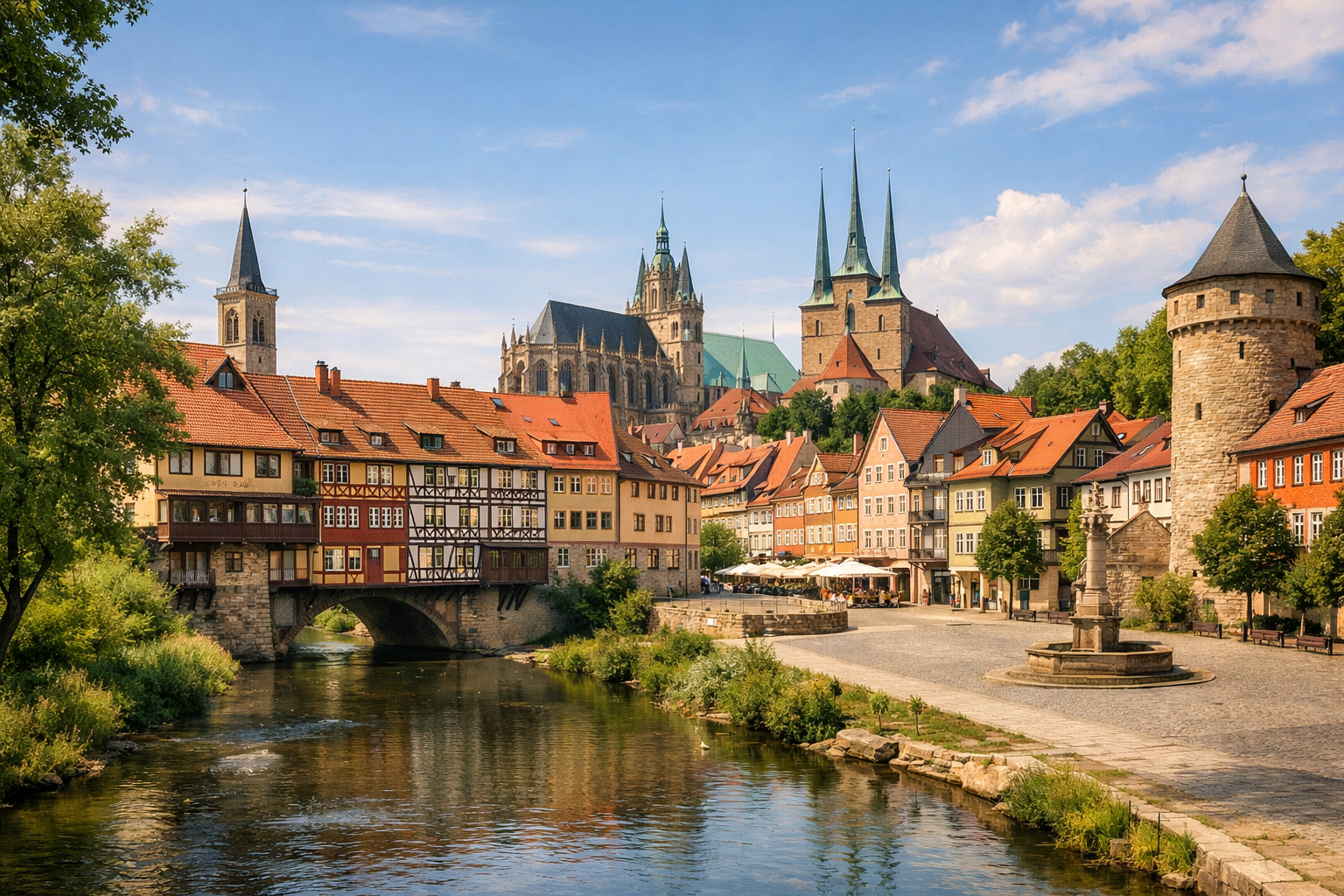
Erfurt captures the charm of Thuringia with its beautifully preserved Old Town, where medieval lanes lead to the famous Krämerbrücke, lined with half-timbered houses and small artisan shops. Above the city, Petersberg Fortress adds sweeping views and a sense of history to this quietly captivating destination.

🧭 DAY-BY-DAY ITINERARY

Ready-made country and city routes with daily plans, sights, transport and accommodation. Buy PDF guides for independent travel.

🧭 DAY-BY-DAY ITINERARY


Day 1 — Erfurt: Krämerbrücke, Anger, and the Old Town

  • 🚶 Begin your introduction to Erfurt at Krämerbrücke, the legendary merchants’ bridge considered the longest fully built-up bridge in Europe that is still inhabited today. It is not just a photogenic postcard scene, but a living piece of the medieval city: tightly packed half-timbered houses stand above the course of the Gera River, the water glimmers below, and inside the former merchants’ buildings you now find craft workshops, small galleries, shops selling handmade ceramics, glass, and textiles, as well as cozy cafés. As you walk across the bridge, it is easy to imagine how trade once bustled here centuries ago, artisans argued, the air smelled of wood, wax, and fabrics, and Erfurt itself was a wealthy crossroads in the very heart of Germany. It is especially beautiful here in the morning: there are fewer people, soft light slides across the wooden façades, and the whole quarter feels intimate and very “real,” without the sense of a museum set.

  • 🚶 From Krämerbrücke, continue toward Anger Square, the city’s historic commercial center, where old Erfurt meets more formal urban architecture. It is pleasant not to rush here: admire the façades, peek into the arcades, grab a coffee, and simply absorb the rhythm of the city. On the way, it is worth passing through Fischmarkt and the neighboring streets of the old center, where Erfurt’s layered history is especially easy to read: Gothic churches, Renaissance houses, cobbled alleys, old signs, and quiet courtyards come together to create a rare sense in Germany of an intact, undestroyed medieval core. This route is not about racing through a checklist, but about the dense, насыщенной atmosphere of a city that has preserved a human scale and is wonderfully suited to a slow day on foot.

  • 🏛️ If you would like to add a cultural pause to your walk, it makes perfect sense to stop by the Angermuseum at Anger 18. It is housed in a beautiful Baroque building that once served as a warehouse and weigh house, and it complements your impressions from the streets very well: inside are collections of paintings, decorative arts, and historic interiors, and the museum itself helps you feel that Erfurt is not only about façades and bridges, but also an important cultural center of Thuringia. For an unhurried visit, it is usually worth allowing 60–90 minutes.

  • 🍰 After lunch, leave time for a relaxed break in a café in the old town area or right on the approach to the bridge. For a compact two-day itinerary, this matters: Erfurt reveals itself best not in a rush, but through pauses when you can simply sit by the window of a craft shop, watch the passersby, and let the city “settle in.” Toward evening, return to Krämerbrücke once again: in the golden hour, the half-timbering takes on especially warm tones, and the narrow passages and old houses look almost theatrical. This is the ideal time for a second walk across the bridge, calm photographs, and a final evening stroll through the historic center.


Day 2 — Erfurt: Domplatz, cathedral ensemble, Petersberg Citadel, and parks

  • 🚶 Dedicate your second day to a more panoramic and distinctly “urban” side of Erfurt. Start at Domplatz, the spacious square dominated by St. Mary’s Cathedral and St. Severus Church. After the intimate lanes of the old center, this place creates a completely different impression: the scale suddenly expands, the staircase leading up to the churches sets a ceremonial rhythm, and above the square you can feel the weight of centuries of church and urban history. Even without going deep into every building, simply being here is powerful: pale stone, lofty volumes, bell towers, and the open square create the feeling of a major European city with a deep historical memory.

  • 🚶 Then head up to Petersberg Citadel, one of Erfurt’s main symbols. This is a rare chance to see the old town not only from within, but also from above. The Baroque fortress rises over the historic core and offers a completely different view of Erfurt: red-tiled roofs, towers, winding street lines, and the calm scale of the center are especially clear from here. A walk around the fortress grounds and viewpoints usually takes 1.5–2 hours including stops, photos, and rest. It is pleasant to move without rushing here, because Petersberg is not only about fortifications, but also a place of air, views, and quiet, where the medieval city is unexpectedly perceived as a unified composition.

  • 🏛️ On Petersberg, it is convenient to stop by the Besucherzentrum at Petersberg 3 to get oriented around the fortress and exhibitions, and then, if you wish, continue the museum part of the day at Stadtmuseum Erfurt “Haus zum Stockfisch” on Johannesstraße 169 or at Naturkundemuseum on Große Arche 14. The city museum is especially good because it connects your walk through the streets with Erfurt’s history from the Middle Ages to later eras, while the natural history museum adds an unexpected pause within the old urban setting and suits those who prefer a lighter visit format. If you are interested in the city’s Jewish heritage, Alte Synagoge on Waagegasse 8 can be a particularly strong highlight — one of the most important places of historical memory in Erfurt.

  • 🌿 In the second half of the day, leave yourself a choice between two ways to relax. The first is to stay in the center, take another calm walk through the old town, and end the trip on a terrace overlooking evening Erfurt. The second is to head to egapark Erfurt if you want more greenery, space, and a beautiful park finale. This park is known for its themed gardens, flower displays, a Japanese rock-and-water garden, and wide walking avenues, so it is especially lovely in the warm season. For a two-day itinerary, this is a successful gentle finale: after bridges, museums, and fortress walls, Thuringia opens up as landscape and garden culture.

  • 🚋 The day’s logistics are realistic and comfortable: all of central Erfurt is excellent for walking, transfers between key points in the old town most often take 5–20 minutes, and egapark is more convenient to reach by public transport. Thanks to the city’s compactness, the route never feels overloaded: you still have time for proper sightseeing, coffee breaks, and a relaxed dinner without the feeling of constantly rushing.

Flight tickets

eSIM for travel

Buy PDF guide

Buy PDF guide — 4.28 USD

PDF — 4.28 USD