
Buy PDF guide

Buy PDF guide — 10.90 USD

PDF — 10.90 USD

THURINGIA - Grand Cultural Tour of Thuringia: Erfurt - Weimar - Eisenach

THURINGIA - Grand Cultural Tour of Thuringia: Erfurt - Weimar - Eisenach

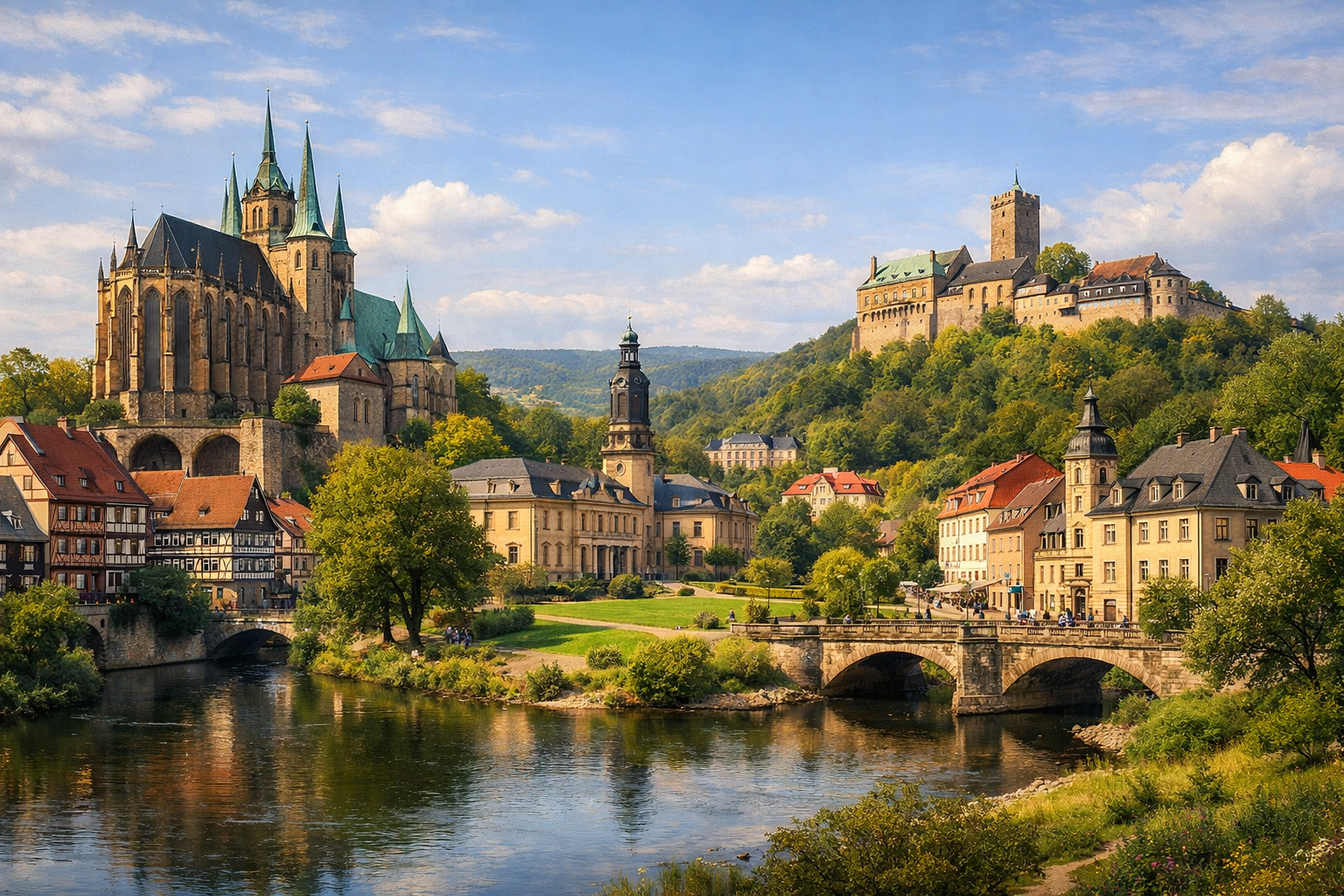
Discover the heart of Germany in Thuringia, where medieval streets, grand cultural landmarks, and rolling green landscapes create a journey full of character. From Erfurt’s beautifully preserved old town to Weimar’s artistic legacy and Eisenach’s castle-crowned hills, this route blends history, beauty, and timeless charm.

🧭 DAY-BY-DAY ITINERARY

Ready-made country and city routes with daily plans, sights, transport and accommodation. Buy PDF guides for independent travel.

🧭 DAY-BY-DAY ITINERARY


Day 1 — Erfurt: old town, Domplatz, and the quarter by Krämerbrücke

  • 🚶 Erfurt is ideal for a gentle start to a cultural journey: it is a rare German city where the medieval skyline does not look like museum scenery but remains a living urban fabric. Begin the day around Domplatz, where you immediately feel the scale and dignity of old Thuringia: the broad square, powerful stairways, cathedral dominance, and neighboring St. Severus Church create one of the most expressive urban ensembles in central Germany. For centuries, Erfurt stood at the crossroads of trade routes, was a wealthy merchant and university center, and this historical confidence can be read in the stone, towers, façades, and in the very logic of its streets. Then make your way down toward the fish market and the narrow lanes of the old center, where Gothic and Renaissance houses, small signs, cafés, and craft shops create the feeling of an unhurried European city best discovered on foot.

  • 🚶 Be sure to reach Krämerbrücke — the famous “merchants’ bridge,” completely lined with houses. This is not just a photogenic sight, but a rare preserved space where the bridge is still perceived as a street with a history, not as an engineering structure. It is worth lingering here longer than usual: step into little workshops, bookshops, and ceramic stores, and feel how the tourist rhythm blends with everyday urban life. In the evening, it is better not to overload the program: after a flight or train ride, leave time for an early dinner, a calm walk through the illuminated center, and rest. Erfurt is best at exactly this pace — it reveals itself not through rushing between points, but through atmosphere, street perspectives, the ringing of bells, and the beautiful sense that you have arrived in one of Germany’s most underrated cultural capitals.


Day 2 — Erfurt → Weimar: classical Weimar, Goethe, and Park an der Ilm

  • 🚆 Transfer: Erfurt → Weimar by regional DB / VMT train — usually about 15–20 minutes on the way; from Weimar station, it is convenient to take a bus to the historic center or walk part of the route. It is a short and very comfortable transfer, so the day can be planned without haste and with a full museum block.

  • 🚶 Weimar has a completely different mood from Erfurt. If Erfurt impresses with medieval density and verticality, Weimar wins you over with intellectual depth, intimacy, and a rare sense of cultural concentration. It is here that you especially clearly feel that German history is not only about castles and cathedrals, but also literature, philosophy, music, theater, political ideas, and artistic manifestos. Start in the Frauenplan area and at Goethe-Nationalmuseum mit Wohnhaus: even if you are not a specialist in German literature, this place conveys an almost physical presence of the era. Goethe’s house, the urban scale of Weimar, and the proximity of key addresses allow you to perceive the city as a single cultural text.

  • 🚶 After the museum part, be sure to leave time for Park an der Ilm. This is not a “tick-the-box park,” but one of the most poetic spaces on the route: the gentle landscape, water, old trees, opening views, and historic pavilions offer exactly the kind of walk you need after an intense exploration of interiors. Here it is especially easy to understand why Weimar became a symbol of German classicism: the beauty is not loud, but intelligent, composed, contemplative. In the evening, stay in the center — around Marktplatz and the neighboring streets it is lovely simply to wander without a program, taking in the façades, memorial addresses, and the calm, almost literary evening atmosphere.

Day 3 — Weimar: Bauhaus, the Weimar Republic, and an unhurried museum day

  • 🚶 The second day in Weimar is worth dedicating to the 20th century to see how important this small city is not only for the era of Goethe and Schiller, but also for modern European culture. Start with Bauhaus-Museum Weimar — it is here that you especially clearly understand that Bauhaus was not just a style, but a new system of thinking about form, function, craft, education, and everyday life. The exhibitions help you see how ideas born in Weimar later spread across the world and still shape our visual language today — from architecture to product design.

  • 🚶 Then it makes sense to move to the theme of politics and memory by adding Haus der Weimarer Republik. Weimar is unique in that within one compact center it allows you to travel from high classicism to modernism and further — to the dramatic experience of the first German democracy. Such a route gives the trip depth: the city ceases to be a “pretty postcard” and opens up as a place where aesthetic and political ideas were born that shaped 20th-century Europe. Between museums, be sure to build in pauses for coffee and rest: Weimar is best taken in portions, when space remains between blocks for reflection.

  • 🚶 Dedicate the evening to a light walk along the central streets and, if you still have the energy, stop by Herzogin Anna Amalia Bibliothek from the outside and the surrounding quarter. Even without an overloaded program, this day turns out to be very rich in meaning. Weimar is wonderful because it does not require constant movement: all the key points are relatively close to each other, which means the route remains realistic, not exhausting, and truly cultural rather than just a checklist of visits.

Day 4 — Weimar → Eisenach: Wartburg, Luther, and old Eisenach

  • 🚆 Transfer: Weimar → Eisenach by DB train — usually about 45–60 minutes, depending on the specific service and category. After arrival, it is best to leave your luggage at the hotel or station first and only then head to Wartburg, so the climb to the castle does not turn into a logistical stress.

  • 🚶 The main climax of the day is Wartburg. This is not just a beautiful castle on a hill, but one of the most important historical points in all of Germany, a place where knightly legend, religious history, politics of memory, and the romantic image of the German Middle Ages intersect. The ascent itself already works as part of the experience: the higher you go, the more widely the forested slopes and the town below open up, and the castle itself gradually stops being a silhouette and becomes a full stone world. It is worth allowing plenty of time here: the grounds, the views, the interiors, and the atmosphere itself require not a quick inspection, but calm presence. Wartburg makes a strong impression precisely through its many layers — it is at once a fortress, a court, and the place where Luther hid and worked on his translation of the New Testament into German.

  • 🚶 After Wartburg, descend into Eisenach and continue the day at Lutherhaus Eisenach and in the old center. Eisenach is much more compact than Erfurt and Weimar, but that is its advantage: the city is easy to cover on foot and gives a very coherent impression. Narrow streets, squares, church silhouettes, and the memory of Luther and Bach create a special sense of historical density here. In the evening, it is best to keep the route as gentle as possible: after the castle and museum, leave time for a quiet dinner and a walk through the center. The day is intense both physically and emotionally, so an early rest will be wiser here than trying to squeeze in too much.

Day 5 — Eisenach: Bach, the city’s museum rhythm, and the end of the tour

  • 🚶 The final day is best devoted to a more intimate, musical, and contemplative Eisenach. Start with Bachhaus Eisenach — one of the most important addresses for anyone interested in European music history. Even if you are not a fan of Baroque music, the museum is arranged in a way that helps you feel not an abstract cult of a great composer, but the environment in which Bach was formed, and how his legacy continues to sound today. It is especially pleasant that the museum format is not dry: it combines a historic house, an exhibition, and a living musical dimension, so the visit is not tiring but, on the contrary, gives a rare sense of contact with culture through sound and space.

  • 🚶 Then leave time for an unhurried conclusion to the route: a walk through the center, coffee in the square, a bit of shopping, buying local souvenirs, and a gentle end to the trip without a rush. If you want one more green pause, you can add a city park or viewpoints in the lower part of town, but it is better not to turn the last day into a marathon. This tour of Thuringia is valuable precisely because in five days it manages to show three different faces of the region: merchant and medieval Erfurt, intellectual and artistic Weimar, and then the more legendary, musical, and historically rich Eisenach.

  • 🚆 For the return journey, it is convenient to plan departure from Eisenach by rail via Erfurt or directly toward Frankfurt/Leipzig — depending on your onward route. If you need a flight, it is logistically sensible to check the train + airport connection in advance and allow at least 60–90 minutes of buffer time for transfers and the journey to the terminal.

Flight tickets

eSIM for travel

Buy PDF guide

Buy PDF guide — 10.90 USD

PDF — 10.90 USD