
Buy PDF guide

Buy PDF guide — 3.90 USD

PDF — 3.90 USD

THURINGIA - Eisenach and Wartburg Castle

THURINGIA - Eisenach and Wartburg Castle

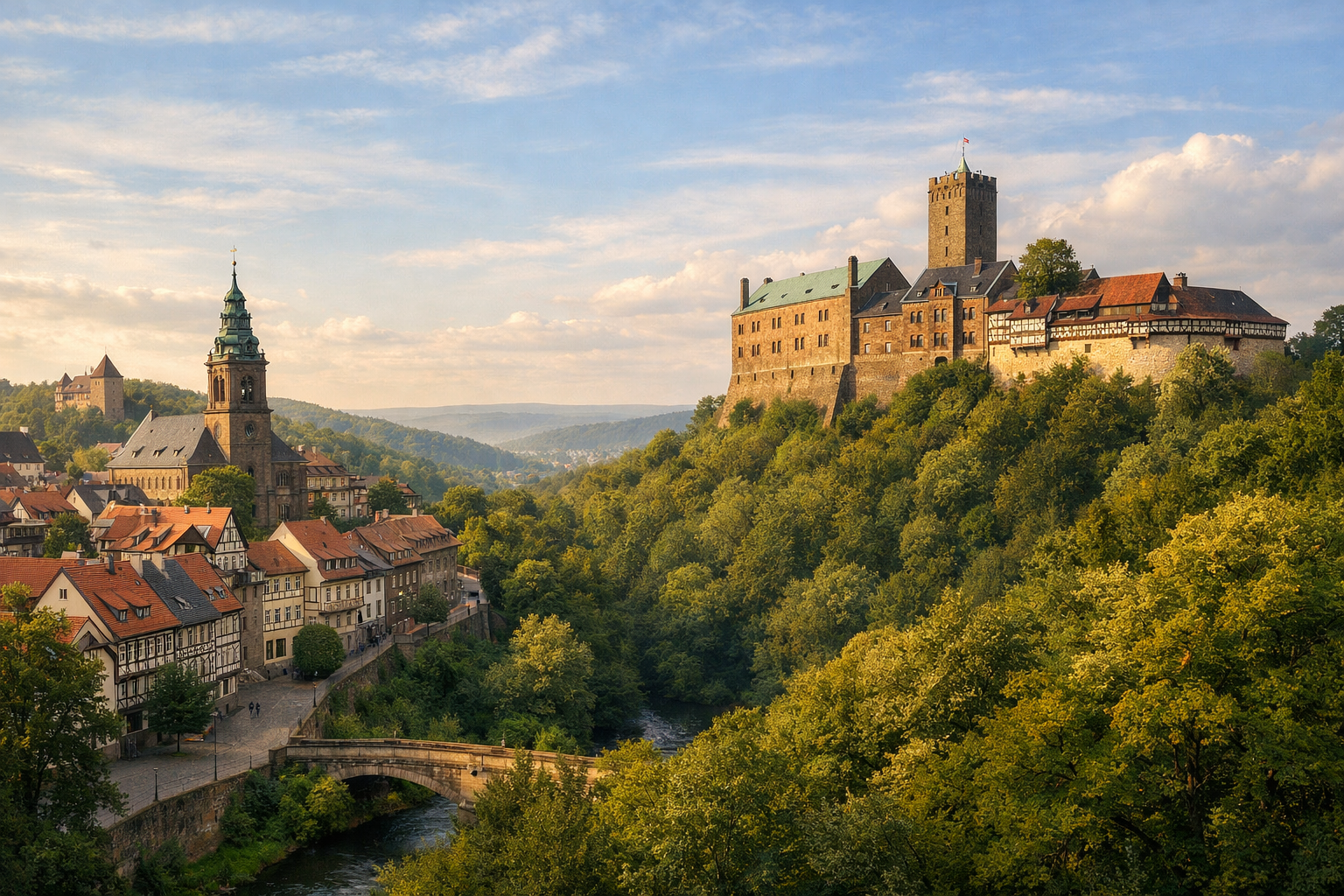
Discover Thuringia through Eisenach, the gateway to the legendary Wartburg Castle. Perched high above the town, this UNESCO-listed fortress blends medieval grandeur, sweeping views, and the stories of Martin Luther into one unforgettable stop.

🧭 DAY-BY-DAY ROUTE

Ready-made country and city routes with daily plans, sights, transport and accommodation. Buy PDF guides for independent travel.

🧭 DAY-BY-DAY ROUTE


Day 1 — Eisenach: old town, Bach, and Luther

  • 🚆 Transfer: if you arrive in Germany via Frankfurt am Main, allow about 2h 10m–2h 40m by train to Eisenach Hbf, depending on the specific connection; from the station to Eisenach’s historic center it is usually a 10–15 minute walk or just a few minutes by taxi. If you arrive via Berlin, the trip to Eisenach is usually noticeably longer and often takes around 3h 30m–4h 30m with transfers, so for a two-day itinerary it is more convenient to plan your rail arrival through central Germany.

  • 🚶 Start getting to know Eisenach calmly and without rushing: this city does not try to overwhelm you with size, it charms you with the density of its history. The compact center is easy to explore on foot, and that is exactly its main pleasure: in just one day you can walk a route where several major European storylines echo at once — medieval Thuringia, the youth of Martin Luther, the birth of Johann Sebastian Bach, and the romantic silhouette of Wartburg above green slopes. The old streets around Markt, Georgenkirche, Frauenplan, and Lutherplatz present not a museum display but a living picture of the city: neat facades, cobbled stretches, cozy squares, cafés, shop windows, and the gentle feeling that everything here is designed for an unhurried traveler rather than a rushing tourist flow.

  • 🚶 Then head to Bachhaus Eisenach — one of the city’s most atmospheric museums. This is not just a biographical point on the map, but a place where music is felt almost physically in the space. Bach was born in Eisenach in 1685, and it was here that his first musical impressions began: the urban church environment, choir, organ tradition, and school education. The museum is especially good because it shows not a dry “chronology of genius,” but the musical world from which that genius grew. The historic building, garden, intimate scale of the space, and live musical demonstrations create a rare sense of closeness to the era. Even those who do not consider themselves fans of classical music can easily catch that very thread connecting a person’s biography, urban culture, and larger European history. It is reasonable to allow about 1–1.5 hours for Bachhaus, and after the visit, take a coffee break near Frauenplan.

  • 🚶 In the second half of the day, move on to Lutherhaus Eisenach — one of the city’s most important addresses. Externally, it is an old half-timbered house with an almost fairy-tale texture of wood and plaster, but its real strength lies in its historical content. Eisenach is connected with Martin Luther’s most important school years, and the city rightly presents this not as a formal detail but as a stage in the formation of his personality. The exhibition brings together the authentic historical setting, the theme of the Reformation, Bible translation, and the fate of German spiritual culture. Inside, the contrast between the intimacy of the old house and the scale of the consequences of the ideas that later changed Europe is especially impressive. It is best to allow 1–1.5 hours for Lutherhaus without rushing, so that you do not simply skim the text panels but truly “enter” the era.

  • ☕ After the museums, leave yourself time to relax in the center: a late lunch or early dinner, a short walk to Georgenkirche and around Markt, and then a gentle evening without overload. For a two-day itinerary this matters: Eisenach wins not by the number of checkmarks, but by its rhythm. If you still have energy, you can walk toward Karlsplatz and Nicolaitor to feel the city in the evening light, when the streets become especially photogenic. It is best to spend the night right in the center, so that the next day you do not waste energy on extra logistics.


Day 2 — Wartburg, panoramas, and museum Eisenach

  • 🚌 Start the morning a bit earlier and head to Wartburg Castle. From the city center and the station area, it is convenient to use bus line 3 — Luthershuttle, which goes toward Wartburg; the ride itself from the center is short, usually about 15–20 minutes including the climb up the slope and the stops. An alternative is a taxi or a combined option: ride closer to the castle and then walk a little. For visiting Wartburg, it makes sense to set aside at least 2.5–3 hours, because it is not just a “viewpoint,” but a place where a fortress, palace architecture, museum spaces, viewing terraces, and a very strong historical context all come together.

  • 🚶 Wartburg is one of the most powerful historical stage sets in all of Germany. The castle has looked out over Thuringia from above for almost a thousand years, and even the approach to it works like a theatrical introduction: wooded slope, stone walls, towers, openness above the valley, and that very moment when Eisenach remains below like a miniature. Wartburg is famous not only as a medieval fortress, but also as the place where in 1521–1522 Martin Luther, hiding under the name “Junker Jörg,” translated the New Testament into German. Because of this, the castle is not just an architectural monument, but a symbol of a turning point in cultural and spiritual history. Another line of memory is also strong here: Saint Elizabeth of Thuringia, court culture, legends of the singers’ contest, and the later romantic interpretation of German history. Inside, what is especially valuable is that Wartburg does not reduce itself to a single era: you feel its layered nature, the transition from fortress to representative residence, from real history to national myth. The viewpoints around the castle deserve separate time: in good weather, the panoramas over Eisenach and the Thuringian Forest become one of the highlights of the whole trip.

  • 🌿 After Wartburg, do not try to squeeze in too many places one after another immediately. It is better to go back down into the city, have a calm lunch, and leave yourself an hour to catch your breath. In the second half of the day, Automobile Welt Eisenach is perfect for a short museum block — an unexpectedly strong location for those who love not only the Middle Ages, but also industrial history. Eisenach is one of Germany’s oldest automotive centers, and the museum on the site of the former factory shows the path from early Wartburg Motorwagen through the Dixi and BMW era to postwar Wartburg and later industrial chapters. This is a very successful complement to Wartburg: in the morning you see Germany’s “high” history, and later — the history of technology, labor, and urban identity. 1–1.5 hours is enough for the museum.

  • 🚶 If you still have time and the mood for it after that, finish the route with a gentle walk to Reuter-Wagner-Museum or simply through the green areas at the foot of Wartburg Hill. This kind of ending ties all of Eisenach together well: the city turns out to be not only Luther’s and Bach’s, not only a postcard with a castle, but also a cultural hub with music, literature, museum tradition, and an industrial past. For the return trip to the station from the center, again allow about 10–15 minutes on foot; if you are leaving by train in the second half of the day, it is wise to leave at least a 20–30 minute buffer.

Flight tickets

eSIM for travel

Buy PDF guide

Buy PDF guide — 3.90 USD

PDF — 3.90 USD