Buy PDF guide

Buy PDF guide — 25.90 USD

PDF — 25.90 USD

Siena

Siena

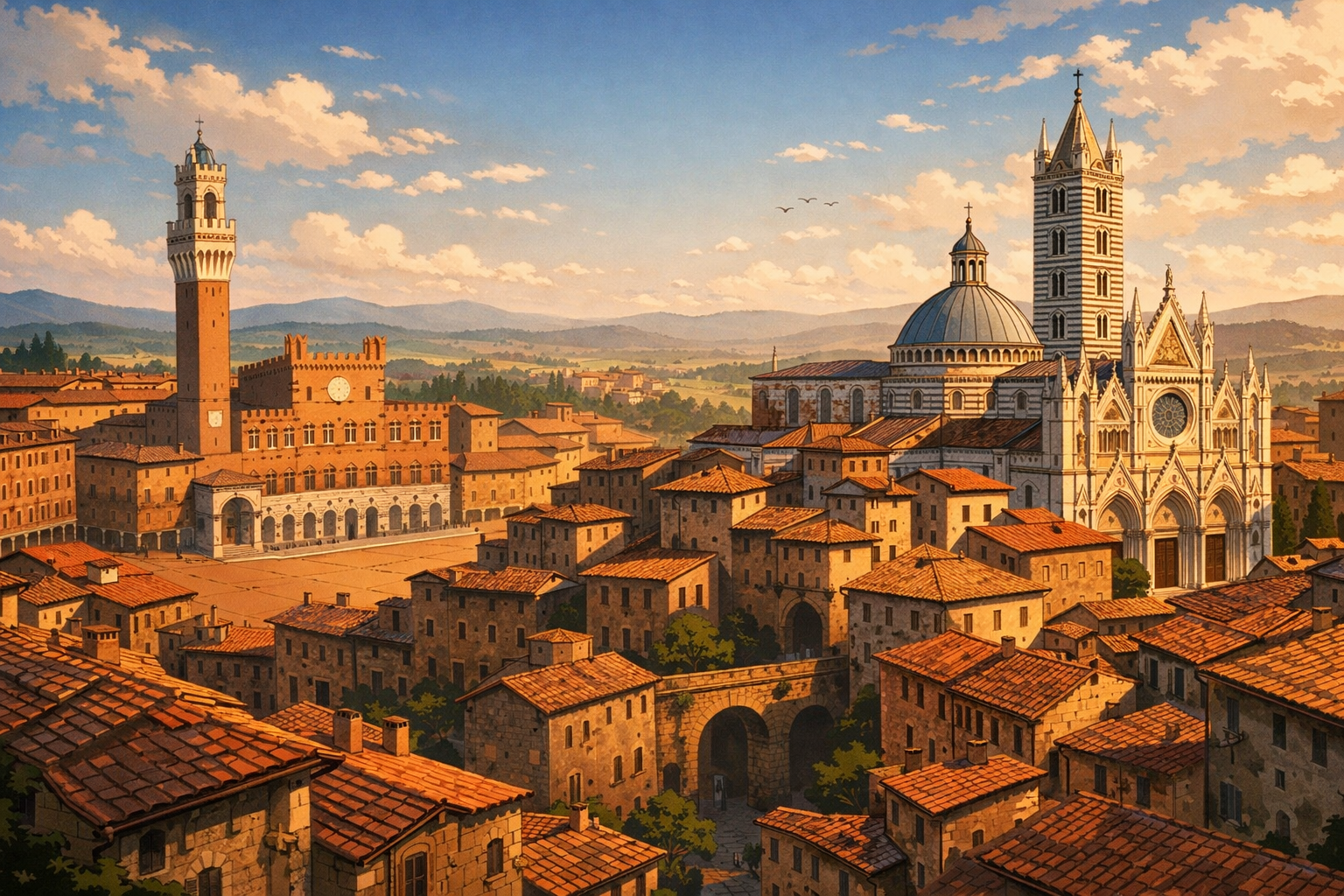
Italy beckons with a Tuscan loop of hill towns and abbeys: begin in Siena’s medieval heart, wind to tower-studded San Gimignano, walled Monteriggioni, and Etruscan Volterra. Sip Brunello in Montalcino, hear chants at Sant’Antimo, wander Pienza’s Renaissance lanes and Monte Oliveto Maggiore’s frescoes, then circle back to Siena.

🧭 DAY-BY-DAY ITINERARY

Ready-made country and city routes with daily plans, sights, transport and accommodation. Buy PDF guides for independent travel.

🧭 DAY-BY-DAY ITINERARY


Day 1 — Arrival → Siena: the city “entrance” and Piazza del Campo

  • ✈️ Arrival logistics: optimal airports are Florence (FLR) and Pisa (PSA). From FLR, the T2 tram line to Firenze SMN is convenient (≈ 20–25 min), then: a Trenitalia train to Siena via Empoli (on average 1 h 30 min–1 h 45 min) or the 131R express bus from Firenze Autostazione (≈ 1 h 15–30 min). From PSA — PisaMover to Pisa Centrale (≈ 5 min), then regional trains via Empoli (≈ 1 h 50–2 h 10 min).

  • 🚶 Evening orientation: descend to the concave Piazza del Campo — the city’s “stone shell.” Here the medieval urban logic is easy to read: the fan of street “canalicci,” façades of contrade and towers, the arc of Palazzo Pubblico with the elegant Torre del Mangia. In the soft light, the brick fabric, the rhythm of openings, and the thin stone cornices become visible — an ideal prologue to the whole Sienese week.


Day 2 — Siena Cathedral complex: Gothic, marble, and a “museum in the city”

  • 🚶 Route: Cattedrale di Santa Maria Assunta → Libreria Piccolomini → Crypt → Battistero di San Giovanni → Museo dell’Opera + panorama from the Facciatone. This is a concentration of the high technologies of Tuscan stone architecture of the 13th–15th centuries: striped cladding (dark serpentine + light marble), carved portals, spectacular inlaid floors, and a “vertical” dramaturgy of space. On the Facciatone terrace — a full unfolding of the stone city and its “wavy” surroundings. The plan for the day is unhurried, with a lunch break in the Piazza del Duomo area.

Day 3 — Santa Maria della Scala and the Pinacoteca: the city as a hospital, art as a chronicle

  • 🚶 The former hospital complex Santa Maria della Scala is an entire underground-and-aboveground world: ward-halls with frescoes about charity, archaeology (including Bronze Age finds and Etruscan material), and city passages to the cathedral slope. After that — the Pinacoteca Nazionale di Siena: painting of the Sienese school (13th–15th centuries) with its delicate line, gold background, and architectural “models” in tiny city scenes — the best key to reading the façades and interiors you see in reality.

Day 4 — Palazzo Pubblico and Torre del Mangia: “city government” as architecture

  • 🚶 Morning — Museo Civico in Palazzo Pubblico: Ambrogio Lorenzetti’s cycle “Allegory and Effects of Good and Bad Government” literally connects painting and urban morphology: squares, markets, walls, the “obligatoriness” of measures and rules. Climbing the Torre del Mangia is about visual axes and the scale of medieval Siena. Then — a slow walk through the terzi quarters (Città, San Martino, Camollia), contrada fountains, and to the Fortezza Medicea for a final sunset view.

Day 5 — Basilica of San Domenico and gardens: shrines, travertine, and the city’s “green” layers

  • 🚶 Morning at the Basilica Cateriniana di San Domenico: a severe brick mass, powerful buttresses, and a rare interior “asceticism” — another facet of Siena’s spiritual geometry. By day — the Orto Botanico dell’Università di Siena: a terraced garden inside the walls where the relief dictates routes, and views of tiled roofs form mini panoramas. Evening — an easy line along the ramparts via the Fortezza Medicea.

Day 6 — San Gimignano: a “forest of towers” and a stone economy

  • 🚌 Transfer: Siena (Via Tozzi) → San Gimignano (line 130 via Poggibonsi; travel time ≈ 1 h 15–30 min). Plan an early departure.

  • 🚶 City profile: Palazzo Comunale / Museo Civico and a climb up Torre Grossa (Piazza Duomo, 2) — a textbook of verticals and the city’s “windows” onto the landscape. The Collegiata of Santa Maria Assunta is a rare example of “history in frescoes” along both naves. The lanes between towers show how the private rivalry of merchant families wove the city’s public silhouette.

Day 7 — Monteriggioni and Colle di Val d’Elsa: a fortress-crown and craft valleys

  • 🚌 Transfer: Siena → Monteriggioni (via Colle Val d’Elsa/Poggibonsi; bus connections ≈ 35–60 min total).

  • 🚶 Monteriggioni’s ring of walls is an “architecture-quote” in the Chianti landscape. The museum “Monteriggioni in Arme” (Piazza Dante Alighieri, 23) brings defensive technology and everyday life of the Republic of Siena’s outpost to life. Optionally — stop in Colle di Val d’Elsa (glassmaking, cobbled streets) and return to Siena by sunset.

Day 8 — Volterra: Etruscans and a Roman theater on the edge of the plateau

  • 🚌 Transfer: Siena → Colle Val d’Elsa (line 130) → transfer to line 770 to Volterra (total travel time ≈ 1 h 50–2 h 15 min).

  • 🚶 Museo Etrusco Guarnacci (Via Don Minzoni, 15) is one of Europe’s oldest Etruscan museums: urns, sarcophagi, characterful portrait heads. Then — the archaeological area of the Roman Theater in Vallebuona: the amphitheater and thermal block “tie” the ancient layer to the medieval perimeter of the walls. In the evening — return to Siena.

Day 9 — Montalcino and Sant’Antimo Abbey: Romanesque and the “sound of stone”

  • 🚌 Transfer: Siena → Montalcino (line 114; roughly 1 h 15–1 h 40 min, more departures on weekdays). On site — a short taxi transfer to Abbazia di Sant’Antimo (≈ 15–20 min; saves energy and time).

  • 🚶 Sant’Antimo is honey-colored travertine, строгие аркады, ритм колонн и редкая акустика; architecture “slumbers” in a valley of olives and vineyards. Return to Montalcino via scenic bends; if desired — enter the fortress (Fortezza) up to the bastion for a panorama.

Day 10 — Pienza and Monte Oliveto Maggiore: the “ideal city” and a monastic cycle

  • 🚌 Transfer: Siena → Pienza (bus connections via S. Quirico/Montepulciano; plan for 1 h 30–2 h 00 min). Then taxi/bus to Abbazia di Monte Oliveto Maggiore (≈ 45–60 min by car from Siena; easier with a driver/NCC on this day).

  • 🚶 In Pienza — the square ensemble of Piazza Pio II: the Duomo and Palazzo Piccolomini with a hanging garden over the Val d’Orcia — pure Renaissance “stage design.” In the second half of the day — Monte Oliveto Maggiore Abbey: a monastic small town with church, cloisters, and Sodoma’s famous frescoes about St. Benedict; here the order’s planning logic is especially tangible.

Day 11 — Chiusi: Etruscan necropolises and Porsenna’s underground passages

  • 🚆/🚌 Transfer: Siena → Chiusi (regional trains toward Chiusi‑Chianciano Terme; on average 1 h 20–1 h 40 min with transfers) or scheduled bus connections. Day in Chiusi — Museo Nazionale Etrusco and the underground “Labirinto di Porsenna” from the Cathedral Museum (Piazza Duomo): a rare chance to “read” the city from below — ancient water tunnels, a Roman cistern, a bell tower with views over the lakes.

Day 12 — Siena: “return points,” shopping, and departure

  • 🚶 Morning — free time: go back to where it “clicked” the most (for example, the Museo dell’Opera for another look at Duccio’s “Maestà,” or to Piazza del Campo to relate the city’s “bowl” to everything you saw in the valleys).

  • ✈️ Transfer to the airport: to Florence — bus 131R to Firenze Autostazione and then tram T2 to FLR (≈ 1 h 40–2 h total). To Pisa — train to Pisa Centrale via Empoli (≈ 2 h) + PisaMover (5 min). To Rome Fiumicino — direct Tiemme buses (≈ 3 h 45–4 h 30 min, per schedule) or by train via Chiusi–Rome.

Flight tickets

eSIM for travel

Buy PDF guide

Buy PDF guide — 25.90 USD

PDF — 25.90 USD