
Buy PDF guide

Buy PDF guide — 6.90 USD

PDF — 6.90 USD

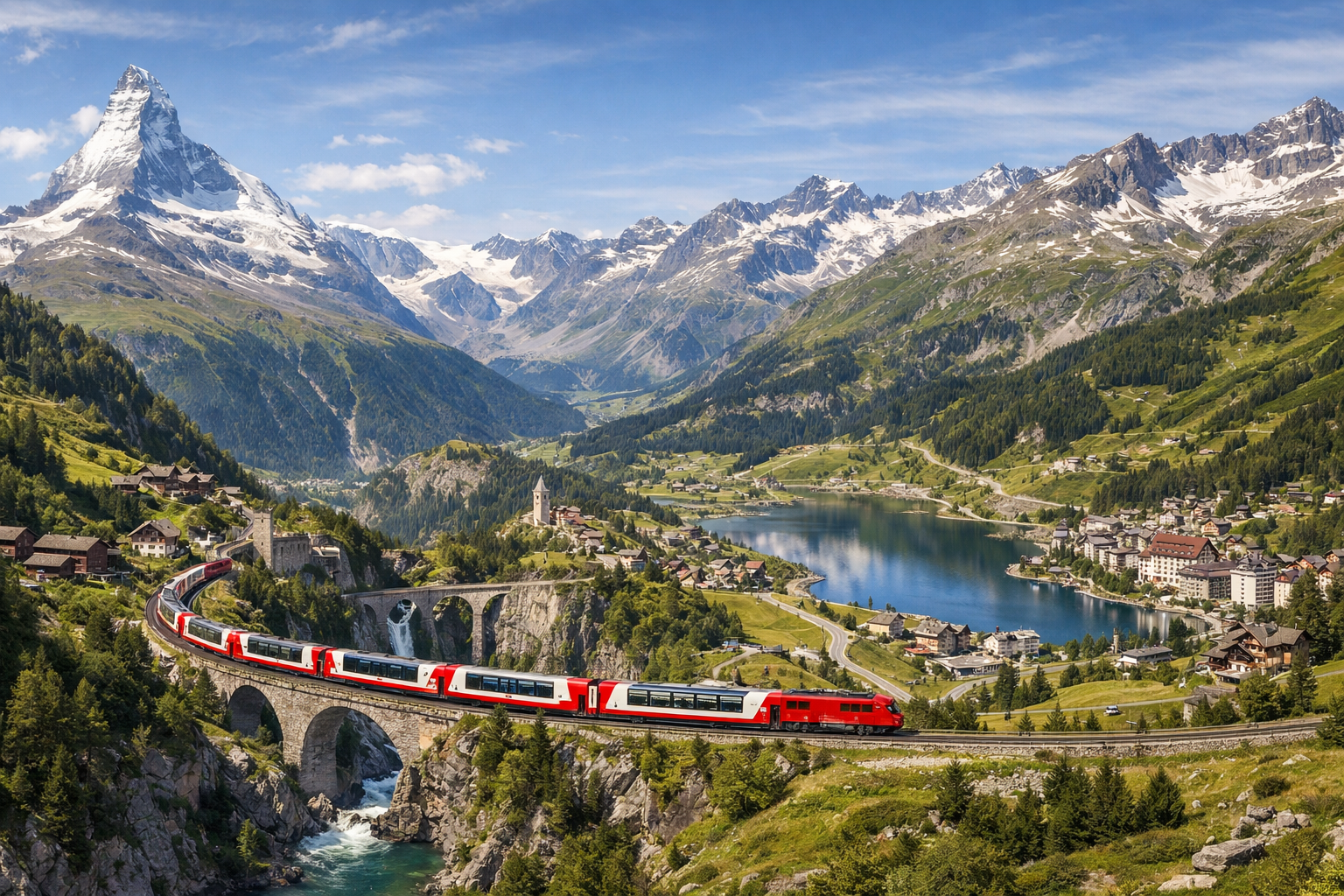
Switzerland. A panoramic journey on the Glacier Express from Zermatt via Brig, Andermatt, and the Oberalp Pass to St. Moritz with views of the Alps, gorges, and mountain villages.

Switzerland. A panoramic journey on the Glacier Express from Zermatt via Brig, Andermatt, and the Oberalp Pass to St. Moritz with views of the Alps, gorges, and mountain villages.

Cross Switzerland in unforgettable style aboard the Glacier Express, from the Matterhorn village of Zermatt to elegant St. Moritz. Along the way, the route winds through Brig and Andermatt, over the Oberalp Pass, and past soaring Alpine peaks, deep gorges, and storybook mountain villages.

🧭 ROUTE BY DAY

Ready-made country and city routes with daily plans, sights, transport and accommodation. Buy PDF guides for independent travel.

🧭 ROUTE BY DAY


Day 1 — Zermatt: arrival in an alpine village at the foot of the Matterhorn

  • 🚆 Arrival logic: the main rail access to Zermatt goes via Visp and Täsch. Zermatt is a resort without regular cars, so the final part of the trip is almost always planned as a train to Zermatt Bahnhof, and then on foot, by hotel electric vehicle, or by local electric taxi to your accommodation. It is best not to plan arrival too late on this day, so you can check in calmly, leave your luggage, and ease into the rhythm of this high-altitude resort without rushing.

  • 🚶 Zermatt is one of those places where the railway does not simply deliver the passenger, but quite literally ushers them onto the theatrical stage of the Alps. The train climbs higher and higher through the valley, the air becomes drier and clearer, and then suddenly the village itself appears: neat chalets, wooden facades, the quiet of streets without regular car traffic, and the sense that the landscape matters more here than anything else. Zermatt lives in dialogue with the Matterhorn, and even if the summit is partly hidden in clouds, its presence is felt in everything — in the panoramas, in the names, in the rhythm of walks, in the evening light on roofs and balconies.

  • 🚶 After checking in, it is best to devote the day to gentle acclimatization and an unhurried first look at the resort. Walk along Bahnhofstrasse and the nearby lanes of Old Zermatt, where modern shopfronts stand beside traditional barns on stone "stilts." Then it is worth visiting the Matterhorn Museum – Zermatlantis: this is not a dry museum stop, but a deep story about the making of Zermatt, the dramatic history of the first ascents, and the harsh logic of life in a high mountain valley. In the evening, it is pleasant to stroll along the Mattervispa River, and if you still have energy, head up to a viewpoint within the village to see how the mountains gradually fade into cold blue tones.

  • 🚆 Practical note before the panoramic journey: Glacier Express requires mandatory seat reservation even if you already have a valid ticket or pass for the route. The most comfortable choice is the morning train from Zermatt toward St. Moritz, so you can travel the full classic daytime panoramic section through Brig, Andermatt, and Oberalp Pass. It makes sense to be at the station 20–30 minutes before departure: to photograph the train, calmly find your carriage, place your hand luggage, and avoid boarding stress.

  • 💤 An overnight stay in Zermatt is especially logical right before the Glacier Express: you start in the morning without extra transfers, do not risk being late because of connections, and can begin the main panoramic day right from the foot of the Matterhorn itself. If you have a lot of luggage, it is better to arrange a short electric shuttle with the hotel in advance or use the luggage storage/deposit at the station. For a large suitcase you do not need on the journey, Switzerland also offers station-to-station luggage shipping, but this must be planned in advance, as delivery between stations takes time.


Day 2 — Glacier Express: Zermatt → Brig → Andermatt → Oberalp Pass → St. Moritz

  • 🚆 The main day of the route: the panoramic journey on the Glacier Express from Zermatt to St. Moritz. Current seasonal trains run via Brig, then through the Upper Valais valley to Andermatt, climb to Oberalp Pass — the highest point of the route at 2,033 m — and then descend through Disentis/Mustér and Chur into the Engadin to St. Moritz. According to the current timetable, the full journey takes about 8 hours, so this is not just a transfer, but a major experience in its own right, and the whole trip is built around it.

  • 🚶 The Zermatt — Brig section sets a dramatic opening: the train gently leaves the resort, passes through the high mountain valley, by villages and slopes where the alpine landscape is still closely tied to the life of small settlements. дальше линия становится всё более «большой» по масштабу, and in Brig the journey seems to unfold more broadly: from here the Glacier Express begins its long arc through the inner Alps, linking completely different cultural and natural regions of the country.

  • 🚶 From Brig to Andermatt, you can especially feel the character of Swiss rail travel: the train does not fly over space, but carefully reads the terrain, following valleys, curves, and climbs. As it approaches Andermatt, the landscape becomes harsher and more austere. Andermatt is the most important alpine railway hub on this route, a place where historic mountain crossings converge and where you understand especially clearly why it was the railway that made such journeys reliable and year-round.

  • 🚶 After Andermatt begins one of the most memorable stretches: the climb to Oberalp Pass. Here the Glacier Express reaches open altitude, where the landscape appears almost graphic — snowfields early in the year, pastures and grey rocky slopes in summer, sharp light, sparse buildings, and the famous lighthouse at the pass, recalling the nearby source of the Rhine. This is the moment when the panoramic windows truly work as part of the performance: your gaze glides along the line of the pass, the paths on the slopes, and the isolated mountain houses that against such a backdrop look almost like toys.

  • 🚶 The train then crosses the country’s linguistic and landscape boundaries. Through Disentis/Mustér and the Chur area, the route gradually changes character: harsh altitude gives way to broader valleys, and then begins a graceful entry into the world of the Rhaetian Railway and the Engadin. The final approach to St. Moritz is not as dramatic as the climb to the pass, but is very beautiful in its own way: lake scenery, a bright high mountain valley, and the special elegance of the resort make the arrival truly ceremonial.

  • 🍽️ Important trip details: Glacier Express requires a seat reservation specifically, and in addition you need a valid ticket for the entire route and your chosen class. It is best to bring water, a light snack, and a phone charger, although food services are available on board. A suitcase is easiest if kept compact: the panoramic train is designed primarily for passenger luggage, not bulky transport. If you plan to take photos, choose your side of the train not for one “perfect” view, but for the overall rhythm of the route — beautiful scenes will appear throughout the whole day.

  • 🚆 It is best to keep your arrival in St. Moritz free of a complicated program. After such an intense railway day, a short walk to the lake, along the central streets of Dorf, or to terraces overlooking the valley is enough. This lets you end the day calmly and leave museums and more substantial walks for the next morning.

Day 3 — St. Moritz: lakeside Engadin and a cultural finale to the route

  • 🚶 St. Moritz is a beautiful ending specifically for a railway journey, because it does not compete with the Glacier Express, but gently completes it. After the dramatic line of passes and gorges, a different mood appears here: clear high mountain light, a lake, elegant facades, old hotels, galleries, sporting history, and the sense that the Alps can be not only severe, but refined. The morning is best started with a walk along the shore of Lake St. Moritz or a short outing to quieter natural corners around forest and water if you want some silence after the long ride.

  • 🚶 The cultural core of the day is conveniently built around the Segantini Museum and the Berry Museum. The Segantini Museum is especially fitting after the Glacier Express route itself: the valleys, light, and pastures seen from the window unexpectedly receive an artistic continuation in the works of Giovanni Segantini, one of the most important singers of alpine light. This is a museum not simply about painting, but about how mountain landscape becomes image and symbol. The Berry Museum, located in Villa Arona, offers a more intimate, almost personal view of the resort’s history through the work and legacy of Peter Robert Berry — an artist and doctor closely connected with the development of St. Moritz.

  • 🚶 If you want to add a walking segment, a great idea is an outing to Lake Staz or a longer walk along Lake St. Moritz with stops at viewpoints. Here the difference between the southern drama of Zermatt and the “society” character of the Engadin is felt especially clearly: the same Alps, but presented in a completely different way — more air, a gentler valley line, more light on the water, and less vertical pressure from the rocks.

  • 🚆 Departure practicalities: St. Moritz remains a full-fledged railway hub for the region, so it makes sense to continue by regular regional and interregional trains via Samedan/Chur or to other parts of the Engadin. If you are leaving the same day for elsewhere in Switzerland, allow at least half a day for museums and walks and build in extra time for boarding, especially in high season. If your route ends here, it makes sense not to hurry and make this day truly final — without overload, with a good lunch and a long look at the lake.

Flight tickets

eSIM for travel

Buy PDF guide

Buy PDF guide — 6.90 USD

PDF — 6.90 USD