
Buy PDF guide

Buy PDF guide — 6.90 USD

PDF — 6.90 USD

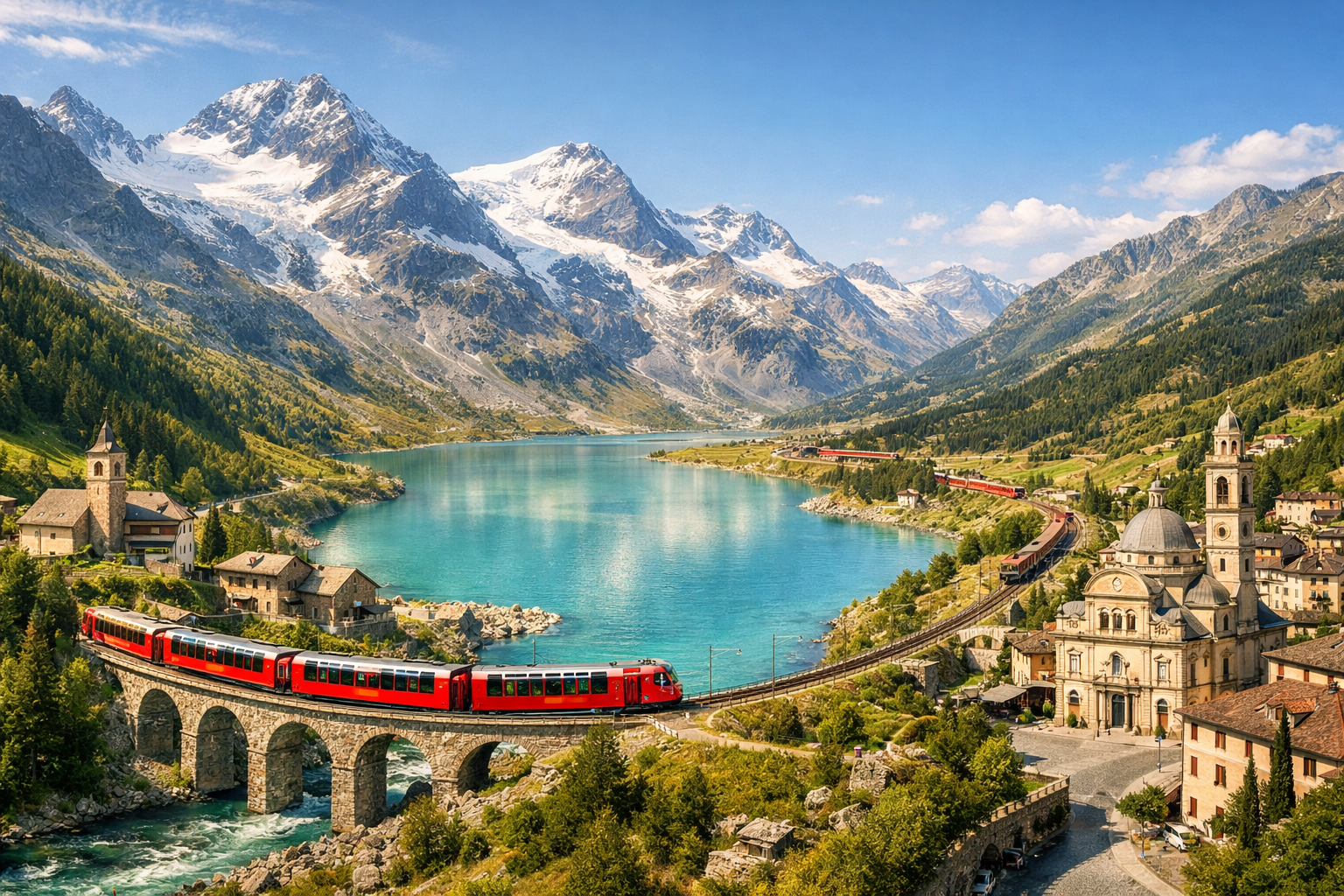
Switzerland — Italy. A journey on the Bernina Express from Chur through St. Moritz, the Bernina Pass, and Lago Bianco to the Italian town of Tirano.

Switzerland — Italy. A journey on the Bernina Express from Chur through St. Moritz, the Bernina Pass, and Lago Bianco to the Italian town of Tirano.

Ride the Bernina Express from alpine Chur through glamorous St. Moritz and over the Bernina Pass, where glaciers and high mountain lakes frame every turn. The journey ends in sunlit Tirano, as Switzerland’s crisp peaks give way to the warmth and charm of Italy.

🧭 DAY-BY-DAY ROUTE

Ready-made country and city routes with daily plans, sights, transport and accommodation. Buy PDF guides for independent travel.

🧭 DAY-BY-DAY ROUTE


Day 1 — Chur: Switzerland’s oldest city and a convenient base before the Bernina Express

  • 🚆 Arrival in Chur — the main starting point for the full Bernina Express route from northern Switzerland. The logic of this trip is very convenient: you spend the night in Chur, and the next day board the panoramic Bernina Express or combine the trip using regular RhB trains through St. Moritz and onward to the Bernina line. Chur works so well as a departure base because one of the Alps’ most famous railways begins here: the route follows the Albula line through tunnels, viaducts, mountain valleys, and gradually lifts you toward the Engadin. If you are taking the panoramic Bernina Express, seat reservation is mandatory; if you choose regular RhB regional trains, mandatory reservation is not required, though on some sections of the Bernina line an optional seat booking may be available. It is best to allow at least 20–30 minutes for boarding, especially if you have large luggage or want time to find the platform and buy a snack for the journey.

  • 🚶 Chur is not just a transfer city, but a very atmospheric place for a slow evening before the great Alpine railway journey. It is often underestimated, even though it is Switzerland’s oldest city, with thousands of years of history and one of the best-preserved old towns in the country. In the center you will find pedestrian streets, arches, pastel façades, old shop signs, small squares, and a sense of calm that is rare for a transport hub. A walk through the historic core to Arcas square is especially pleasant: it feels almost southern, with open space, townhouses, and cafés, and in the evening it becomes especially photogenic. Old Chur is wonderful because it does not demand a race through attractions: it is a place to slip into the rhythm of the trip, switch into an Alpine mood, and go to bed early before the next and most panoramic day of the route.

  • 🏛️ If you still have energy after arrival, you can choose a short cultural program near the center and the station. Bündner Kunstmuseum, in Villa Planta and its modern extension, is one of the most interesting art museums in Graubünden; it suits a calm first day when you do not want to travel far. An alternative is the Bündner Naturmuseum, where you can better understand the region’s nature, geology, wildlife, and the landscapes you will literally be following by rail tomorrow. Both museums combine easily with a walk along Bahnhofstrasse and through the old town.

  • 💤 Overnighting in Chur makes sense not only aesthetically, but also logistically. It reduces the risk of missing an early train and gives you time to check your tickets, reservations, current timetable, and any service changes on the RhB line without rushing. If you plan to travel on the panoramic Bernina Express over the long Chur → Tirano section, keep not only your ticket but also your separate seat reservation confirmation close at hand. On trips like this, luggage is best kept compact: a suitcase you can lift yourself makes boarding and transfers noticeably easier.


Day 2 — Bernina Express: Chur → St. Moritz → Pontresina → Ospizio Bernina → Lago Bianco → Alp Grüm → Poschiavo → Tirano

  • 🚆 The main day of the journey. The classic full scenario is a morning Bernina Express from Chur to Tirano via the Albula line and then the Bernina Line. According to the current published Bernina Express patterns for 2026, one of the main direct panoramic services departs from Chur in the morning at about 08:17 and arrives in Tirano at about 12:49; there is also an afternoon option roughly 13:34 → 18:00. This is a very important point for planning: the train exists as a real direct railway connection, but on different dates and in different seasons the specific train numbers and times may change, so before buying a tour and again on the eve of the trip you absolutely need to recheck the timetable and RhB service notices. If the panoramic service you need is sold out, the reliable backup plan is to travel by RhB regional trains: Chur → St. Moritz, then transfer to a Bernina Line train via Pontresina toward Tirano.

  • 🚆 The Chur → St. Moritz section already feels like a major journey in its own right. The train starts in the valley and gradually draws you into the more dramatic mountain landscape of Graubünden: deep gorges, curves, stone bridges, viaducts, and the sense that the railway is not fighting the mountains but conversing with them. This is exactly the part where RhB’s engineering boldness is felt most strongly: the line does not seem fast, but it gives you the chance to truly look out the window rather than simply move from one place to another. Even if you have seen the Alps before, this transition to the Upper Engadin feels like a gradual change of worlds — from strict Swiss urban order to an open high-mountain space.

  • 🚶 In this route, St. Moritz is not just a prestigious resort but an important railway hub before the climb onto the Bernina line. If you are traveling on the direct Bernina Express from Chur, you will see the town as a key point on the route; if you are traveling with a transfer, the main thing is not to rush and to allow at least 15–20 minutes between trains. The station is convenient, but in high season there can be many tourists with luggage on the platform. If time allows, you can briefly step out toward the lake or into town: St. Moritz combines sunlight, water, thin mountain air, and that special Alpine elegance for which it is known around the world. But on a short tour it is more important not to stretch the stop too much: the true jewel of the day still lies ahead on the Bernina line itself.

  • 🚆 After St. Moritz and Pontresina, the train enters one of Europe’s most famous high-mountain railway sections. Here begins the truly theatrical ascent to the Bernina Pass: the train slowly gains height, passes glacial views, severe slopes, and lakes, and then reaches Ospizio Bernina — one of the most impressive points on the route. This is where Lago Bianco is located, whose pale waters, surrounded by stone, wind, and an almost cosmic high-altitude landscape, create one of the most recognizable images of the entire trip. In good weather the scene feels almost unreal: smooth water, the sharp line of the embankment, a thin thread of tracks, and the feeling that the train is traveling across the roof of the Alps.

  • 🚶 Lago Bianco and the Bernina Pass are the culmination not only geographically, but emotionally as well. Here you can feel especially clearly why the Bernina line is part of UNESCO heritage and why this journey is recommended in any season. In summer this section plays with contrasts of light, water, stone, and patches of snow on the horizon; in winter it becomes an almost graphic composition of whiteness, dark rock, and the red RhB train. On a clear day, views appear one after another in the train windows that are hard to replicate by car: the railway goes exactly through places where it would not be so easy for a person to reach without rails and without a long trek.

  • 🚆 Then begins a completely different act of the spectacle — the descent to Alp Grüm, Poschiavo, and Tirano. The landscape does not change abruptly, but in layers: from severe high mountains to gentler southern slopes, then to the Poschiavo valley, villages, terraces, and finally to the almost Mediterranean mood of the Italian finale. The section near Alp Grüm is especially beautiful, where views of the glacier and valley open wide and almost cinematically. Then the train goes through Poschiavo and Le Prese, and closer to Tirano the railway already lives within the urban fabric and reaches the famous spiral at Brusio, if you are traveling on the appropriate regional train and watching carefully along the route. The final arrival in Tirano feels like a real shift between climates and cultures in just a few hours.

  • 🧳 Practical note for the day: in the panoramic Bernina Express cars, seat reservation is mandatory for all passengers regardless of class, and it is paid separately from the regular ticket. On RhB regional trains along the Bernina line there are no Bernina Express panoramic cars, and the service is simpler, but this allows a more flexible stop-over strategy if you want to spend longer in St. Moritz or at other stations along the route. Large luggage should be placed so that it does not block the aisles; if you have a short transfer in St. Moritz or Pontresina, do not plan complicated maneuvers with several bags. For a comfortable connection between trains, it is wise to allow at least 15 minutes, and on an independent trip 20 minutes or more.

  • 💤 Overnight in Tirano is a logical end to a big railway day. Arrival around midday or in the evening, depending on the service chosen, allows you to check in without rushing, stroll through the historic center, and feel how in a single day you effectively traveled from Switzerland’s oldest city to northern Italy via a pass, lakes, glacial panoramas, and two different cultural zones of the Alps.

Day 3 — Tirano: the Italian finale of the railway route and a calm end to the journey

  • 🚶 Tirano is the perfect finale to the Bernina Express precisely because, after the grandeur of the mountain railway, it does not try to compete with the landscape but gently changes the tone of the journey. This is a small town in Lombardy where Alpine severity has already clearly given way to Italian warmth: different façade colors, a different street rhythm, and a more southern atmosphere in the squares and cafés. After the Swiss part of the route, it is especially pleasant simply to walk from the station into the old center, slowly taking in the journey itself. Here the railway seems to release you from the world of viaducts and passes into a more human scale of streets, churches, and palaces.

  • 🏛️ The city’s main cultural landmark is the Basilica Madonna di Tirano, the region’s most important spiritual and artistic symbol. It is a Renaissance sanctuary connected with the story of an apparition of the Virgin Mary and especially impressive inside: decoration, proportions, carved wood, light, and silence create the feeling that you have arrived not simply at the endpoint of a tourist train, but in a town with its own deep memory. The basilica is very well suited to finishing the route: after a moving day on the train, it offers a completely different, contemplative kind of impression.

  • 🏛️ The second strong stop is Palazzo Salis, a historic palace with frescoes and an Italian garden. This place is especially good at revealing Tirano not as a transit town, but as a historic cultural hub of Valtellina. Inside, you feel the noble intimacy of an old northern Italian aristocratic residence: painted halls, decorative details, and that slightly slowed beauty best appreciated after an early departure and a long railway day. If you want a finale with architecture and atmosphere, Palazzo Salis is one of the best options.

  • 🚆 From a transport point of view, the third day can be left completely free or used as a day for further rail travel through Italy. An important nuance: the Bernina Express route ends in Tirano, but it is not a night train and not a through international service continuing across Italy as part of the same RhB trainset. So any onward journeys must be planned separately and with real connections. If you are leaving Tirano onward, do not allow too short a transfer after arrival of the Bernina Express the previous day, and do not rely on nonexistent direct combinations without checking the timetable.

  • ☕ For a short three-day tour, the best finale is a slow morning in Tirano, a late breakfast, a walk through the center, the basilica, the palace, and a calm departure. At exactly this pace, the journey feels complete: the first day brings you into the rhythm of the Alps in Chur, the second gives you a grand panoramic railway scene through St. Moritz, the Bernina Pass, and Lago Bianco, and the third gently lands you in an Italian valley where the memory of the red train stays with you long after you have stepped off the platform.

Flight tickets

eSIM for travel

Buy PDF guide

Buy PDF guide — 6.90 USD

PDF — 6.90 USD