
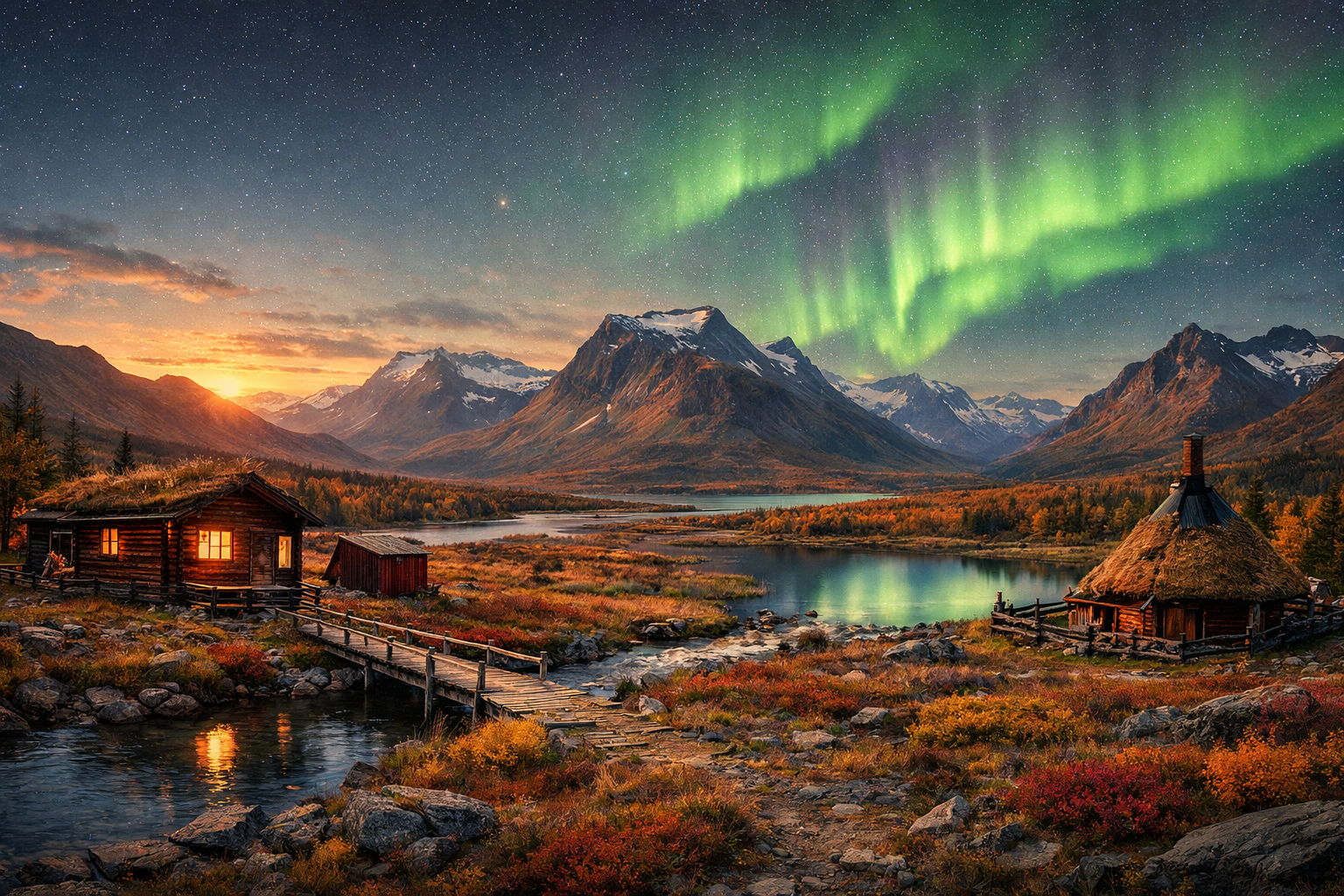
Day 1 — Luleå → Jokkmokk: entering Lapland and preparing for a self-supported trek
✈️ Arrival in Luleå. From the airport, it’s convenient to take a bus to the city center, then transfer to regional transport toward Jokkmokk, or arrange a transfer/taxi in advance. For a route like this, it’s better not to plan things too tightly but to allow a full buffer: northern Sweden runs on the schedule of infrequent flights and long-distance bus legs, and any delay at the start can shift the whole expedition.
🚆 Transfer: Luleå → Jokkmokk, using an airport bus/city bus + intercity bus connection. In reality, the journey usually takes most of the day with a transfer, so this day is kept light on activities and serves as acclimatization. If it works better logistically, renting a car at Luleå Airport is also a valid option: it greatly increases flexibility on the Luleå → Jokkmokk and Saltoluokta/Porjus → Luleå segments.
🌲 Jokkmokk is not just a transit village, but one of the main gateways to Swedish Lapland and a cultural center of the Sámi world. After a long journey, it’s especially pleasant to feel the urban rhythm dissolve: the air becomes drier and colder, the light cleaner, the horizon wider, and the evening in July and August stretches almost endlessly. In July, you can still feel the effect of the white nights and very short darkness, so the route is built primarily around soft Arctic light, mist over the water, and late twilight. In the second half of August and in September, on the contrary, the chances of truly dark skies and possible northern lights are higher, but this is always a matter of probability, depending on cloud cover, moon phase, and geomagnetic activity.
🌌 Use the evening as practically as possible: buy more gas, check the route on offline maps, уточнить forecast weather, wind strength, precipitation levels, and the moon phase for the next 8 days. For this trip, windows around the new moon or a thin waxing/waning moon are ideal: there’s less skyglow, the Milky Way is easier to see, and the chance of noticing faint aurora structures is higher. Under a full moon, the landscapes become more dramatic, but astronomical observing often loses contrast.