
Buy PDF guide

Buy PDF guide — 10.90 USD

PDF — 10.90 USD

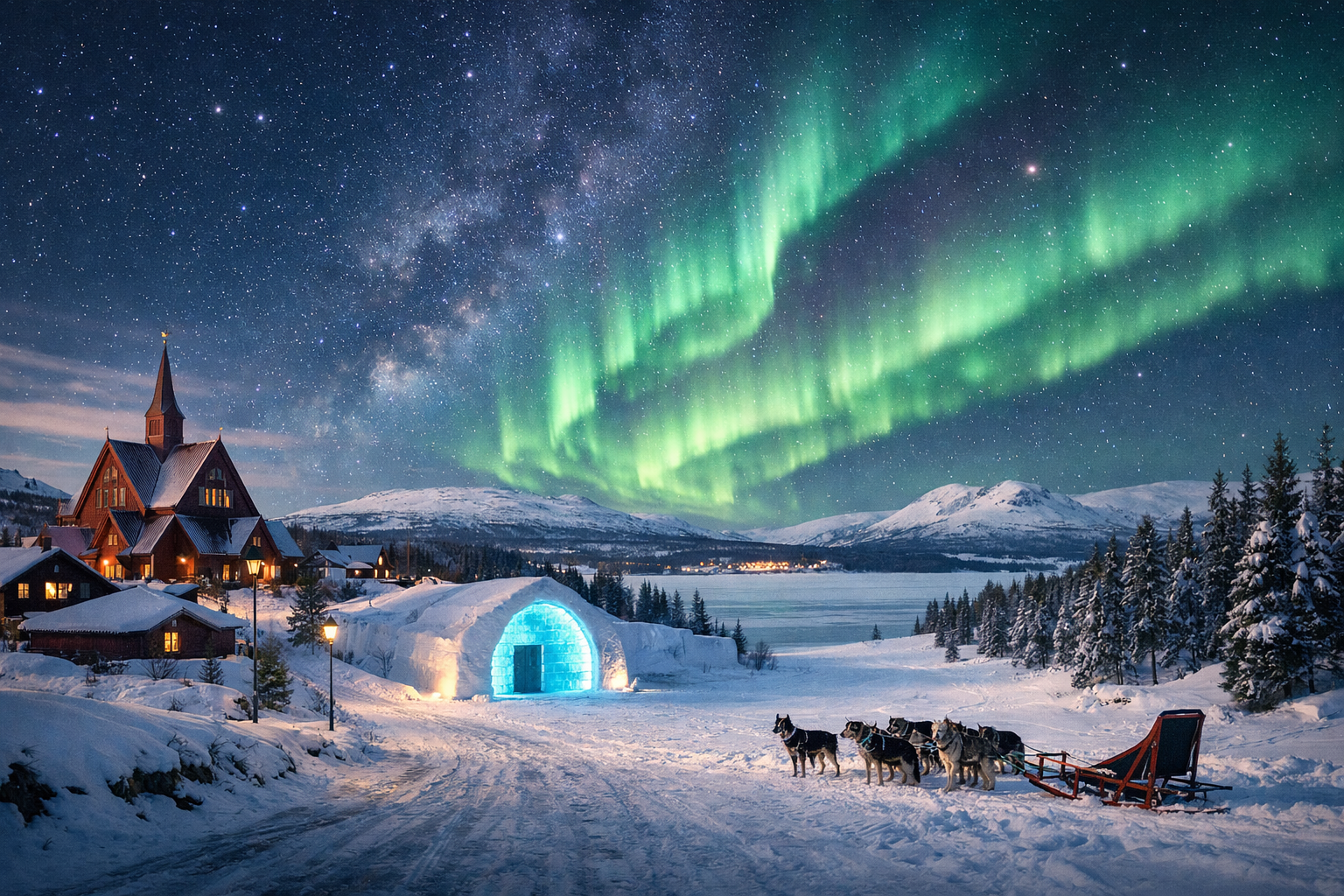
Sweden, Kiruna and Jukkasjärvi. An Arctic route with Northern Lights viewing, stargazing walks, dog sledding, and overnight stays among snowy landscapes.

Sweden, Kiruna and Jukkasjärvi. An Arctic route with Northern Lights viewing, stargazing walks, dog sledding, and overnight stays among snowy landscapes.

Journey through Swedish Lapland from Kiruna to Jukkasjärvi and on to Abisko, where deep winter skies glow with the Northern Lights and stars burn bright above the snow. Ride behind a team of huskies, wander silent Arctic trails, and spend unforgettable nights surrounded by frozen landscapes.

🧭 DAY-BY-DAY ROUTE

Ready-made country and city routes with daily plans, sights, transport and accommodation. Buy PDF guides for independent travel.

🧭 DAY-BY-DAY ROUTE


Day 1 — Kiruna: arrival, adapting to the polar winter, and the first hunt for the sky

  • ✈️ The optimal season for this kind of route is late February and March, as well as the second half of September to early April, when the region is already dark enough for northern lights viewing. For a combination of good snow logistics, dog sledding, and more comfortable daytime outings, March is especially successful: the days get longer, but the nights are still dark enough, and temperatures are often easier to handle than in the depths of the polar winter. If the main goal is specifically dark skies and aurora photography, it is better to plan dates around the new moon or close to it: a bright Moon noticeably reduces sky contrast, although the aurora itself may still be visible during strong activity.

  • 🚍 The transfer from Kiruna Airport to the city takes about 15–20 minutes. The easiest way is the airport bus, which connects with scheduled flights and goes to the center of Kiruna. A taxi is convenient if you arrive late, have a lot of luggage, or need to check in quickly and rest before the evening program.

  • 🏨 It is better to plan your check-in in Kiruna so as not to overload the first day with extra transfers. After a flight, the northern cold feels stronger than usual: dry air, wind, and darkness quickly tire you out. So on the first day, it is sensible to keep only a light daytime walk through the new center, an early dinner, and rest before the evening outing. This pace increases the chances that you will actually enjoy the night rather than struggle with fatigue.

  • 🚶 During the day, it is worth walking around the Kristallen area and the central streets of the new Kiruna. The city is unusual in itself: it is not just a northern center of Lapland, but a place of ongoing urban transformation linked to mining. Even a short walk here creates a special sense of frontier life — around you are modern northern architecture, low winter light, creaking snow, and an almost theatrical silence that by evening gives way to deep Arctic twilight.

  • 🌌 In the evening — the first trip out for the northern lights and the starry sky. The best scenario for the first evening is not to go too far, but to choose an accessible dark spot outside the brightly lit center, for example in the direction of Luossavaara or on open areas beyond dense urban light pollution, but only with a clear road situation and accompanied by a guide or as part of an organized tour. Northern lights viewing is always a matter of probability: even in a very strong region, visibility depends on cloud cover, local clear patches, solar activity, air transparency, and light from the Moon. Sometimes the sky seems empty for hours and then suddenly lights up within minutes.

  • 🧤 For the first night, safety is especially important: layered clothing, insulated boots, chemical hand warmers, a thermos, a headlamp with red light, and the rule of not going alone into unfamiliar snowy areas. Around Kiruna in winter, you should not underestimate ice, wind, snowdrifts, and rapid chilling when standing still for a long time.


Day 2 — Jukkasjärvi: ICEHOTEL, ice architecture, and a night among the snow

  • 🚗 The transfer Kiruna → Jukkasjärvi takes about 20–25 minutes by car or transfer, a distance of around 17 km. It is a short ride, so the day can be planned without rushing: a late breakfast, departure after sunrise, check-in, and getting to know the surroundings.

  • ❄️ Jukkasjärvi is one of the most atmospheric bases for an Arctic route. Here, on the banks of the Torne River, stands the famous ICEHOTEL — at once a hotel, an art space, and a rare example of how climate, ice, and light become part of architecture. Even if you do not stay in an ice room, the visit itself gives a powerful sense of northern winter: dim light, ice sculptures, blue half-shadows, snow corridors, and an almost museum-like silence.

  • ⛪ After visiting ICEHOTEL, it is worth stopping by Jukkasjärvi kyrka — the oldest church in Lapland in this area, wooden, red, and very northern in character. The contrast between the hotel’s icy avant-garde and the old church architecture makes Jukkasjärvi not just a tourist village, but a полноценная cultural stop on the route.

  • 🐕 In the second half of the day, it makes sense to schedule dog sledding. In this area, such programs usually take from 1.5–2 hours up to half a day including briefing and gear. It is here that the Arctic rhythm is felt especially well: dry snow, the dogs’ breathing, the whisper of sled runners, and an almost complete absence of urban sounds. If the ride takes place closer to dusk, it gives a rare sense of transition from silvery daylight into the blue northern night.

  • 🌌 In the evening and at night, Jukkasjärvi is good for sky watching thanks to its calmer setting and lower light pollution than central Kiruna. However, even here the result cannot be guaranteed: the northern lights may be bright, faint, local, or completely hidden by clouds. If the Moon is close to full, what may be more beautiful is not so much the aurora itself as the landscape — illuminated snowy plains, trees, and icy surfaces. At new moon, by contrast, the chances are higher for deep starry skies and more contrasty photographs.

  • 💤 Overnight in Jukkasjärvi is the key emotional highlight of the trip. If you choose a warm room at ICEHOTEL, the route will be more comfortable; if you choose an ice room, the experience will become more extreme and almost ritual-like. In any case, it is useful not to plan late activity after midnight without a warming break: in the Arctic environment, fatigue and cold build up faster than it seems.

Day 3 — Abisko: national park, dry microclimate, and one of the best nights for astronomy

  • 🚆 It is best to plan an early departure Jukkasjärvi/Kiruna → Abisko via Kiruna C, then continue by train or organized transfer toward Abisko. In terms of time, the road usually takes about 1.5–2 hours from Kiruna to Abisko Turiststation, and the whole trip from Jukkasjärvi with a connection takes longer, so after an icy night it is worth allowing for a calm morning and not overloading the schedule.

  • 🏔️ Abisko is the most important point of the entire route for those traveling specifically for the sky. This area is known for drier conditions and a “rain shadow” effect, which often means less cloud cover here than in neighboring Arctic locations. This does not mean clear skies every evening, but statistically the chances for breaks in the clouds are often higher than in wetter places or places more enclosed by terrain.

  • 🥾 During the day, you can devote a few hours to an easy walk on accessible winter trails near STF Abisko Turiststation and the entrance area of Abisko National Park. It is important not to turn this day into a hard trek: the main goal is to save energy for the evening and night. Even a short outing into the national park gives that feeling of vast northern geography — open spaces, mountain outlines, snowfields, and Lake Torneträsk, which in clear weather creates a magnificent horizon line.

  • 🌠 If your trip falls on the dates of an active meteor shower, Abisko is especially good as an observation site: low light pollution and open horizons make even short flashes more noticeable. But meteors, like the aurora, are visible only when several factors come together — clear skies, enough darkness, patience, and luck. Outside the period of known showers, it is still magnificent here simply to watch the winter Milky Way, bright constellations, and the movement of satellites.

  • 🚠 In the evening, you can choose a program in the Aurora Sky Station area, if it operates on your dates and if weather conditions allow the ascent. This is one of the best-known Arctic formats for sky observation: going higher up, getting away from some of the low haze, and gaining a panoramic sense of the night space. But even such a spot does not guarantee the aurora — it only improves the quality of the experience itself if the sky is open.

  • 🌌 This night is the best in the route for a long stargazing session. It is useful to define your personal “cold threshold” in advance: for example, 20–30 minutes of shooting, then mandatory warming up indoors. In Abisko at night, you should not go far from clear trails without navigation and experience: in wind and darkness, orientation is lost faster than expected, and icy patches and crusted snow can be treacherous.

Day 4 — Abisko and surroundings: weather buffer, second aurora night, and snowy landscapes

  • 🧭 The fourth day is deliberately left as a weather buffer — this is a very important logic for chasing natural phenomena. The main mistake of short Arctic trips is building a route without any reserve. If the sky over Abisko was overcast one night, a second night sharply increases your chances of catching clear breaks or at least a short window of clarity.

  • 🏞️ During the day, you can choose a calm program: a photo walk along the shores of Torneträsk, a short snowy route with a guide, observing the low winter light over the mountains, or simply relaxing at the hotel if the previous night was late. On northern trips, rest is not “empty time” but part of the strategy: an overtired traveler is more likely to miss the best hours at night.

  • ☁️ This is exactly the day when it is convenient to monitor the latest forecasts: general cloud cover, local clear-sky windows, wind, temperature, humidity, and geomagnetic conditions. For the northern lights, a high Kp alone does not decide everything: under full cloud cover it will remain hidden, while under a clean sky even moderate activity can produce a beautiful display. So in practice, the combination of space and earthly weather matters more.

  • 🌙 If your route falls during a bright Moon, the fourth day still does not lose its meaning. In moonlight, Arctic landscapes become almost cinematic: the snow begins to glow, the relief is easier to read, and the silhouettes of mountains and trees become more expressive. This is more difficult for astrophotography, but very beautiful for a night walk on a safe route with a guide.

  • ✨ On the second night in Abisko, it is again worth driving or walking out to a dark spot with an open horizon. This night may bring either the long-awaited aurora or a perfect starry sky without it — and both outcomes count as success on a trip like this. No rare phenomena, including the northern lights, meteors, cloud inversions, or especially exotic effects like bioluminescence, can be promised in advance here. Everything depends on nature, not on a schedule.

  • 🛑 In and around the national park, be sure to follow official restrictions, do not go onto closed sections, and do not go out onto the ice without confirmed local information. Before any night outing, you need to check trail conditions, wind, and the host’s recommendations.

Day 5 — Return to Kiruna: a cultural finale and departure

  • 🚆 The morning transfer Abisko → Kiruna usually takes about 1.5–2 hours by train or transfer. For your return flight, it is better not to schedule too tight a connection: in winter in the north, delays due to weather, road conditions, or operational changes are more common than on southern routes.

  • 🏛️ If time allows, it is good to add one short city stop in Kiruna before departure. For example, the Kin Museum in the Kristallen building provides a modern cultural accent and helps end the trip not only with nature, but also with northern art. An alternative is an exterior visit to Kiruna kyrka, one of the region’s most recognizable buildings, if the schedule and access allow.

  • ⛏️ Another option for a daytime window is a pre-booked Mine Tour, which starts from the tourist center in Kiruna and leads to the LKAB Visitor Centre. This is no longer about the sky, but about understanding why this northern city is arranged the way it is. But such a visit is worth taking only if your return flight is late and you have enough time without stress.

  • 🌌 Even on departure day, nature should not be written off: if your flight is in the evening and the sky unexpectedly clears, a final short stop at a viewpoint outside the center may give you the last shots of the Arctic sky. But it is better to treat this as a bonus, not as an обязательный finale.

  • 📌 The overall strategy of the route is simple: 5 days in a compact Arctic region with two nights aimed at maximizing the chances for aurora and starry skies, one emotional overnight stay among snowy landscapes, and a sensible weather buffer. Before the trip, be sure to check fresh forecasts, the Moon phase, geomagnetic conditions, the operation of lifts and tours, road conditions, national park rules, and possible weather restrictions. Neither the northern lights, nor meteors, nor clear skies, nor any other natural phenomena can be guaranteed in advance.

Flight tickets

eSIM for travel

Buy PDF guide

Buy PDF guide — 10.90 USD

PDF — 10.90 USD