
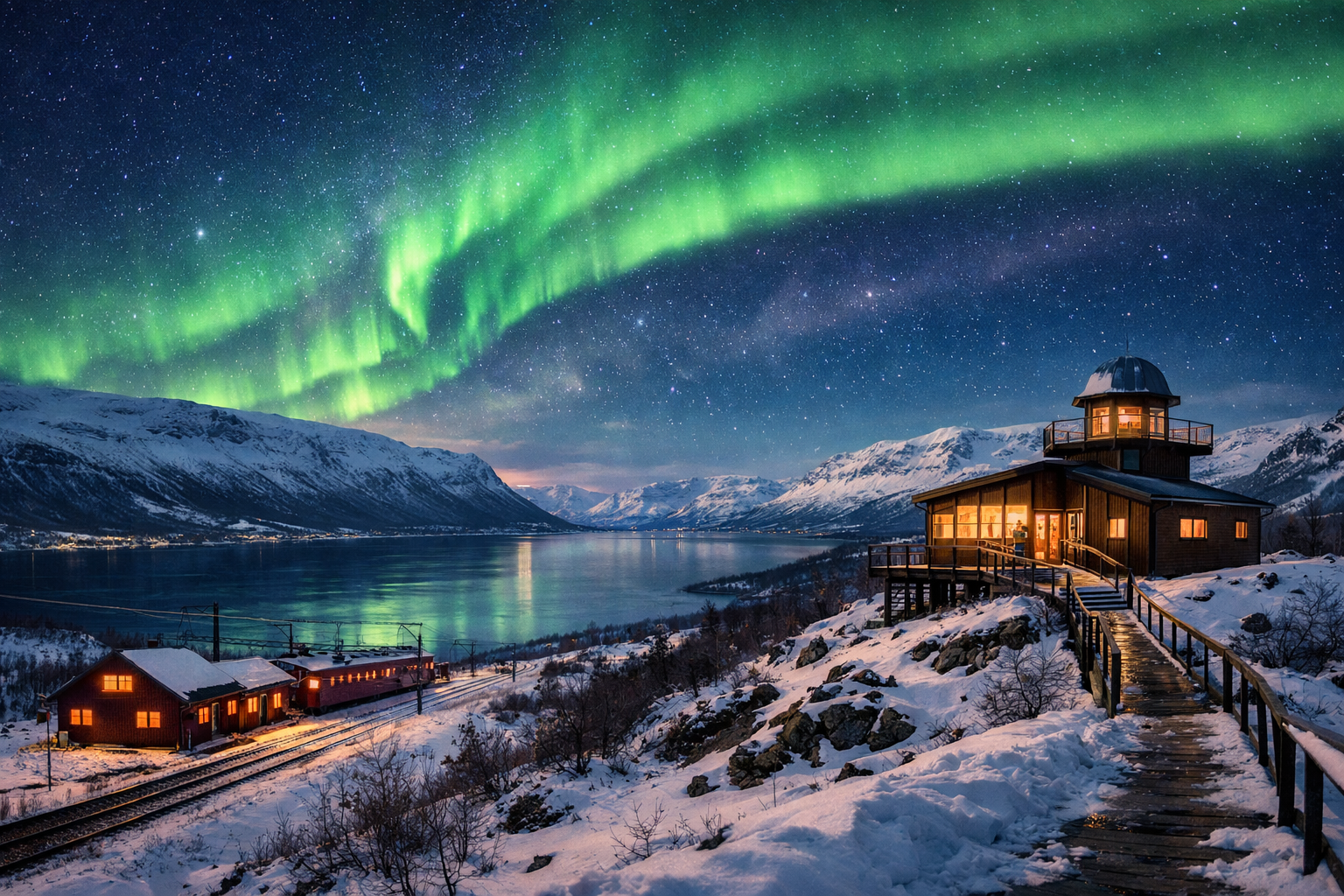
Day 1 — Kiruna → Abisko: entering Arctic silence
🚆/🚌 Arrival via Kiruna and transfer to Abisko. The most realistic logistics for such a short route are to fly into Kiruna Airport and then continue to Abisko by bus, transfer, taxi, or rental car. Via the E10 road, it is about 100 km to the northwest; the bus from the Kiruna transport hub to Abisko Turiststation usually takes around 1 hr 15 min, while train and car transfer options require checking the schedule for your exact date. Plan to arrive in the first half of the day so you can check in calmly, adapt to the polar climate, and not begin nighttime sky watching exhausted.
🏔️ After check-in, devote the day to a gentle introduction to the place: Abisko does not impress with noisy attractions, its strength lies in the feeling of space. Here the fells, the valley, the dark line of conifer forest, and the vast Lake Torneträsk create that rare northern landscape where even daylight feels cinematic. The most important thing for a journey focused on aurora and stars is the local reputation as one of the best Arctic observation areas thanks to dry air, stable winter cold, and the famous “Blue Hole of Abisko,” when the sky above the area is often clearer than above the neighboring mountains.
🚶 In the second half of the day, take a walk to Naturum Abisko and around the tourist station. This is the best start for understanding the terrain, wind directions, proximity of trails, possible nighttime outings, and the rules of behavior in the national park. It is important right away to assess where the lit areas are, where the darker zone begins, how much time is needed to return, and what the trail looks like in twilight or snowfall.
🌌 In the evening, go on your first sky hunt in a “no overload” format. Do not rush into a long outing right away: after the journey, it is better to do a short trial observation near STF Abisko Turiststation or at a safe dark spot within walking distance. If the sky is clear, you may see a rich field of stars, the Milky Way in the dark season, and, with a lucky combination of geomagnetic activity and cloud cover, the northern lights. But they cannot be guaranteed: even in Abisko, the result is always probabilistic and depends on solar activity, atmospheric conditions, clouds, haze over the lake, and the phase of the Moon. For the best chance, choose dates closer to the new moon or at least avoid the brightest moonlit nights.
🧣 First-night safety practice: layered clothing, spare mittens, a thermos, a headlamp with a red mode, a fully charged phone, an offline map, and the rule “do not go far from base alone without experience.” In the national park in winter, darkness falls quickly, and distances in snow are deceptive. This trip is built around natural phenomena, which means rest and energy management are just as important as the observation itself.