
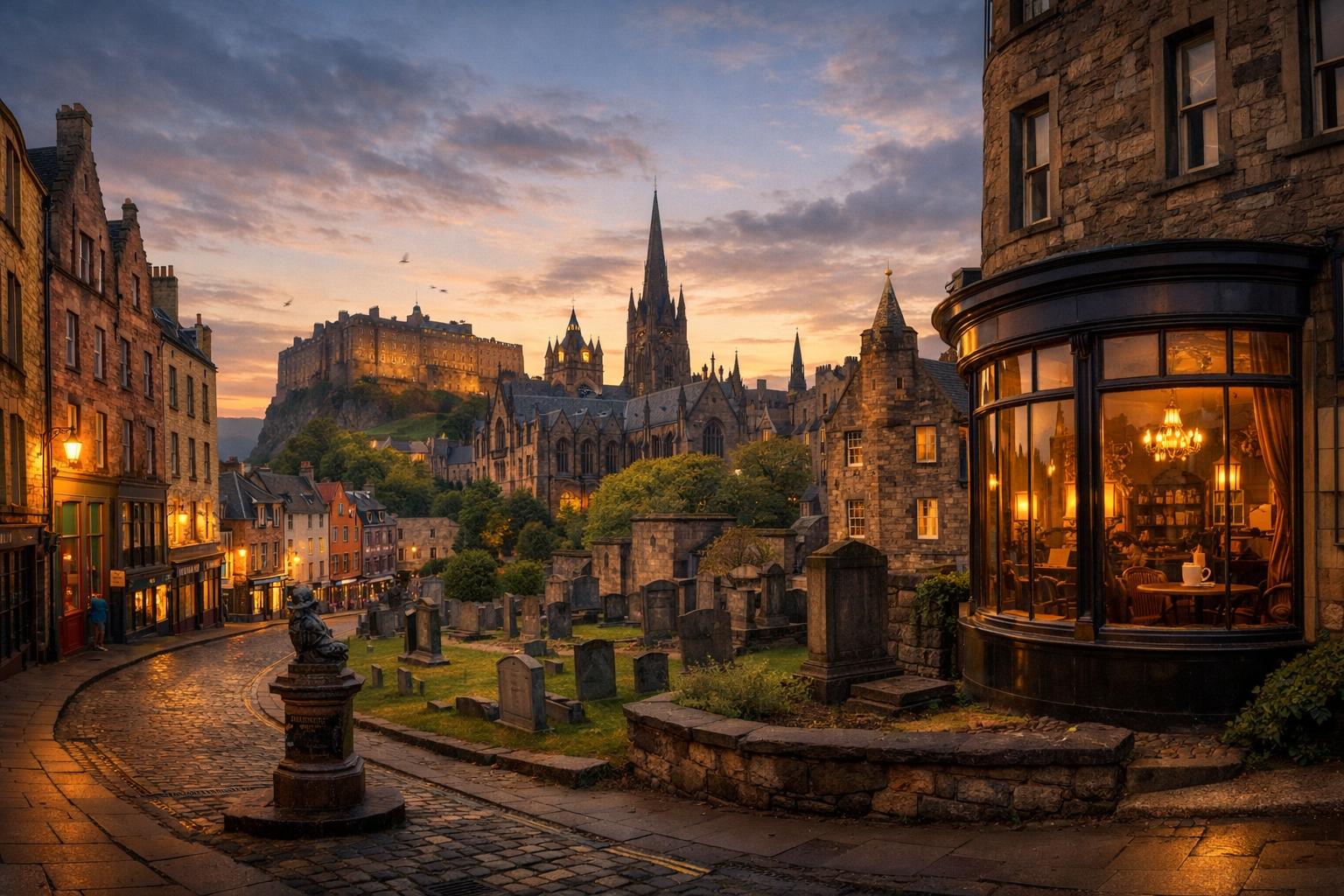
Day 1 — Edinburgh: Old Town, Victoria Street, Greyfriars, and cafés connected with the creation of the Harry Potter world
🚶 This day is designed as a very easy walking stroll through the compact core of Edinburgh’s Old Town, where almost all points are within 5–20 minutes of each other. It is important to set expectations right away: Edinburgh itself does not have confirmed Harry Potter film shooting locations in the sense of studio sets or on-screen façades. The main thing here is not “places from the frame,” but real urban spaces that official tourism projects and themed tours connect with the history of the books’ creation, the mood of the wizarding world, and certain visual associations. So the route honestly distinguishes between literary inspiration, an official tour context, and a popular but unconfirmed legend.
🚶 Start your morning on George IV Bridge, in an area where it is easy to cover several key points right away. The first stop is The Elephant House, 21 George IV Bridge, Edinburgh EH1 1EN. This is one of the city’s most famous “Potter” places: the café has firmly entered fans’ cultural memory as a spot connected with J. K. Rowling’s early working period. Even if you are not planning a long break, it is worth coming here at least for the context: the view over the old city, the proximity to the university quarter, and the stone architecture around it help you feel that distinctly Edinburgh backdrop against which literary imagination easily turns into a whole world. Before visiting, be sure to check current opening hours and access format, because schedules at popular central places can change.
🚶 From here, it is an easy 3–5 minute walk to Greyfriars Kirkyard, address: 26A Candlemaker Row, Edinburgh EH1 2QE. This is one of the most important points of the whole route and probably the most atmospheric place in Potter-themed Edinburgh. The cemetery is accessible around the clock, but it is better to come during the day, when inscriptions are easier to read, paths are safer, and the impression feels not gloomy but rather cinematic. This is where fans look for surnames and names resembling those of the series’ characters, including Riddell/Riddle and McGonagall. But it is crucial to understand the difference: this is not a film set and not a confirmed shooting location, but a real historic site that official tourism resources connect more with atmosphere and possible naming inspiration. Walk the grounds respectfully: this is not an attraction, but an active historic cemetery and memorial space.
🚶 Nearby are Greyfriars Bobby and the whole Candlemaker Row area — a convenient place for a short stop and photos. From here, you can make a gentle loop through Grassmarket and climb up to Victoria Street. The transition takes about 8–10 minutes at an unhurried pace. This is exactly the street that often creates the strongest visual association for travelers with Diagon Alley: a curved line of façades, bright shopfronts, changes in level, old stone, and the feeling that behind one of the doors there really could be a shop selling quills, maps, old folios, or strange artifacts.
🚶 Victoria Street is probably the most photogenic part of the whole route. However, here again it is important to separate legend from fact: the street is not a confirmed shooting location for the Harry Potter films and is not presented as an official on-screen franchise site. Its value lies elsewhere — in the enduring cultural association and in the fact that official Edinburgh tourist guides explicitly include it in Potter walks as a place with a very strong mood. Walk along the lower level, then go up to Victoria Terrace to look at the curve of the street from above. It is reasonable to allow 45–60 minutes for an unhurried look around, photos, and visits to themed shops.
🚶 On Victoria Street, it is worth stepping into Museum Context, a themed shop at 40 Victoria Street, Edinburgh EH1 2JW. This is not a museum in the academic sense and not an official Warner Bros. venue, but it is one of the best-known specialized spots for fans of magical aesthetics in the Old Town. It is enjoyable not only for buying souvenirs, but also for observing how the street itself works as a theatrical set for literary imagination. If you want to keep the route strictly within confirmed facts, treat this place precisely as a themed shop, not as a “film site.”
🚶 After Victoria Street, walk to Lawnmarket and Lady Stair’s Close — about 7–10 minutes on foot at a calm pace. Here you will find the Writers’ Museum, Lady Stair’s House, Lady Stairs Close, Lawnmarket, Edinburgh EH1 2PA. Although the museum is not directly dedicated to Harry Potter, it works perfectly as a contextual stop in a journey through literary Edinburgh: the city is understood not only as the backdrop for one famous series, but as a centuries-old capital of words, manuscripts, storytellers, and writers. In the inner courtyard, the connection between Edinburgh and literary tradition in general is felt especially well — and this helps explain why the theme of books and the author’s world feels so organic here.
🚶 End the day in the Nicolson Street area, about a 15–20 minute walk from Lawnmarket through the Old Town. Here is Spoon, 6a Nicolson Street, Edinburgh EH8 9DH — another important place that official tours and tourist descriptions connect with the early period of writing the first book. This is not a “movie” location, but a literary place of memory. Unlike the dramatic views of Victoria Street, Spoon feels more grounded and intimate: not a mythical façade, but a very real city address where it is especially easy to imagine the writing process — drafts, cups of coffee, street noise outside the window, and the gradual birth of a world. You can plan 60–90 minutes here for dinner and rest, then return to your hotel on foot or by a short taxi ride if you do not want to climb the hills.