
Buy PDF guide

Buy PDF guide — 6.43 USD

PDF — 6.43 USD

SCHLESWIG-HOLSTEIN - Wadden Sea National Park

SCHLESWIG-HOLSTEIN - Wadden Sea National Park

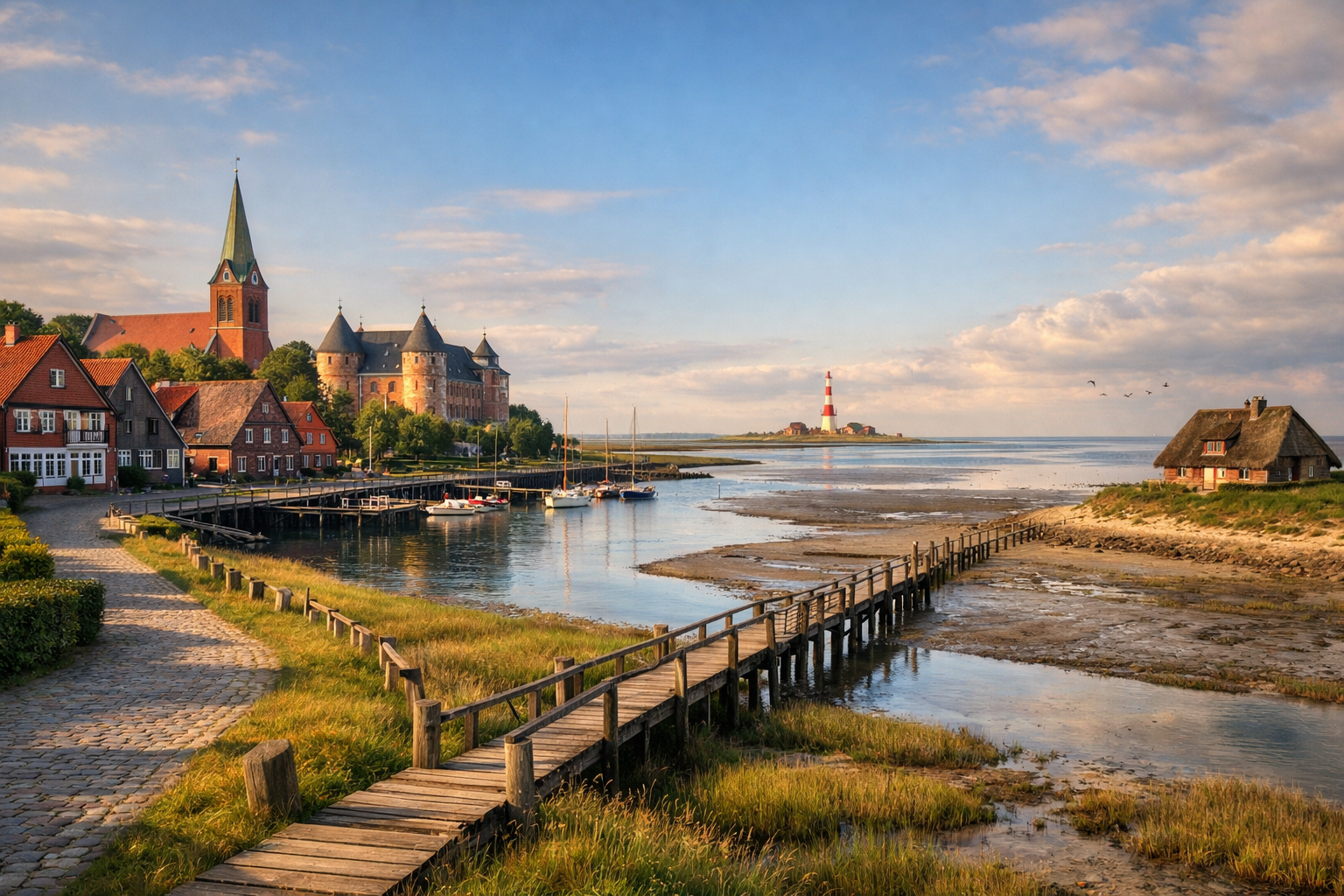
Discover Schleswig-Holstein’s Wadden Sea National Park, where wide tidal flats, salt marshes, and endless skies create a landscape unlike anywhere else. From the harbor charm of Husum and Tönning to the dunes of St. Peter-Ording and the iconic lighthouse at Westerhever, this stretch of coast feels wild, peaceful, and beautifully open.

🧭 DAY-BY-DAY ROUTE

Ready-made country and city routes with daily plans, sights, transport and accommodation. Buy PDF guides for independent travel.

🧭 DAY-BY-DAY ROUTE


Day 1 — Husum and Tönning: getting acquainted with the Wadden Sea

  • 🚆 A logical starting point for the route is Husum, which is easy to reach by train from Hamburg. From Husum station to the town center is a short walk, and from there the route unfolds easily without rushing: first the old harbor, then Nationalpark-Haus Husum, after which you can continue exploring the North Frisian coast through local museums and atmospheric streets. Husum is often called the “gray town by the sea,” but this is not gloominess, rather a special poetry of northern light: low skies, brick facades, a harbor with masts, and a calm rhythm of life create a rare sense of openness and inner quiet here.

  • 🚶 Start the day with a walk along the Binnenhafen in Husum and a visit to Nationalpark-Haus Husum. This is not just an info center, but a very good entry point into the theme of the Wadden Sea: it explains in clear language what makes this landscape unique, how its inhabitants live, and why the tides shape an entire universe of mud, salt, birds, and shallow waters. After that, the town feels different: you are no longer just looking at the northern coast, you understand that you are beside one of Europe’s most important natural complexes.

  • 🏛️ If you want to add a cultural layer, stop by Storm-Haus and Nordfriesland Museum.Nissenhaus. The first helps you feel the literary soul of Husum and better understand the mood of this land, while the second shows the struggle between people and the sea, storms, and the harsh coastal environment. This combination — nature, history, and literature — works surprisingly well именно here.

  • 🚆 Transfer: Husum → Tönning by regional train on the line toward Bad St. Peter-Ording, usually about 20–25 minutes without complicated transfers.

  • 🚶 In the evening — Tönning and Multimar Wattforum, the main visitor center of the Schleswig-Holstein Wadden Sea National Park. Even if you have seen marine museums before, the scale of the theme here is impressive: huge aquariums, interactive zones, stories about whales, birds, tides, salt marshes, and the microworld of the mudflats. This place works especially well on the first day of the route because it sets the context for all the outings that follow. Tönning itself is also very cozy: a small port town with a historic waterfront, brick houses, and calm water by the piers feels intimate and almost cinematic. The evening here is best finished with an unhurried walk along the harbor and an early rest, so that the next day you can head out to the open coast without fatigue.


Day 2 — St. Peter-Ording: beach, dunes, and the salty air of the North Sea

  • 🚆 Transfer: Tönning → Bad St. Peter-Ording by regional train, usually about 20–25 minutes; from the station it is easy to walk to the main points in the Bad area or take a local bus/taxi.

  • 🚶 St. Peter-Ording has a completely different coastal rhythm: not the intimate feel of a port, but the broad breathing of open space. Its beach is famous for its almost unbelievable width, long wooden boardwalks, and iconic stilt houses that stand between sky, sand, and wind as a symbol of the whole northern German Baltic and North Sea coast — only here everything feels even harsher, freer, and more spacious. When you walk along the boardwalk toward the water, it seems as if the shoreline keeps retreating farther away, and the horizon becomes an attraction in its own right.

  • 🚶 The main value of the day is not trying to “tick off” as many spots as possible, but to experience the landscape. It is best to go out to the beach early in the morning, while the light is soft, the wind fresh, and the dunes and sand flats look especially graphic. Here you can really feel the nature of the tidal zone: far-reaching shallows, wet sand, salt-marsh areas, and the sharp shifts in the mood of the sky. If the weather is kind, the walk feels almost meditative; if the northern wind and clouds roll in, the place becomes dramatic and especially photogenic.

  • 🦭 In the second half of the day, you can add Westküstenpark & Robbarium. This is a good stop for those who want to see the region’s fauna not only in the wild, but also in a more interpreted format. In addition, the park is conveniently located and does not overload the logistics. If you want the day to feel as natural as possible, it is better to choose an organized guided walk on the mudflats: in this region such outings are especially valuable, because the Wadden Sea is beautiful precisely as a living, changing environment, not just as a beach.

  • 💤 It is important not to overload the day: after a long beach walk, wind, and salty air, your energy goes faster than it seems. So it is better to leave the evening for a calm dinner and a short walk around the Bad or Ording area. Staying overnight in St. Peter-Ording is fully justified here: there is no need to return late, you can sleep well, and in the morning head to the most photogenic point of the route — the Westerheversand lighthouse — without rushing.

Day 3 — Westerhever and Katinger Watt: landscapes, lighthouse, and a gentle finale to the route

  • 🚌 Dedicate the morning to heading toward Westerhever. From St. Peter-Ording, people usually get there by bus, seasonal excursion transport, or taxi; a route via local travel around Eiderstedt followed by a walk to the lighthouse is also popular. Travel time depends on the specific connection, but for the journey, waiting time, and the walk to the spot itself, it is best to allow at least 1.5–2 hours each way including transfers and the walking section if you are traveling without a car.

  • 🚶 The Westerheversand lighthouse is one of the most iconic images of the entire Schleswig-Holstein coast. But in person, what impresses most is not the lighthouse itself, but its surroundings: a long path through the salt marshes, open sky, damp wind, birds above the grasses, and the feeling that people here are only guests in a world of tide, light, and horizontality. The white-and-red tower rises from the flat landscape almost like a mirage, and it is precisely the walk to it that makes this place special. On a good day, you will want to stay longer, simply watching the colors of the grass, clouds, and water change.

  • 🌿 After Westerhever, it is good to make a calmer, more contemplative stop in the Katinger Watt area at NABU Naturzentrum Katinger Watt. This is a wonderful final note for the route: less “postcard beauty,” but more observation of how a restored and protected natural area lives its own life. What matters most here are the silence, the viewing points, the birds, and the sense that the national park is not a set of separate sights, but an entire fragile ecosystem.

  • 🚆 It is easiest to plan the return via Tönning or Husum, depending on your next destination. If you are leaving for Hamburg the same day, it is wise to leave at least a 45–60 minute buffer between the local return from the coast and your long-distance train: on the North Sea coast, it is better not to build a schedule too tightly, because wind, waiting for the bus, walking sections, and the temptation to linger by the view almost always add time.

  • ✨ This three-day route is good because it does not try to embrace all of northern Germany. It focuses on what matters most: understanding the Wadden Sea not only as a beautiful shore, but as a living, pulsing world of tides, birds, salt marshes, port towns, and huge beaches. In three days, you manage not to just “tick off points,” but to truly tune in to the northern landscape — austere, honest, and surprisingly cleansing.

Flight tickets

eSIM for travel

Buy PDF guide

Buy PDF guide — 6.43 USD

PDF — 6.43 USD