
Buy PDF guide

Buy PDF guide — 10.90 USD

PDF — 10.90 USD

SCHLESWIG-HOLSTEIN - Route through the Baltic resorts of Schleswig-Holstein

SCHLESWIG-HOLSTEIN - Route through the Baltic resorts of Schleswig-Holstein

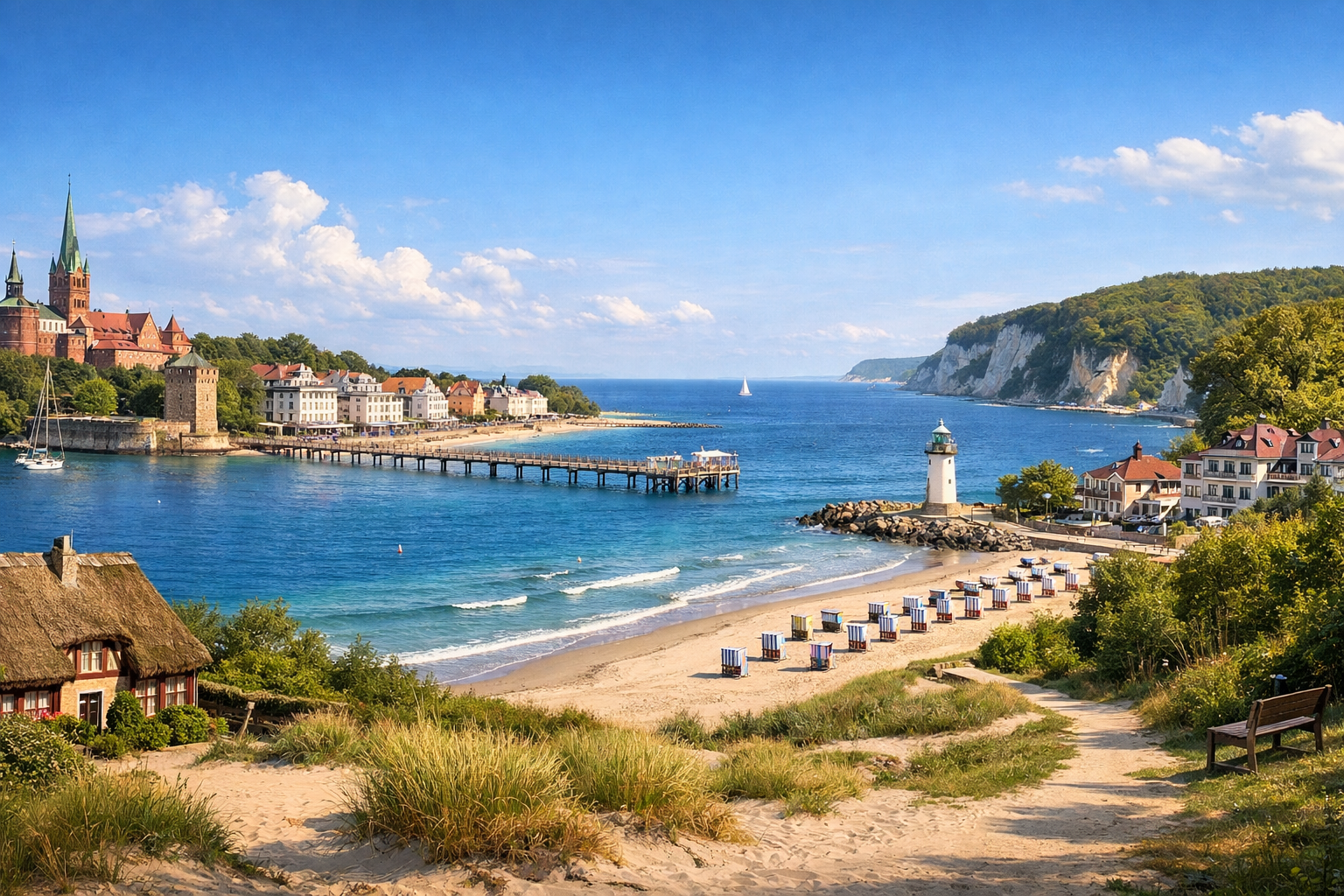
Follow Schleswig-Holstein’s Baltic coast through elegant seaside resorts, from Travemünde and Scharbeutz to Timmendorfer Strand, Grömitz, and Heiligenhafen. Expect long sandy beaches, breezy promenades, and a relaxed maritime charm all along the way.

🧭 DAY-BY-DAY ROUTE

Ready-made country and city routes with daily plans, sights, transport and accommodation. Buy PDF guides for independent travel.

🧭 DAY-BY-DAY ROUTE


Day 1 — Travemünde: a seaside resort with a lighthouse, ferries, and old spa-town elegance

  • 🚶 Travemünde is one of the most atmospheric Baltic resorts in northern Germany, where old maritime history can be felt in almost every gust of wind. Formally, it is a district of Lübeck, but in character it lives its own resort life: broad sandy beaches, promenades, a harbor with yachts, large ferries crossing the Baltic, and that very feeling of a “northern holiday,” where everything revolves around the sea, light, and an unhurried rhythm. It is especially beautiful to begin the route from the promenade and the area by the mouth of the Trave: here you can watch historic facades, beach basket chairs, fishing boats, and huge ships entering the port all coexist side by side. Travemünde has a rare combination of resort relaxation and genuine port drama: this is not a decorative seaside town, but a truly living coast.

  • 🚶 Be sure to set aside time for a walk to the old lighthouse and along the seafront. It’s pleasant not to rush here: sit on a bench, have a coffee overlooking the Baltic, watch the ferry traffic, and then move on to the quieter stretches of the coast. If you want to add a more cinematic feel to the route, head to Priwall and the new BeachBay areas: the contrast between the historic resort and the modern wood-and-glass architecture makes the location especially striking. For one day, 5–7 hours with breaks for lunch and rest by the water is enough.

  • 🚆 If you arrive via Hamburg, allow about 2–2.5 hours to get to Travemünde with a transfer via Lübeck and/or regional trains. Via Lübeck Airport the journey is shorter, but it’s worth checking flight schedules in advance. It’s best not to overload the first half of the day, so you can keep a gentle start and check in without stress.


Day 2 — Scharbeutz and Timmendorfer Strand: promenade, pier, classic resort atmosphere, and an evening by the sea

  • 🚆 Transfer: Travemünde → Scharbeutz by car or taxi usually takes about 25–35 minutes; by public transport via coastal lines and transfers it is more often 45–70 minutes depending on the season and connections.

  • 🚶 Scharbeutz is a very “open” and photogenic Baltic resort: a long promenade, pale sand, modern coastal development, restaurants with terraces, and the feeling of a light, festive holiday. The main symbol of the resort is the Seebrücke pier, stretching out into the water and offering that wide sea horizon that draws visitors here in the first place. In clear weather it is especially beautiful in the morning and in the pre-sunset light, when the promenade fills with a soft golden glow and the sea appears almost silvery. This is a great place not for racing between sights, but for a beautiful walk, a leisurely swim, time on the beach, and lunch with a view of the Baltic.

  • 🚶 In the second half of the day, it makes sense to move on to Timmendorfer Strand — one of the best-known resorts on Lübeck Bay. It has a different character: a little more classic spa-town respectability, boutiques, well-kept avenues, and the feeling of an “old-school seaside resort” adapted for modern holidays. It is pleasant to stroll along Strandallee and Kurpromenade, head down to the sea, take in the famous rhythm of the resort, and stay until evening. If you don’t want to rush, it’s best on this day to keep to the beach area of Timmendorfer Strand, leaving museums and parks for the next day. For Scharbeutz and Timmendorfer Strand together, it is sensible to allow a full day with several long breaks: around 8–10 hours with time to relax.

Day 3 — Timmendorfer Strand and Niendorf: SEA LIFE, Vogelpark, and the resort’s quieter maritime side

  • 🚶 This day is best devoted to a more substantial introduction to the resort. Start with SEA LIFE Timmendorfer Strand on Kurpromenade — a convenient family-friendly and all-weather stop on the route right by the sea. Inside, the focus is on the underwater world and a lively, engaging introduction to marine life: this kind of visit works very well as a calm morning start, especially if the coast is windy or cool. For the visit, it is usually convenient to allow 1.5–2 hours without rushing.

  • 🚶 After that, it is worth heading toward Niendorf — a calmer, more natural part of the municipality. The atmosphere here is different: less glossy resort style, more air, greenery, and a sense of steady seaside life. Vogelpark Niendorf is a good choice for those who love not only the sea but also quiet walks among greenery. Afterward, you can stroll to Niendorf harbor, look at the fishing and leisure marina, then head to the beach and end the day with a long walk along the water.

  • 🚶 Overall, the day feels very well balanced: a little “interactive” sightseeing, a little nature, a little harbor, and a large block of time for relaxation. This is a good point in the route when you no longer need to keep moving all the time and can simply feel the rhythm of a Baltic resort: cool salty air, cyclists on the promenade, seagulls, wooden boardwalks, beach basket chairs, and a very northern style of holiday that is tidy yet cozy.

Day 4 — Grömitz: a long promenade, a pier over the Baltic, and a resort day without rush

  • 🚆 Transfer: Timmendorfer Strand → Grömitz by car usually takes about 45–55 minutes. By public transport the journey is noticeably longer — more often around 1h 30m–2h 10m, so for a short 5-day route, a car or taxi saves a lot of energy here.

  • 🚶 Grömitz is one of the most popular seaside resorts on the eastern part of the Schleswig-Holstein coast, and its main strength is that it is very coherently designed for relaxation. Here you have a long, broad promenade, a beautiful seafront, a pier extending into the Baltic, and a setting that quite literally invites you to slow down. Unlike the more “urban” resorts of Lübeck Bay, Grömitz feels like a pause-resort: people come here not so much for a packed program as for the air, the beach, walks, and the feeling of a holiday without overload.

  • 🚶 The best plan for the day is, after checking in, to walk along Strandallee, head out onto Seebrücke Grömitz, sit by the water, and not be afraid to leave empty spaces in the schedule for rest. If you want to add a more substantial stop, you can choose either Zoo Arche Noah or a short trip to Cismar for Haus der Natur and the area of the former monastery. But it’s not worth overloading the day: Grömitz is especially good at a slow pace, when there is room between places for coffee, ice cream, a deckchair, reading in the wind, and simple contemplation of the sea.

Day 5 — Heiligenhafen: harbor, promenades, Heimatmuseum, and a route finale on the eastern coast

  • 🚆 Transfer: Grömitz → Heiligenhafen by car usually takes about 35–45 minutes. By public transport — more often 1h 20m–2h with transfers, so on the final day it’s better to leave earlier.

  • 🚶 Heiligenhafen offers a slightly different Baltic landscape: less of the classic resort “showcase,” more of the feeling of a real northern seaside town tied to its harbor, sea wind, and open horizon. Here the transition from strolling resort to living port landscape is felt especially clearly. The old center, the bay, waterside walking areas, and sea views create a very cohesive finale to the trip: the route seems to move gradually farther east, into broader and windier Baltic spaces.

  • 🚶 Start with the promenade and harbor, then visit Heimatmuseum Heiligenhafen — a compact but substantial museum that helps you see the city’s real biography behind the resort shell: fishing, maritime trade, bathing culture, and local history. After the museum, it is especially pleasant to return to the water once more: walk along the promenade, have lunch with a view of the marina, and leave the final hours not for ticking boxes but for a calm end to the trip. It is a good ending to the route: not noisy, not hurried, but composed and very northern in mood.

Flight tickets

eSIM for travel

Buy PDF guide

Buy PDF guide — 10.90 USD

PDF — 10.90 USD