
Buy PDF guide

Buy PDF guide — 17.14 USD

PDF — 17.14 USD

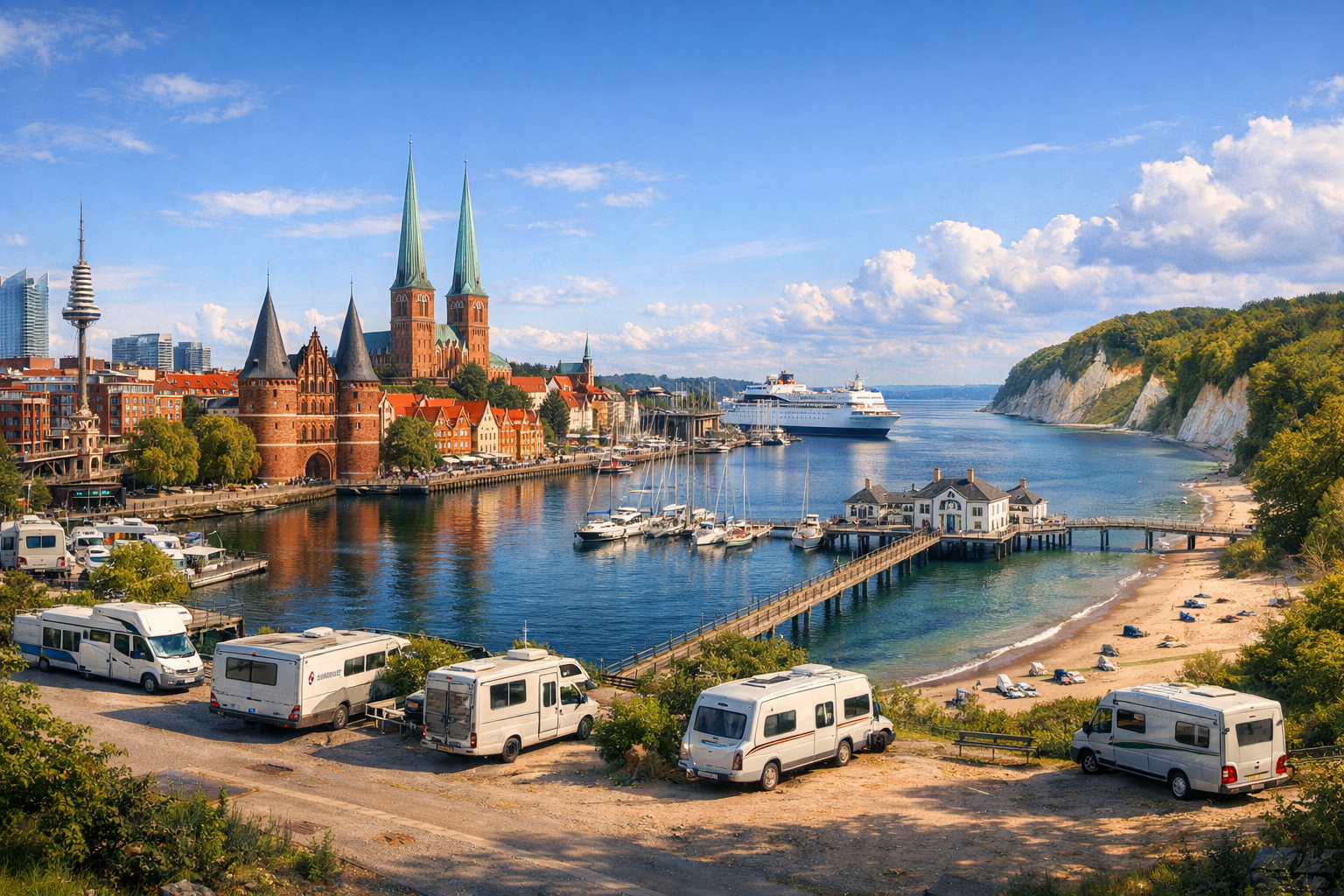
Northern Germany - Hamburg - Lübeck - Kiel - Rügen - Baltic campsites, parking lots near ports, parking areas by beaches

Northern Germany - Hamburg - Lübeck - Kiel - Rügen - Baltic campsites, parking lots near ports, parking areas by beaches

Northern Germany blends Hanseatic charm with fresh Baltic air, from Hamburg’s lively harbor to the brick lanes of Lübeck and the seaside feel of Kiel and Laboe. Follow the coast on to Rügen, where wide beaches, relaxed campsites, and convenient parking near ports and waterfronts make every stop easy and scenic.

🚗 DAY-BY-DAY ROUTE

Ready-made country and city routes with daily plans, sights, transport and accommodation. Buy PDF guides for independent travel.

🚗 DAY-BY-DAY ROUTE


Day 1 — Hamburg: start of the road trip

  • 🚗 Start and end of the day: Hamburg → Hamburg. Approximate mileage around the city and approaches to parking areas: 25–35 km, pure driving time about 1–1.5 hours. After picking up the car, it is convenient to have a gentle warm-up day without a long transfer: drive to the Landungsbrücken area, then to HafenCity and the Elbphilharmonie, and toward evening head to the area around St. Michael's Church or to viewpoints by the port. Main stops: Landungsbrücken, Speicherstadt/ HafenCity, Elbphilharmonie Plaza. For parking, it is best to rely on official parking garages right away, because there are few spaces in the center and by the water; parking at the Elbphilharmonie is limited, and access from the Baumwall side has changed due to works, so it is easier to follow the navigator and not count on an informal stop. An overnight stay in central Hamburg makes sense so that the next morning you can leave for the northeast without rush. Road nuances: traffic in Hamburg itself is dense, there are many cyclists, zones with limited stopping, and one-way streets; this is an urban rather than a countryside day, so it is realistic for an average driver — short transfers, clear logistics, and an early rest before heading to the Baltic.


Day 2 — Hamburg → Lübeck → Travemünde

  • 🚗 Start of the day: Hamburg. End of the day: Travemünde/Lübeck Bay. Approximate mileage: 95–120 km depending on whether you drive into old Lübeck, pure driving time 1.5–2 hours. It is convenient to drive via the A1 toward Lübeck, then make the first major stop in Lübeck’s historic center, and by evening move to the sea in Travemünde. Main stops along the way: Lübeck old town, Passathafen, Priwallpromenade, or Nordermole. This day is very comfortable: a short highway stretch after which you can already walk along the waterfronts, watch ferries, the beach, and port life. For parking in Lübeck, it is better to use a regular city parking garage on the way into the center and continue on foot; in Travemünde, it is more convenient to use official parking areas by the promenade and port rather than trying to find free spaces in the coastal neighborhoods. Overnight stay — Travemünde: this is a good base to combine sea, beach, port, and an early departure along the coast the next day. Why the day is realistic: in fact, it is a short intercity transfer plus a seaside evening without fatigue.

Day 3 — Travemünde → Timmendorfer Strand/Niendorf → Kiel

  • 🚗 Start of the day: Travemünde. End of the day: Kiel. Approximate mileage: 105–130 km with coastal stops, pure driving time 2–2.5 hours. In the morning, you can leisurely drive west along Lübeck Bay, stop at Timmendorfer Strand or Niendorf/Ostsee, then continue toward Kiel. Main stops: the beach area of Timmendorfer Strand, Niendorf harbor, and on the approach to Kiel — the Hörn district or the port promenade. Road nuances: along the sea in season, parking by the beaches fills up quickly, some spaces are paid, and in some sections you may park only in marked zones; rely on large public parking areas rather than narrow residential streets. Kiel is already a port city with active traffic, especially near the Ostseekai and Schwedenkai terminals. Overnight stay — Kiel, preferably in the center or by the station/waterfront. Why the day is realistic: it is not a long haul, but a beautiful transfer with two logical seaside stops and an early arrival in the city.

Day 4 — Kiel → Laboe → beaches of the Probstei coast → Kiel

  • 🚗 Start and end of the day: Kiel → Laboe/Stein → Kiel. Approximate mileage: 35–60 km, pure driving time about 1–1.5 hours. This is a full car sightseeing day without changing base. In the morning, it is worth driving along the Kieler Förde toward Laboe, leaving the car in an official parking area, and walking around the harbor, beach, and Marine-Ehrenmal. If you want more sea and a camping atmosphere, you can then make a short drive to Stein and the Ostsee-Camp Kliff area, where you can really feel the Baltic rhythm of the coast with beaches, dunes, and caravans. Main stops: Laboe harbor, Marine-Ehrenmal, and the beach and dunes at Laboe/Stein. Road nuances: in summer, parking in central Laboe and by the beach fills up quickly, so the municipality itself recommends using the lots higher up by the memorial and walking down to the waterfront. Overnight stay again in Kiel so you do not have to repack your things. Why the day is realistic: minimal mileage, lots of time by the sea, and a convenient return to the same hotel.

Day 5 — Kiel → Stralsund → Sassnitz (Rügen)

  • 🚗 Start of the day: Kiel. End of the day: Sassnitz on the island of Rügen. Approximate mileage: 290–330 km, pure driving time 3.5–4.5 hours. This is the longest transfer of the trip, so it should be done without overloading the program: an early departure, one or two technical breaks on the highway, and, if desired, a short pause around Stralsund before entering the island. The main route goes via the A20, then across the Rügenbrücke onto the island. Main stops: a service area on the highway, a short walk or coffee in Stralsund, and an evening walk along the Sassnitz waterfront. Road nuances: autobahns in Germany for passenger cars are usually without a paid vignette, but speed and roadworks strongly affect travel time; it is better to refuel before entering the island or immediately after arriving in Sassnitz. Overnight stay — Sassnitz: this is an excellent base for Jasmund National Park, the chalk cliffs, and port views. Why the day is realistic: one truly long but simple drive on good roads, after which the following days become calm again.

Day 6 — Sassnitz → Hagen parking → Königsstuhl and Jasmund → Sassnitz

  • 🚗 Start and end of the day: Sassnitz → Jasmund National Park → Sassnitz. Approximate mileage: 25–45 km by car plus walks/shuttle, pure driving time 40–60 minutes. This is one of the most beautiful days of the route. From Sassnitz, it is convenient to drive to the Hagen parking area, because further on to the Nationalpark-Zentrum KÖNIGSSTUHL through traffic for regular cars is restricted; from there, it makes sense to switch to a bus/shuttle or walk part of the way. Main stops: Parkplatz Hagen, Königsstuhl Skywalk and the visitor center, viewpoints, and forest trails of Jasmund. It is important to take the park rules into account: this is a protected area, overnight stays outside permitted places and unauthorized camping in the park are not allowed, and there are restrictions for water sports in the coastal waters. Overnight stay again in Sassnitz. Why the day is realistic: a short car segment, controlled parking, and the rest is walking through one of Rügen’s main natural sites without difficult driving.

Day 7 — Sassnitz → Prora → Binz/Sellin → Mönchgut/Thiessow

  • 🚗 Start of the day: Sassnitz. End of the day: southeast Rügen, the Thiessow/Mönchgut area, or return to Sassnitz if choosing a single base. For a more scenic driving scenario, it is better to change base and spend the night in the south of the island. Approximate mileage: 85–120 km, pure driving time 2–2.5 hours. In the morning, depart via Prora and Binz, then along the resort arc to Sellin and further into the quieter corner of Mönchgut. Main stops: the beach area of Prora, Binz promenade, Sellin pier or coastal viewpoints, and by evening — the port and spits of Thiessow. Road nuances: these are not difficult roads, but in summer there are many cyclists, pedestrians, and local traffic jams near the seaside resorts; allow for patience on the approaches to Binz and Sellin and do not park outside marked spaces by the beaches. If you need a campground, the southeast of Rügen offers the most logical options by the water. Why the day is realistic: short island transfers, beautiful stops, and not a single difficult section.

Day 8 — Thiessow/Mönchgut → Schaprode/port line to Hiddensee or northern beaches of Rügen → Hamburg

  • 🚗 Start of the day: Thiessow/Mönchgut or southern Rügen. End of the day: Hamburg. Approximate mileage: 350–400 km depending on the morning stop, pure driving time 4.5–5.5 hours. To keep the day realistic, choose only one short final point in the morning: either the port area of Schaprode as the gateway to Hiddensee, or a northern beach section such as Drewoldke/Altenkirchen if you spent the night on the island and want to wrap up the theme of campgrounds and the open Baltic shore. After that — a direct departure toward Hamburg via the Rügenbrücke and A20/A1. Main stops: a short port stop, one highway break for coffee/fuel, and car return in Hamburg. Road nuances: this is the final long transfer, so do not try to squeeze in a full island sightseeing program as well; it is better to leave before noon. Why the day is realistic: in the morning there is still the taste of the sea and port, and then one clear main-road transfer back to the starting point.

Flight tickets

eSIM for travel

Buy PDF guide

Buy PDF guide — 17.14 USD

PDF — 17.14 USD