
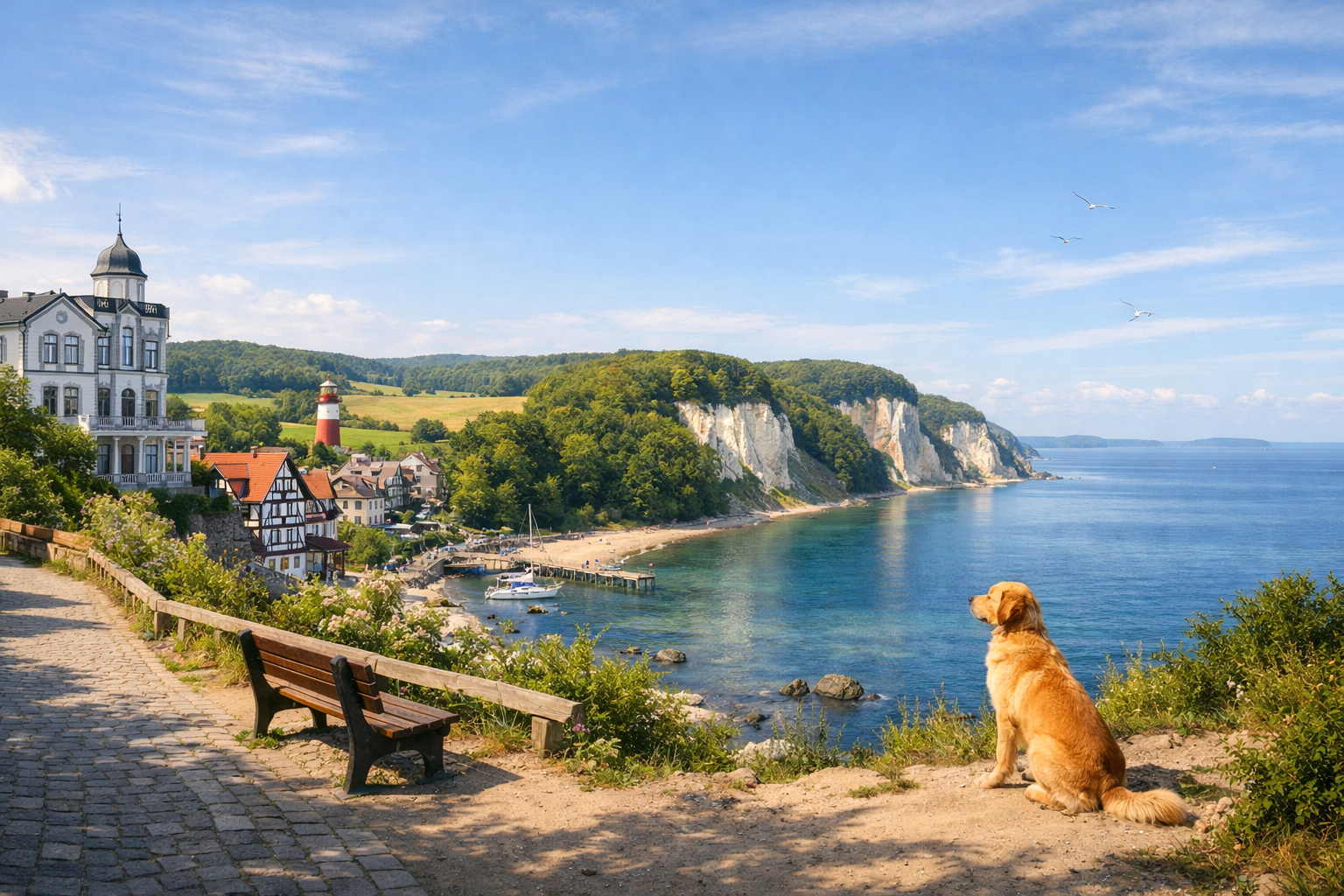
Day 1 — Stralsund → Binz: arrival on Rügen and a calm first day by the sea
🚆 Day logic: fly into one of Germany’s major airports and continue by train via Stralsund to Rügen Island, or arrive by train directly in Binz. From Stralsund to Binz by rail, usually allow about 50–70 minutes depending on the connection and the type of regional train. This is the gentlest start for traveling with a dog: minimal abrupt moves, maximum time to adapt after the journey.
🐾 Pets when traveling to Germany and to the island: for non-commercial entry into Germany with a dog, cat, or ferret, you usually need a microchip, a valid rabies vaccination, and the standard veterinary document. If you are entering from another EU country, the EU Pet Passport is generally used. If entry is from a non-EU country, an Animal Health Certificate is usually required, and from some countries a rabies antibody titration test and entry through a specially designated control point may also be needed. The basic rule: the microchip must be recorded in the documents before the rabies vaccination, and the primary vaccination becomes valid only after the required waiting period. Rules differ for other small animals, so before departure they should be checked separately for the country of origin, the airline, and the route.
✈️ Air travel rules with a pet: the conditions depend not on Germany as a country, but on the specific airline. Usually only small dogs and cats in a carrier under the seat are allowed in the cabin; large dogs travel in the hold in a rigid IATA crate. Restrictions on weight, carrier size, breeds, and surcharges vary greatly between carriers. Special restrictions often apply to brachycephalic breeds. In your final itinerary, allow extra time for check-in, document inspection, and a walk before boarding. Before booking, be sure to recheck the fare, permitted weight, carrier dimensions, and whether your specific type of animal is allowed.
🚄 Trains and buses with a dog on the way to Rügen: with Deutsche Bahn, small dogs up to the size of a domestic cat can usually travel free in a closed carrier, while larger dogs are treated as a separate passenger and require a separate ticket; for them, the leash rule also applies, and a muzzle is recommended and may be required under local carrier rules. On VVR buses on Rügen, small pets up to the size of a domestic cat in a closed container are carried free as hand luggage, while dogs and other animals outside such a carrier need a Tier ticket. On the island and in Mecklenburg-Vorpommern, local dog-keeping regulations also apply, so a leash and calm behavior are the safe basic standard throughout the route.
🏨 Check-in in Binz. This is the most convenient resort as a 5-day base: a long promenade, easy beach access, train station, bus connections, taxis, and the ability to combine the sea with trips to Jasmund, Sellin, and Göhren without rushing. After check-in, give your dog not a program but a rhythm: a short walk along the promenade, getting acquainted with the sea, a water break, and rest in the room.
🌊 An evening walk in Binz is a gentle introduction to the atmosphere of Rügen. White resort villas, the wide Strandpromenade, salty Baltic air, and an unhurried pace make this resort very friendly for a holiday with a dog. It is a good place to spend the first evening without long transfers: walk along the sea, go out to the pier, stop by Schmachter See, and let your pet unwind after the trip. In high season, regular beach sections have restrictions for dogs, so orient yourself immediately toward the officially marked Hundestrände.
🐕 Beaches and walks with a dog in Binz: in the warm season, dogs are allowed only on designated dog beaches, while out of season access is usually much freer, but with a leash and respect for local rules. For Binz, it is useful to remember a practical scheme: in summer use only marked Hundestrand sections, and from October to April access is usually broader. Before going to a specific section, still check the latest sign at the beach access point: on Rügen, rules are tied not only to the village, but also to the specific Strandabgang.
🏥 Veterinary backup at the start: if you want to feel more at ease, save the contacts of the nearest vet clinics and practices on the day of check-in. For the northeastern part of the island, practices around Sassnitz and central Rügen are often used; for any chronic treatment, it is best to bring enough medication for the whole trip plus a 2–3 day reserve.