Buy PDF guide

Buy PDF guide — 25.90 USD

PDF — 25.90 USD

Rome. Baroque and Squares

Rome. Baroque and Squares

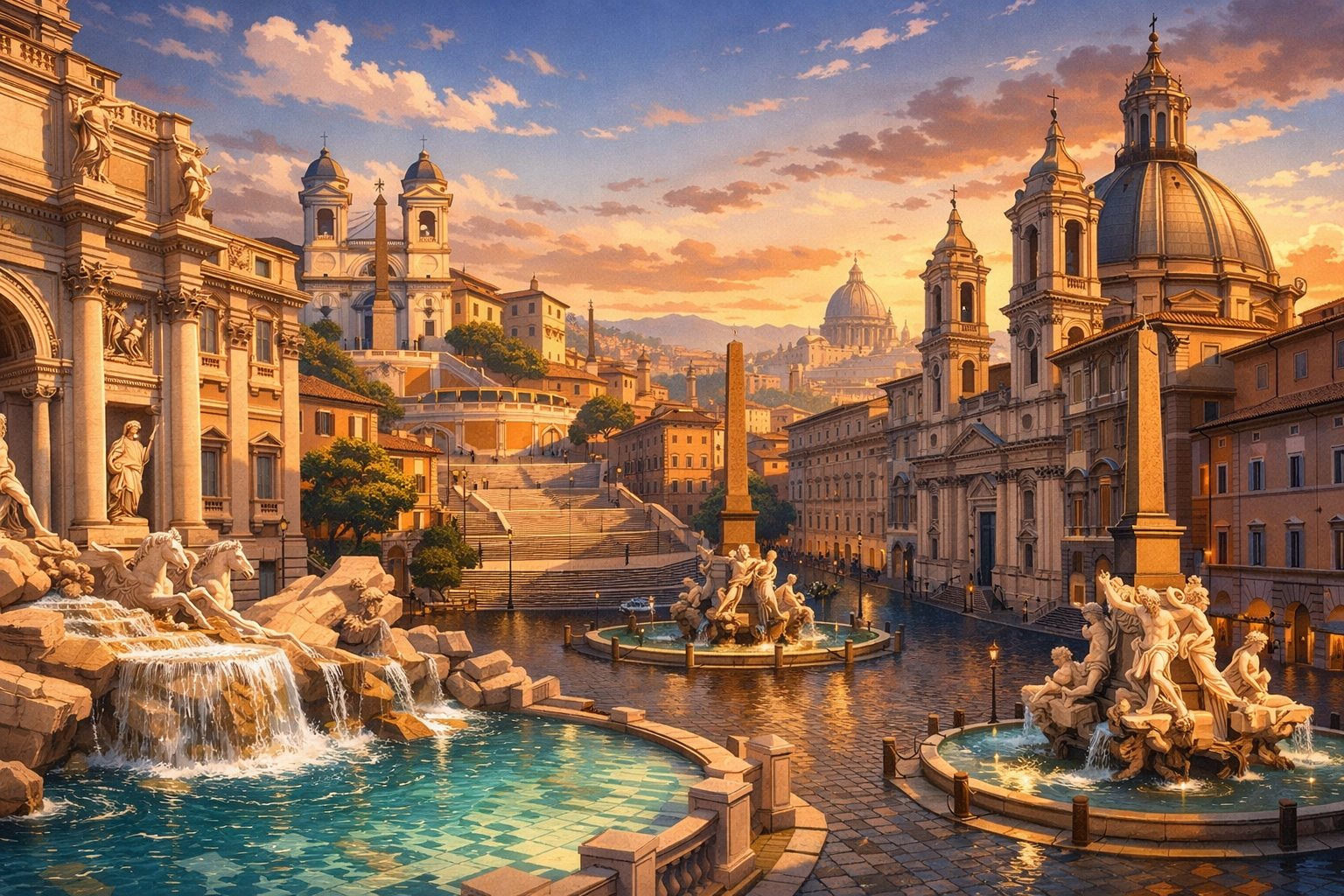
Rome sweeps you from the Centro Storico and Capitoline hilltops to the Vatican’s glinting dome and the green hush of Villa Borghese. Ride the Appian Way under ancient aqueducts, step through time in Ostia Antica, and escape to Tivoli’s Hadrian’s Villa and Villa d’Este before returning to Rome aglow at dusk.

🧭 DAY-BY-DAY ITINERARY

Ready-made country and city routes with daily plans, sights, transport and accommodation. Buy PDF guides for independent travel.

🧭 DAY-BY-DAY ITINERARY


Day 1 — Arrival and getting in the mood: the Pantheon, Piazza Navona and an evening in Centro Storico

  • ✈️ Transfer from Fiumicino Airport (FCO): the direct Leonardo Express train takes ≈ 32 minutes to Termini, then a short taxi ride/walk to the hotel. Check-in and rest.

  • 🚶 Evening warm-up in the historic center: the Pantheon (a majestic Roman dome and the “oculus” as a living link to antiquity), Piazza Navona (a Baroque “stage” on the site of Domitian’s stadium) and narrow lanes with warm light. Walks are short: Pantheon → Navona ≈ 7–10 minutes on foot — a perfect format after the journey.


Day 2 — “Bernini vs. Borromini”: Baroque churches and Quirinal squares

  • 🚶 A route built on the contrasts of two Baroque geniuses. San Carlo alle Quattro Fontane (Borromini’s oval wave, the play of light in the coffers) and across the street — the crossroads of the Four Fountains as a “theater of the city.” Then — Bernini’s Sant’Andrea al Quirinale (the dramaturgy of axes, the entrance as a prologue) and Santa Maria della Vittoria with the “Ecstasy of Saint Teresa.”

  • 🕑 A leisurely pace: at least 20–30 minutes for each interior. Moves are compact (everything within a 10–15 minute walk); plan a coffee break at Piazza Barberini with a view of the “Triton Fountain.”

Day 3 — The Capitoline and the “heart of Rome”: Capitoline Museums + Forum panoramas

  • 🏛️ The Capitoline Museums on Michelangelo’s square are the best “entry point” into the city’s ancient topography: collections of bronzes and marbles, the city plan, views over the Forum and the Palatine. A key move: after the museum, step out to the balustrade and “read” the relief of the Forum valley — the space of civic rituals and politics.

  • 🚶 In the evening — a walk along Via dei Fori Imperiali to the Colosseum in golden light: the sculptural quality of arches and colonnades reads especially vividly.

Day 4 — The Colosseum, the Roman Forum and the Palatine: the city as an archaeological landscape

  • 🚶 Start with the Colosseum (the scale and engineering of the Flavians), then along the Via Sacra to the Forum (temple terraces, the Curia, arches) and up to the Palatine (imperial palaces, views over the Circus Maximus). Budget 4.5–6 hours for the combined sites with a break for a light lunch in the shade of umbrella pines.

  • 🧭 Logistics: Metro B to “Colosseo” from the center ≈ 4–8 minutes from Termini; inside the archaeological zone there’s lots of stone and inclines: comfortable shoes, water, and sunscreen are essential.

Day 5 — The Vatican: museums + St. Peter’s Square

  • 🏛️ The Vatican Museums are a concentration of ancient and Renaissance heritage (Laocoön, the “Belvedere Apollo,” the Gallery of Maps) leading into the Sistine Chapel. Plan an early entry, 3–4 hours for the visit + a break.

  • ⛪ St. Peter’s Square — Bernini’s Baroque colonnade as an “embrace” for pilgrims; the basilica facade is the square’s ceremonial “backdrop.” In clear weather, climb the dome (optional) for a panorama of the city’s axes.

Day 6 — Villa Borghese and the Galleria Borghese + the northern squares

  • 🏛️ Galleria Borghese: Bernini (“Daphne and Apollo,” “The Rape of Proserpina”), Caravaggio — masterpieces in an intimate casino palace. The display is a “lesson” in Baroque sculpture: movement, fabric, light. Book a time slot in advance; allow 2 hours for the visit.

  • 🚶 Afterward — the Villa Borghese park (scenic alleys), down to Piazza di Spagna (a trapezoidal space at the foot of the Trinità dei Monti steps) and to the Trevi Fountain — the climax of the Baroque “water” stage. Walks are 10–20 minutes between points.

Day 7 — “Palaces and collections”: Palazzo Barberini + Galleria Corsini

  • 🏛️ Palazzo Barberini (National Gallery of Ancient Art): Bernini/Borromini’s grand staircase, Pietro da Cortona’s vaults — the birth of the Baroque “sky” in an interior. Then — the Galleria Corsini in Trastevere: 17th–18th century painting, an intimate display in a palace interior.

  • 🚶 In the evening — the Tiber embankment and a stop for a panorama of the Mausoleum of Augustus and the Ara Pacis Museum — a dialogue between antiquity and Richard Meier’s modern shell.

Day 8 — Via Appia Antica and Parco degli Acquedotti: “infrastructure as architecture”

  • 🚴 Ideally — by bike/on foot. Via Appia Antica reveals the structure of an ancient Roman road: basalt paving, mausoleums and villas along the axis. In the Parco degli Acquedotti area — the arcades of Anio Novus/Claudia, the city’s water “profile.” Budget 5–6 hours for the day circuit with a picnic in the shade of pines.

  • 🧭 Access: Metro A to “Giulio Agricola”/“Subaugusta,” then 10–15 minutes to the park; on the Appian Way — bike rentals at the park info centers, convenient for a loop route.

Day 9 — The ancient port: Ostia Antica

  • 🚆 Route: Metro B to “Piramide” → transfer to Porta San Paolo → Metromare line to “Ostia Antica” (≈ 30–40 minutes travel time) → 10 minutes on foot to the entrance. Allow 4–5 hours to explore: the cardo/decumanus streets, the Baths of Neptune (mosaics), insulae, the theater and portico. This is the “everyday city” of ancient Rome — it reads especially clearly.

  • 🌅 Return to Rome — dinner in Trastevere or at Campo de’ Fiori; it’s a full day, so plan for rest.

Day 10 — Tivoli: Hadrian’s Villa + Villa d’Este

  • 🚆 Logistics: the FL2 regional line from Termini/Tiburtina to Tivoli ≈ 36–60 minutes; taxi/bus to Hadrian’s Villa. In the morning — Hadrian’s Villa (the architectural “world of the emperor”: the Maritime Theatre, the Canopus, the bath complex), in the afternoon — Villa d’Este (Renaissance cascades and hydraulics as art).

  • 📷 Contrast of the day — Hadrian’s “intellectual landscape” and d’Este’s “music of water.” Return to Rome in the evening.

Day 11 — Palace-collections and antiquity within the city: Doria Pamphilj + Palazzo Altemps

  • 🏛️ DORIA PAMPHILJ GALLERY: a private collection in a palace on Via del Corso — gallery rooms, Caravaggio, Velázquez; the interior as a “frame” for the paintings. Then — Palazzo Altemps (a branch of the Museo Nazionale Romano): ancient sculpture in Renaissance enfilades, exemplary museum presentation.

  • 🚶 Finish — Piazza del Popolo: the axis between Porta del Popolo and the “twin” churches, a perspective down Via del Corso. Cozy cafés to sum things up.

Day 12 — Buffer for favorites and departure

  • 🕊️ Morning — return to the spot that hooked you most (Barberini/Capitoline/Borghese) or take a final walk along the Tiber embankments.

  • ✈️ Transfer to the airport: Leonardo Express (Termini ↔ FCO ≈ 32 minutes, every ≈ 15 minutes) or bus shuttles to Termini. Build in a 2–3 hour buffer before departure + travel time.

Flight tickets

eSIM for travel

Buy PDF guide

Buy PDF guide — 25.90 USD

PDF — 25.90 USD