
Buy PDF guide

Buy PDF guide — 10.90 USD

PDF — 10.90 USD

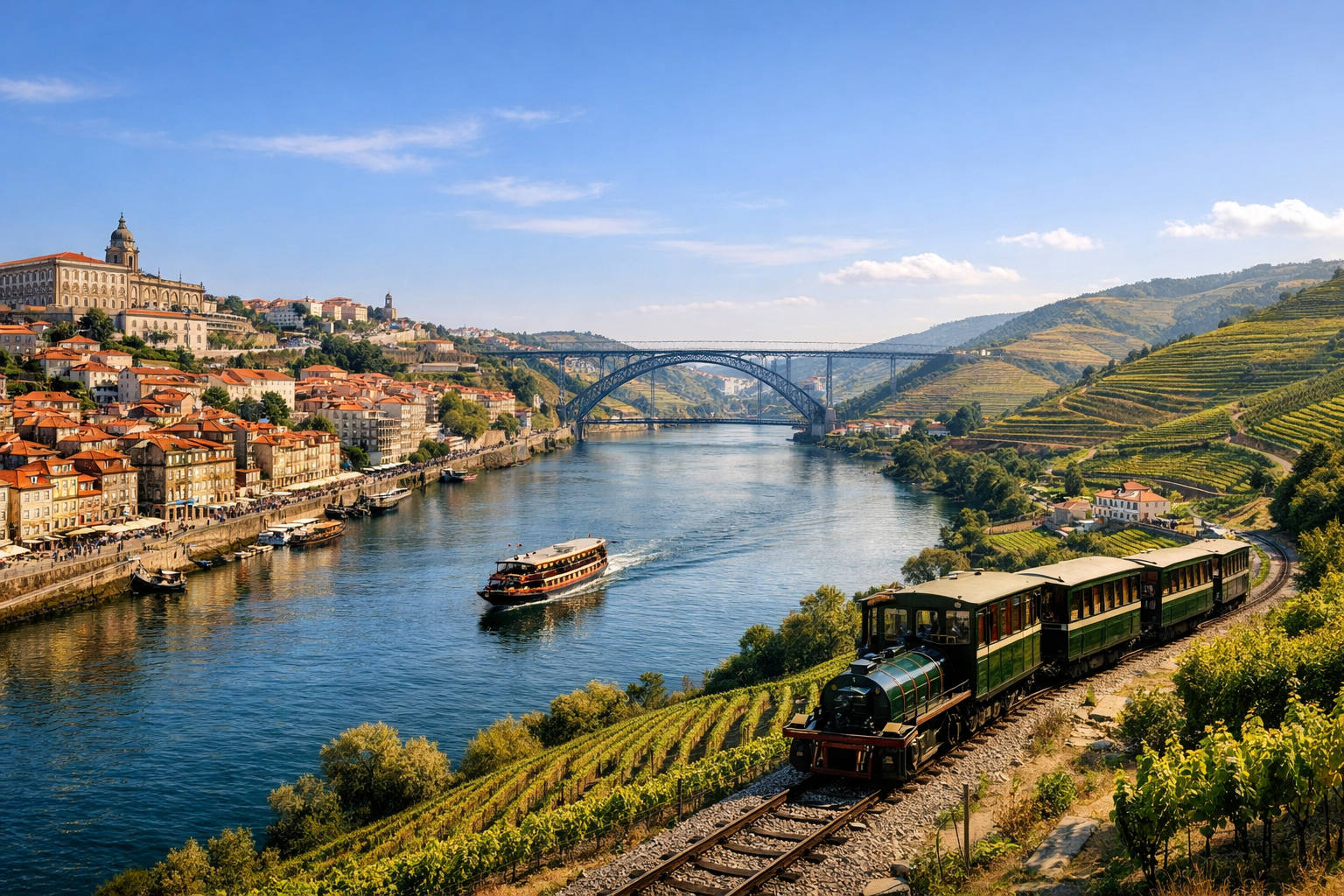
Portugal, Porto and the Douro Valley. Walks along the Ribeira waterfront, a visit to the Bolsa Palace, a cruise on the Douro, and a one-day tour of the wine valley by tourist train or car with driver.

Portugal, Porto and the Douro Valley. Walks along the Ribeira waterfront, a visit to the Bolsa Palace, a cruise on the Douro, and a one-day tour of the wine valley by tourist train or car with driver.

Wander Porto’s Ribeira waterfront, step inside the elegant Bolsa Palace, and cruise the Douro as the city’s riverfront unfolds around you. Then cross to Vila Nova de Gaia and follow the valley inland for a memorable day among terraced vineyards, whether by tourist train or with a driver through the heart of Portugal’s wine country.

🧭 DAY-BY-DAY ITINERARY

Ready-made country and city routes with daily plans, sights, transport and accommodation. Buy PDF guides for independent travel.

🧭 DAY-BY-DAY ITINERARY


Day 1 — Porto: gentle arrival, check-in, and the Ribeira waterfront

  • 🚇 Arrival at Francisco Sá Carneiro Airport and a calm transfer to central Porto. The most convenient public option is Metro line E (purple), which connects the airport directly with the city; for the most comfortable start when traveling with luggage, you can pre-book a taxi or private transfer right to your hotel door. For a 60+ itinerary, it’s better not to plan an intensive schedule on the day of arrival: after check-in, take a break of at least 1.5–2 hours, have a coffee or tea in the lobby, and only then head out for your first walk.

  • 🏨 It is convenient to stay in central Porto, where it is easier to get around by taxi, metro, and on foot in short stretches. For a comfortable pace, hotels with an elevator, spacious rooms, good soundproofing, breakfast on site, and the ability to quickly call a car are preferable. Before booking, be sure to confirm the availability of a shower without a high bathtub edge, the exact distance to the nearest stop, and the possibility of early check-in or late check-out.

  • 🚶 The Ribeira waterfront is one of Porto’s most atmospheric corners, the city’s historic riverfront facade, where colorful houses rise in tiers above the Douro and, below, a lively line of cafés, terraces, and excursion piers stretches along the water. It is especially pleasant not to rush here: walk a few hundred meters, stop for a scenic photo, sit by the water, watch the rabelo boats and the majestic two-level Dom Luís I Bridge. The area is beautiful in the morning and becomes especially gentle toward evening, when the facades begin to glow in the golden reflection of the river. For a comfortable rhythm, it is best to choose a flat section along the waterfront without climbing into the old quarter and finish the walk with an early dinner overlooking the water.

  • 🍽️ The evening format is gastronomic but without overload: a glass of white port or vinho verde, bacalhau appetizers, vegetable dishes, caldo verde soup, or a light fish dinner. After the journey, it is better to avoid a late climb up the steep streets of the historic center: ideally, return to the hotel by taxi in 5–10 minutes and save your energy for the full but calm days ahead.


Day 2 — Porto: Palácio da Bolsa and the historic center at a comfortable pace

  • 🚕 Start the morning without an early push: after breakfast, it is convenient to take a taxi to the Palácio da Bolsa area so you don’t have to deal with extra climbs over cobblestones. Palácio da Bolsa is located in Porto’s historic center and is considered one of the city’s most representative civic buildings. It was built by the Porto Commercial Association on the site of a former monastery and became a symbol of the bourgeois flourishing of northern Portugal. Inside, the grand staircases, halls for official receptions, and the famous Arabian Hall are especially impressive, where oriental motifs, stucco, and the shine of decorative details create an almost theatrical atmosphere.

  • 🏛️ It is best to plan your visit to the palace around an official timed tour: this means less standing in line and makes it easier to manage your energy. After the visit, it is worth taking an essential break at a nearby café or in a courtyard close by. This day is especially well suited to a thoughtful introduction to the city: not to “tick boxes,” but to see Porto as a great trading port, a city of merchants, wine connections, decorative arts, and 19th-century architecture.

  • ⛪ After the palace, you can add a short walk through the nearest part of the historic center: see the exterior of the Church of São Francisco, walk slowly to the viewpoints above the river, or take a taxi to the São Bento station area. Even if you do not enter every site, the cityscape itself is exceptionally expressive here: granite buildings, narrow streets, azulejo tiles, tram tracks, and a constant sense of the city’s connection with the river.

  • ☕ In the second half of the day, instead of a long walking route, it is better to choose “one strong point and rest.” For example, a coffee break in the center, then a short visit to a viewpoint and a return to the hotel. This rhythm is especially successful for the 60+ category: there are many impressions, but no exhaustion from stairs, constant climbs, and long links between locations.

Day 3 — Porto and Gaia: a Douro cruise and a wine theme without rushing

  • ⛴️ Today’s highlight is the classic Douro cruise with views of the six bridges. This is one of the most pleasant ways to see Porto and Vila Nova de Gaia without unnecessary physical strain: most of the time you sit on board and watch the city unfold from the water. From the river, the terrain is especially easy to read: old Porto on one bank, Gaia’s wine cellars on the other, the metal outline of the Dom Luís I Bridge, the modern bridges downstream, and the historic density of the waterfronts.

  • 🛥️ It is better to arrive for the cruise a little early, but without too much extra time so you are not waiting standing for long. When booking, it is useful to check the boarding type, whether there is a canopy or enclosed deck, how close the pier is to the taxi area, and how many steps there are during boarding. This format is especially good in the April–June and September–October seasons: soft light, fresh air, and less summer heat. After the cruise, be sure to have a lunch break of at least 1–1.5 hours.

  • 🍷 After a rest, it makes sense to continue the day with the wine theme in Vila Nova de Gaia, but in a lighter format. Instead of several tastings in a row, it is better to choose one well-organized wine program with an explanation of port wine, barrel aging, and the differences between ruby, tawny, and white port styles. It is important to keep the tasting moderate and pair it with food. If you do not want extra activity, you can simply walk a short flat stretch along Gaia’s waterfront with views of old Porto and then return to the hotel.

  • 🌇 In the evening, the “early dinner and free time” scenario works well. You will need your energy for tomorrow’s excursion to the Douro Valley, so after 19:00 it is better not to overload the day. If you wish, you can end it at a panoramic bar or restaurant with a river view, but with an обязательным return to the hotel by taxi.

Day 4 — Day trip to the Douro Valley: train or car with driver

  • 🚆 The Douro Valley is one of Europe’s most beautiful wine landscapes: vineyard terraces descend to the river like amphitheaters, white quintas shimmer among the slopes, and the railway runs almost right along the water. For a comfortable 60+ journey, there are two good scenarios. The first is the train on the Douro Line from Porto São Bento or Porto Campanhã toward Régua or Pinhão. After service was restored on the line, trains are once again running along the full route, and this is a very scenic way to see the valley without needing to drive. The second scenario is an individual trip by car with a driver: it is more expensive, but noticeably more convenient in terms of flexibility, allows you to reduce walking sections, and lets you pause where it is truly beautiful and comfortable.

  • 🚉 If choosing the railway, an early but not too early departure is best so you do not get stressed about connections. It is better to get to the station by taxi. For passengers who need help boarding or disembarking, CP offers an assistance service for people with special needs; this help must be booked in advance. Once there, it is sensible to limit yourself to one main point — for example, Pinhão or Régua — without trying to cover everything at once. This preserves the pleasure of the journey and allows you to have a calm lunch rather than eating on the run.

  • 🍇 Pinhão is especially good as the image of the ideal wine valley: a quiet station with characteristic azulejo panels, gentle river bends, vineyard terraces, and a feeling of unhurried rural aristocratic charm. Régua is more convenient as a transport hub and also offers a beautiful picture of the valley. In both cases, it is worth choosing one lunch with a view, one tasting or short visit to a quinta, and one viewpoint. If you are traveling with a driver, you can add a panoramic stop and visit a winery without long walking stretches on the slopes.

  • 🚗 The driver option is especially good for those who value a gentle rhythm: hotel → panoramic road → quinta → lunch → viewpoint → return. This removes the burden of navigation, parking, and timetables. When booking, it is important to confirm the car class, air conditioning, the possibility of frequent stops, the duration of the excursion, and whether waiting time on site is included in the price.

  • 🌄 It is better to plan your return to Porto before late evening. The day is quite full even at a gentle pace, so after arriving back, only a light dinner near the hotel is appropriate. This is exactly how the Douro Valley will be remembered not as a tiring outing, but as a beautiful, mature, and very Portuguese day.

Day 5 — Porto: museum/garden, a final gastronomic touch, and departure

  • 🌿 It is best to leave the final day semi-free, with a late breakfast, unhurried packing, and one calm cultural stop. An excellent option is the gardens of Palácio de Cristal or the Serralves Museum, depending on your energy and flight time. The gardens are great for panoramic views over the Douro and a gentle walking format: you can walk a short section, sit in the shade, look at the river from above, and feel a greener, more intimate side of Porto. Serralves suits those who want contemporary art, a park, and architecture in one place; here it is convenient to alternate galleries and rest.

  • 🏛️ If you want to end the trip specifically with a museum, a good choice is Museu Nacional Soares dos Reis — the country’s oldest public art museum. It gives the route a more classical ending: sculpture, painting, decorative arts, and a sense of Porto’s cultural depth that extends far beyond postcard images of bridges and port wine.

  • 🍽️ Before departure, leave time for one last thoughtful lunch: fresh fish, seafood rice, vegetable dishes, dessert with coffee, and, if you wish, a small glass of tawny. Do not plan long walking stretches with suitcases. From the hotel to the airport, the most comfortable option is either a pre-booked transfer or a taxi; the metro also remains a reliable option if you are leaving during the day, your luggage is manageable, and the station is nearby.

  • 🩺 For 60+ travel, this route works well because it is based in one region and avoids frequent hotel changes. But the 60+ category does not mean complete step-free accessibility: Porto has a lot of cobblestones, slopes, and occasional stairs. Before final booking, it is worth additionally confirming the presence of an elevator in the hotel, the availability of assistance at the station and airport, the height of the shower threshold, the boarding conditions for the cruise, and the actual accessibility of each specific point on the route.

Flight tickets

eSIM for travel

Buy PDF guide

Buy PDF guide — 10.90 USD

PDF — 10.90 USD