
Buy PDF guide

Buy PDF guide — 8.90 USD

PDF — 8.90 USD

Portugal, Porto and the Douro Valley. City walks along the river, historic neighborhoods, viewpoints, and a day trip through the wine region.

Portugal, Porto and the Douro Valley. City walks along the river, historic neighborhoods, viewpoints, and a day trip through the wine region.

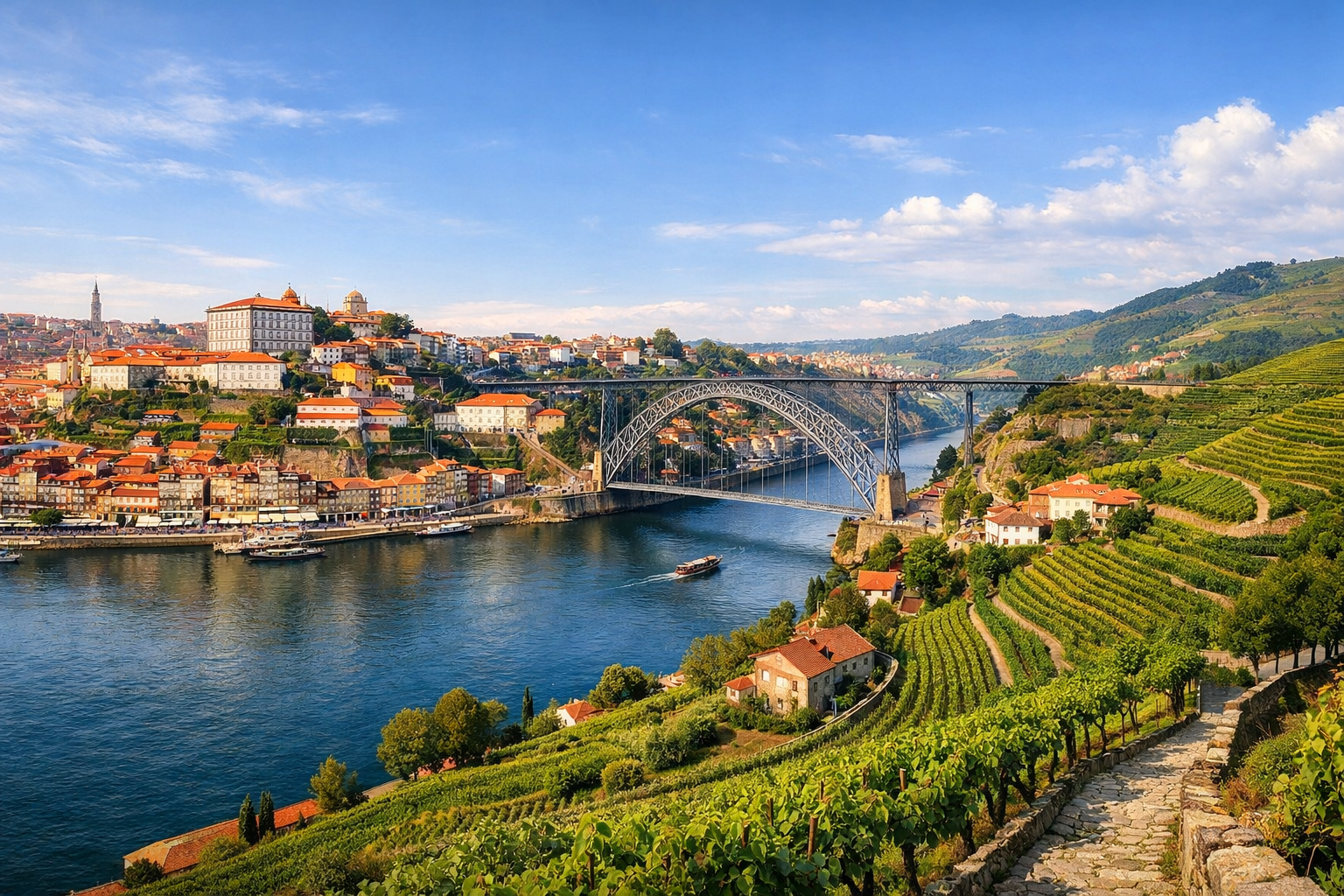
Wander Porto’s riverside lanes, climb to sweeping viewpoints, and soak up the character of its historic neighborhoods before crossing to Vila Nova de Gaia. Then follow the Douro inland to Pinhão for a day among terraced vineyards and dramatic valley views, before returning to Porto with the region’s beauty still lingering.

🧭 DAY-BY-DAY ROUTE

Ready-made country and city routes with daily plans, sights, transport and accommodation. Buy PDF guides for independent travel.

🧭 DAY-BY-DAY ROUTE


Day 1 — Porto: arrival, Ribeira, and Douro panoramas

  • 🚆 For a solo trip, it is best to arrive in Porto in the first half of the day or no later than early evening, so you can check in while it is still light and calmly do your first route without rushing. From Francisco Sá Carneiro Airport, the easiest way to reach the center is by Metro line E to Trindade: it is a clear, direct, and safe way to get into the city without the stress of transfers. If your luggage is heavy or you arrive late, it is better to choose an official taxi or a ride-hailing app and go straight to a hotel in a central area — around São Bento, Aliados, Batalha, or Ribeira, where it is easy to get around on foot and there are always people, cafés, and phone service.

  • 🚶 It is best to dedicate the first day to a gentle introduction to the city: start from Avenida dos Aliados, walk to São Bento station, where even a short stop becomes its own aesthetic experience thanks to the famous azulejos, and then slowly descend to the Ribeira quarter. This is one of Porto’s most photogenic and historically rich areas: narrow house façades, laundry on balconies, stairways, stone, shadows, reflections on the river, and the constant feeling of a living city rather than a museum set. The promenade along the Douro is especially good for a solo traveler: it is easy to move at your own pace, stop for coffee, photograph details of city life, and not feel isolated.

  • 🚶 Be sure to walk across the lower level of the Dom Luís I Bridge or admire it from the waterfront: the huge metal arch gives a dramatic silhouette to the entire river panorama. Then it is worth climbing to the viewpoints near Sé do Porto and farther on to Jardim do Morro on the Vila Nova de Gaia side, if you still have the energy. From here, sunset views over old Porto, bell towers, and the wave-like relief of the rooftops are especially beautiful. For a solo route, this is a safe and logical evening finish, provided you return to the center before late night: the area is lively, tourist-oriented, and easy to navigate.

  • ⛴️ If after checking in you want to add a river element without complicated logistics, a short six-bridges sightseeing cruise on the Douro is a good option. It is a convenient way to see the city’s geography from the water without going far or being tied to a group for the whole day. After the ride, it is best to end the evening with an early dinner in Ribeira or near Praça da Batalha and return to your hotel on foot along busy streets, avoiding deserted downhill lanes and remote embankments after dark.


Day 2 — Porto: historic quarters, literary architecture, and viewpoints

  • 🚶 Dedicate the second day to the architectural heart of Porto. Start in the morning in the Clérigos area and on Rua das Carmelitas while the center is still free of peak crowds. Clérigos Tower remains one of the city’s main vertical symbols, and nearby is Livraria Lello — a place where architecture, literature, and tourist myth merge into one striking scene. Even if you have already seen hundreds of photos, the real space has a stronger effect: carved wood, a staircase with flowing lines, stained-glass light, and the constant movement of people create an almost theatrical composition. For a solo traveler, it is especially convenient to come here in a morning time slot: less bustle, easier interior photography, and more freedom to keep your own pace.

  • 🚶 Then it is worth walking to Miradouro da Vitória or nearby viewpoints in the historic center. This is not a polished postcard but a living urban balcony from which Porto opens up in layers: rooftops, domes, bridges, wine cellars on the opposite bank, and the river itself tying everything into one panorama. After that, it makes sense to continue to Sé Cathedral and then down the old streets, stopping to photograph doors, ceramics, wrought-iron balconies, and staircases — Porto is especially rewarding to lovers of urban photography in exactly these details.

  • 🏛️ In the second half of the day, you can add one museum highlight. For admirers of classical art and a calm atmosphere, Museu Nacional Soares dos Reis is a good choice — the country’s oldest art museum, where you can comfortably spend 1.5–2 hours without overload. If you want a more contemporary rhythm and an architectural contrast, it is better to choose Casa da Música: the building itself, created as a modern icon of Porto, is already worth the visit, and the Boavista area gives a sense of a broader, more businesslike, and less touristy city.

  • 🍽️ The evening is best finished in the central part of the city — around Aliados, Clérigos, or Batalha, where it is easy to find dinner alone without a reservation and without the feeling that you need to spend the evening in a noisy group. Porto is excellent for solo dining: it is convenient to order appetizers, dish-of-the-day specials, bacalhau, or seasonal desserts in small restaurants. For safety reasons, it is better not to plan long late walks on steep dark stairways between the upper city and the river; after dinner, it is best to return to the hotel via well-lit central streets or by a short taxi ride.

Day 3 — Day trip to the Douro Valley: train to Pinhão and wine-country scenery

  • 🚆 The main out-of-town part of the route is an easy day trip to the Douro Valley without renting a car and without a mandatory tour group. The best option for an independent traveler is the morning CP train on the Linha do Douro via Campanhã toward Régua and Pinhão. The line is again operating in full along the entire classic scenic section, and the journey itself is considered one of the most beautiful rail trips in Portugal: the train runs along the river, between terraced vineyards, small stations, and slopes where the landscape looks like a huge man-made amphitheater.

  • 🚶 As the main destination of the day, it is best to choose Pinhão itself: it is a compact, easy-to-understand, and visually very expressive place that is convenient to explore on foot. The station is known for its azulejo panels depicting the life of the wine region, and all around is not a metropolis but an intimate river landscape where vineyard terraces literally come down to the water. There is no need to rush here: walk along the bank, look at the boats, linger at the viewpoints, have lunch overlooking the river, and feel how Porto’s urban rhythm gives way to the almost meditative quiet of the valley.

  • ⛴️ If the weather is good, in Pinhão you can add a short river ride on the Douro or choose a program with a boat and a winery visit if the schedules align. But for a solo format, it is important not to overload the day with infrequent transfers: it is better to plan the route so that the key anchors are the train there and the train back. This gives freedom, preserves a sense of control, and allows you not to depend on a car, unfamiliar roads, and mobile service in rural areas.

  • 🚆 It is better to plan your return to Porto for daytime or early evening rather than the last possible departure. That way you will get back to the city while it is still light or during active hours, calmly make your way to the hotel, and avoid dealing with navigation while tired. A day in the Douro should feel like a beautiful retreat from the city, not an expedition: one main destination is enough, along with real time for rest, lunch, and contemplation of the landscape.

Day 4 — Porto: Serralves, the western waterfront, and a calm finish

  • 🚶 It is best to make the final day more spacious and relaxed. In the morning, head to Serralves — one of Porto’s best cultural complexes, where contemporary art, museum architecture, a villa, and a park form a rare and beautifully integrated whole. For a solo traveler, this is an almost ideal format: you can move at your own pace, lingering over artworks, retreating into the silence of the garden, or simply resting on a bench among the greenery. Unlike the dense city center, there is more air, more lines, and more pauses here, which makes the final day feel not hectic but composed.

  • 🚋 After the museum, you can continue toward the river and the ocean-facing side of the city. If you want atmospheric transport, Museu do Carro Eléctrico and the whole theme of old tram Porto are interesting. Then a gentle route through the western part of the city works well: go out to the waterfronts, take public transport or a bus along the Douro toward Foz do Douro, where the river meets the Atlantic. This is a different Porto — brighter, windier, more horizontal, with long lines of water and promenading views.

  • 📷 For a photographer, this is an excellent day of contrasts: in the morning — minimalist contemporary architecture and a park, then — the historic industrial texture of the tram museum, and in the evening — open space by the water. At the same time, the route remains easy, without tiring climbs and without the need to go into remote sparsely populated areas. If you are traveling alone, it is better to finish the walk before dusk or in early twilight and decide in advance how you will get to the airport or to the next point of your journey.

  • ✈️ On a departure day, it is worth allowing extra time: the trip to the airport on Metro line E from the center is usually straightforward, but it is better to check the schedule in advance. If the flight is early, it is sensible to book a taxi or transfer on an official platform the day before. Before the trip ends, check once again that your documents, insurance, tickets, and charged phone are within reach; when traveling alone, it is especially important not to hand your passport to strangers, to share your final plan for the day with someone close to you, and to avoid rushing in the last hours.

Flight tickets

eSIM for travel

Buy PDF guide

Buy PDF guide — 8.90 USD

PDF — 8.90 USD