
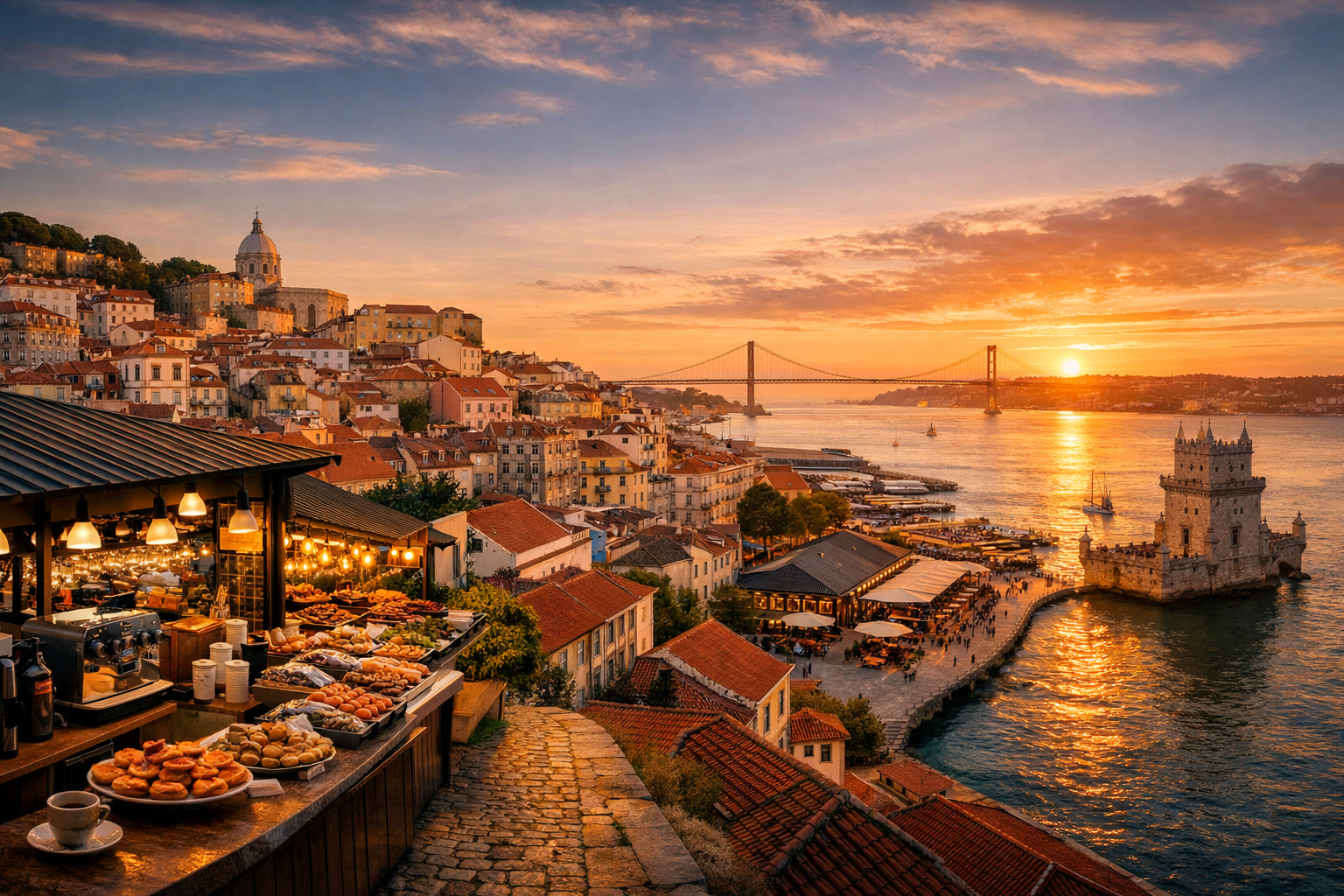
Day 1 — Baixa, Cais do Sodré, and Ribeira Market: a first dive into the taste of Lisbon
🚕 Arrival at Lisbon Humberto Delgado Airport and transfer to the center. The most convenient way to reach the historic districts is by metro in about 20–30 minutes with a transfer, or by taxi/ride-hailing in 20–35 minutes depending on traffic. For a food-focused itinerary, it is best to stay in Bairro Alto, Chiado, Baixa, or Alfama: from here, it is easy to walk between key markets, cafés, and restaurants, but keep in mind that Lisbon is hilly and the cobbled streets can be slippery after rain.
☕ Start the day gently: after checking in, don’t rush to “cover” the whole center at once. It’s better to tune into the city’s rhythm through specialty coffee in Chiado or Cais do Sodré, and then head to Mercado da Ribeira / Time Out Market. This area is especially good for the first day because the logistics are very simple: the waterfront, market, cafés, wine bars, and old streets are all within walking distance, and if your energy is limited after the flight, the route can easily be shortened without losing the atmosphere.
🦐 Time Out Market Lisboa is not a classic municipal market in the purest sense, but a modern gastronomic space that grew out of the historic Mercado da Ribeira. It’s a convenient place for a “tasting start” to the trip: order several small dishes for two or for a group and sample different sides of Lisbon’s contemporary food scene — from seafood and fish dishes to Portuguese snacks, desserts, and wine. The format is especially good for couples, friends, and solo travelers: you don’t have to commit to one menu and can create your own tasting day. It’s best to come either for an early lunch or closer to mid-day to avoid the longest lines.
🍷 After the market, stroll along the waterfront to Ribeira das Naus and Praça do Comércio. This is an important part of the route not only for the views: after a hearty lunch, Lisbon becomes especially pleasant to “unfold” in motion — the salty air from the river, the light on the façades, and the soft rumble of trams help you shift from travel mode into trip mode. As a little extra for the walk, you can have a ginjinha, modern-style tinned fish, or a small glass of vinho verde at one of the bars along the way.
🏛️ Toward evening, head uphill to Chiado and Bairro Alto. This is one of the best areas to understand modern Lisbon: old houses, bookshops, ceramics, fashionable wine bars, small food spaces, and places where traditional Portuguese products are reimagined without losing their character. It’s worth doing a light gastro-round here: olives, sheep’s and goat’s cheeses, presunto, sardine preserves, sourdough bread, seasonal vegetable snacks, and something from the sea — for example octopus or shellfish, if you didn’t have them during the day.
🌇 End the evening at one of the miradouros overlooking the Tagus — for example in the Santa Catarina or São Pedro de Alcântara area. Sunset here is not just a beautiful backdrop, but almost a mandatory city ritual: golden light settles on the red roofs, domes, and river, and an evening aperitif unexpectedly turns into one of the most memorable moments of the trip. For dinner, leave room for a tried-and-tested Portuguese restaurant with a reservable table. If you want seafood and classics, it’s better to book ahead; if you need a more flexible option, choose a wine bar or taberna with a short menu. For vegetarians and those avoiding gluten, it is usually not difficult to find adapted options in the city center, but allergies should be mentioned in advance.