
Buy PDF guide

Buy PDF guide — 10.90 USD

PDF — 10.90 USD

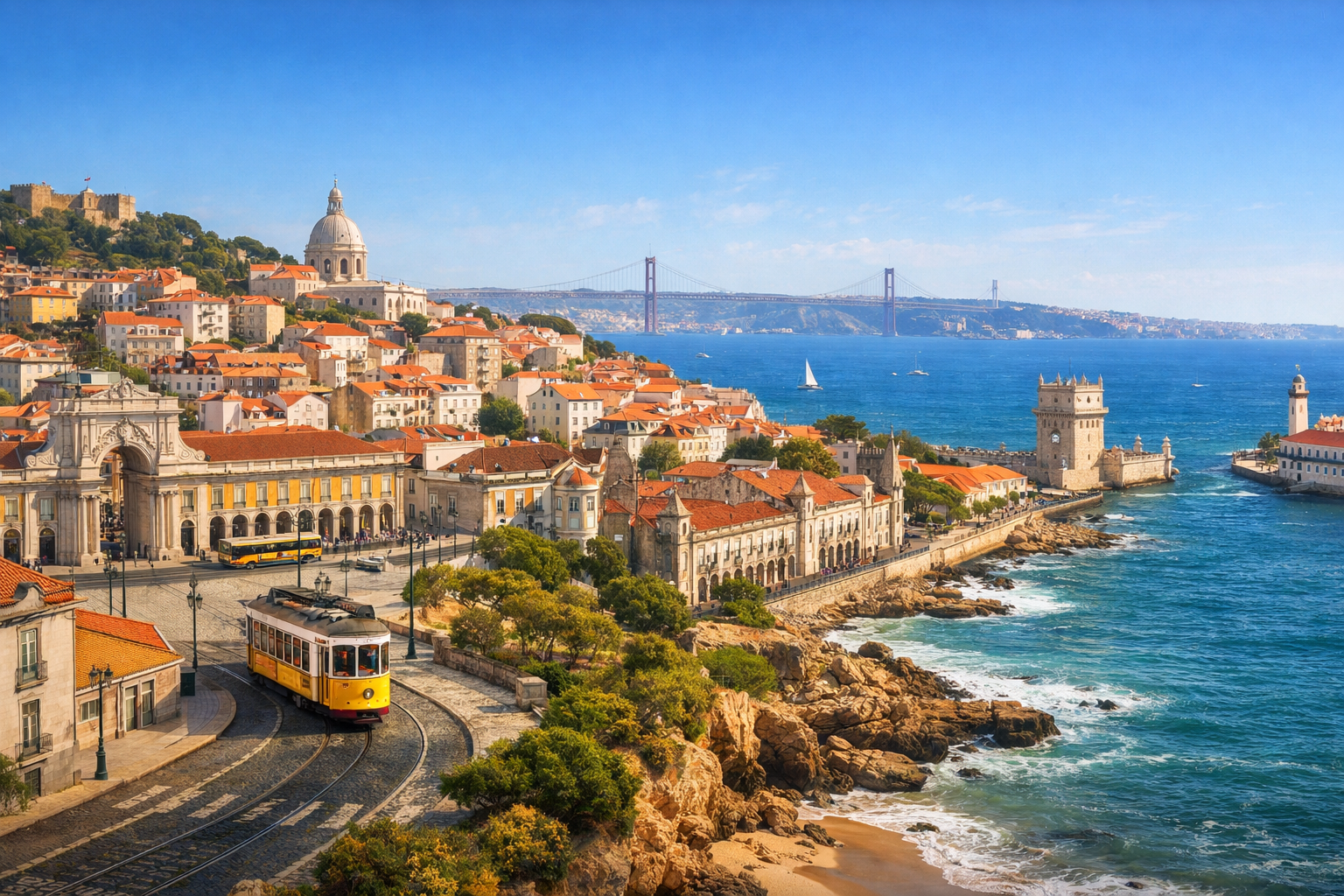
Portugal, Lisbon. Independent exploration of the Baixa, Alfama, Belém districts and the Cascais coast with walks, museums, and trips on public transport.

Portugal, Lisbon. Independent exploration of the Baixa, Alfama, Belém districts and the Cascais coast with walks, museums, and trips on public transport.

Discover Lisbon at your own pace, from the grand squares of Baixa to the winding lanes of Alfama and the riverside landmarks of Belém. Ride out by public transport to the breezy Cascais coast for seaside walks, local museums, and a perfect mix of city charm and Atlantic light.

🧭 DAY-BY-DAY ITINERARY

Ready-made country and city routes with daily plans, sights, transport and accommodation. Buy PDF guides for independent travel.

🧭 DAY-BY-DAY ITINERARY


Day 1 — Lisbon: arrival, Baixa, and Chiado

  • ✈️ For a solo traveler, the calmest scenario is to arrive in Lisbon in the first half of the day, or at least before sunset, so that check-in and your first introduction to the city can happen without rushing. From Humberto Delgado Airport, the easiest way to reach the center is by metro: Aeroporto station is right by the terminal, and from there you can take the red line to interchange stations and get off closer to the Baixa/Chiado area. It’s a clear and budget-friendly option with no need to look for a taxi at night. If your suitcase is heavy or you arrive after a long flight, it makes sense to choose an official taxi through an app or book a transfer in advance, but the basic plan is best built around checking in during daylight hours.

  • 🏨 As a base for all 5 days, it’s best to choose a central, lively, and easy-to-navigate area — Baixa, Chiado, or the upper part of Avenida da Liberdade. These neighborhoods are convenient for a first solo trip: there are plenty of cafés, pharmacies, metro stations, historic streets, and people around until evening, while logistics to Belém and the train line to Cascais remain simple. After checking in, leave your heavy belongings, rest a little, and don’t plan long uphill walks on the first day.

  • 🚶 Baixa is the heart of Lisbon rebuilt after the 1755 earthquake — rational, bright, and geometric. It’s a pleasant place to begin getting to know the city: wide pedestrian streets, elegant façades, cafés under arcades, and the feeling of a European capital that is both grand and relaxed. Walk from Praça da Figueira to Rossio, then along Rua Augusta to the triumphal arch and Praça do Comércio. This route is very convenient on your own: there’s no need to hurry, it’s easy to navigate, and you can always stop for coffee, buy water, or take a break on a bench by the Tagus waterfront.

  • 🌆 In the second half of the day, head up to Chiado — a neighboring district with a more intellectual and artistic atmosphere. Here Lisbon becomes a little more bohemian: bookshops, old pastry shops, theaters, trams, narrow streets, and soft scenic viewpoints. On the first day, don’t venture too far into the maze of hills; it’s better to choose a short walk Baixa → Santa Justa from the outside → Largo do Carmo → Chiado and return to the hotel before dark. This is especially comfortable for beginner solo travelers: the center stays lively, feels safer, and makes it easier to manage your energy.


Day 2 — Lisbon: Alfama, the cathedral, and the Fado Museum

  • 🚶 Alfama is the most atmospheric and perhaps the most cinematic historic district of Lisbon. It survived the earthquake better than other neighborhoods and preserved its medieval street pattern: stairways, arches, laundry on balconies, tiny squares, unexpected viewpoints, and the feeling of a city that grew on the slope between the cathedral and the castle. For a solo format, it’s best to come here in the morning, when the light is soft, the streets are calmer, and climbing the hills is easier. Start at Sé de Lisboa and the Church of Saint Anthony to gradually settle into the rhythm of the district.

  • ⛪ Near the cathedral, it’s convenient to visit Museu de Lisboa – Santo António, a small but very fitting museum for understanding the city’s identity. It is dedicated to Saint Anthony, one of Lisbon’s main symbols, and works especially well as an intimate stop in the middle of a walk. Then it’s worth moving leisurely toward Alfama’s narrow lanes and viewpoints without trying to see everything at once: in solo travel, the quality of impressions matters more than racing between spots.

  • 🎶 Museu do Fado is one of the best cultural stops of the day. Here fado is revealed not as a tourist cliché, but as the emotional code of old Lisbon: the music of sailors, poor neighborhoods, longing, memory, and dignity. Even if you don’t listen to this genre regularly, the museum helps you feel the city more deeply. Afterward, a walk through Alfama feels different: old stones, shadows on the walls, the sound of footsteps on the cobblestones, and occasional guitar motifs begin to come together into a single scene.

  • 🛡️ An important point for a solo route: Alfama is beautiful during the day, but it’s better not to plan late returns on foot through emptying stairways and steep alleys. It’s best to finish your walk after lunch or closer to early evening and return to the center by tram, bus, or taxi app if you’re tired. This rhythm preserves the magic of the district without unnecessary stress and makes the route genuinely easy.

Day 3 — Lisbon: Belém, Jerónimos Monastery, and the waterfront

  • 🚋 The Belém district is best given a full separate day. It’s easy to reach from the center by public transport, and the ride itself along the river already creates the feeling of a small journey within the city. Belém is tied to the Age of Discovery, and a walk here feels more spacious, bright, and grand than in hilly Alfama. For solo travel, it is one of the most comfortable areas: wide sidewalks, clear landmarks, museum spaces, parks, and a constant flow of people.

  • 🏛️ The main historical highlight of the day is Mosteiro dos Jerónimos, one of the greatest monuments of the Manueline style. The huge monastic complex seems to materialize the maritime power of 16th-century Portugal: carved stone, ropes, nautical motifs, arcades, and cloisters create the impression not just of a religious building, but of an architectural epic. Even if there is a queue inside, just seeing it from the outside and walking across the square in front of the monastery is already deeply impressive.

  • ⚓ Then continue your route to the river: Belém Tower and the Monument to the Discoveries form one of the most recognizable panoramas in the country. It is especially pleasant to walk here without rushing, watching the water, ships, and the long horizon of the Tagus. In clear weather, the district feels almost like a seaside resort inside the capital. This is a good day for a long but easy walk without constant climbs, which is ideal for a beginner independent traveler.

  • 🖼️ If you want to add a modern cultural touch, include MAAT – Museu de Arte, Arquitetura e Tecnologia. Its futuristic riverside building creates an interesting contrast with the monasteries and towers of Belém: the Portugal of great expeditions meets here the Portugal of design, energy, and a new museum language. It’s best to return to the center before late evening, leaving long coastal walks only for daylight hours.

Day 4 — Lisbon: azulejo, art, and a calm city rhythm

  • 🏺 After two busy historical days, it’s helpful to make the route a little more intimate and museum-focused. Start with Museu Nacional do Azulejo — one of Portugal’s most characteristic museums. Here azulejo is revealed not simply as decorative tile, but as a language of the country: religious, courtly, urban, and everyday. In the old monastic space, the history of tile reads almost like the history of Portugal itself — from ornament and craft to grand panoramas and scenes of city life.

  • 🎨 In the second half of the day, you can move on to Museu Nacional de Arte Antiga. This is a museum for slow viewing, not for sprinting through: old masters, religious art, objects from the age of maritime expansion, and a garden with a beautiful view of the Tagus create a very composed and peaceful impression. For a solo format, this is an excellent day: less fuss, more inner space, and a chance to catch your breath without losing cultural richness.

  • 🌿 Between the museums, don’t overload the day with additional distant points. It’s better to plan a long lunch, a short café break, and an early return to the central district. This pace matches the route’s easy difficulty and helps you avoid getting tired from Lisbon’s climbs. If you still have energy, dedicate the evening to another short walk around Baixa or Chiado, but without late viewpoints and without the idea of “seeing everything.”

Day 5 — Cascais: coast, museum quarter, and return to Lisbon

  • 🚆 A day trip to Cascais is the perfect finale to the route. From Lisbon, it’s convenient to take the CP suburban train from Cais do Sodré on the Cascais line. The journey takes about 40 minutes and is very pleasant in itself: the line runs along the water, and the shift from urban waterfront to a more open coastline feels almost like a change of scenery. For solo travel, this is a safe and straightforward trip with no transfers into remote inland areas and no dependence on a car.

  • 🌊 Cascais is a former fishing town and an elegant seaside resort where Portugal becomes brighter, freer, and slower. It’s pleasant here simply to walk along the waterfront, listen to the ocean wind, and watch the waves breaking against the rocks. The area around Boca do Inferno is especially striking: the rocky shoreline, natural arches, the roar of the water, and strong Atlantic light create a harsher but very beautiful side of the coast. At the same time, the route remains easy if you stick to the main walking paths and avoid isolated trails.

  • 🏛️ In central Cascais, it’s worth visiting the museum quarter. Casa das Histórias Paula Rego is a striking contemporary museum dedicated to one of Portugal’s most famous artists, while Museu Condes de Castro Guimarães adds a romantic note: a mansion by the water, decorative interiors, and the feel of early 20th-century resort aristocracy. These places combine well with a leisurely walk and lunch, without turning the day into a race.

  • 🌇 It’s best to plan your return to Lisbon before dusk or in the early evening. This is an important rule for solo travel: leave a time buffer for the journey, possible schedule changes, and a calm arrival back in the central district. That way, the final day ends not with exhaustion, but with the feeling of a well-shaped, beautiful, and very vivid journey through Lisbon and its coastline.

Flight tickets

eSIM for travel

Buy PDF guide

Buy PDF guide — 10.90 USD

PDF — 10.90 USD