
Buy PDF guide

Buy PDF guide — 25.71 USD

PDF — 25.71 USD

POMPEII AND HERCULANEUM • THE CITIES OF VESUVIUS

POMPEII AND HERCULANEUM • THE CITIES OF VESUVIUS

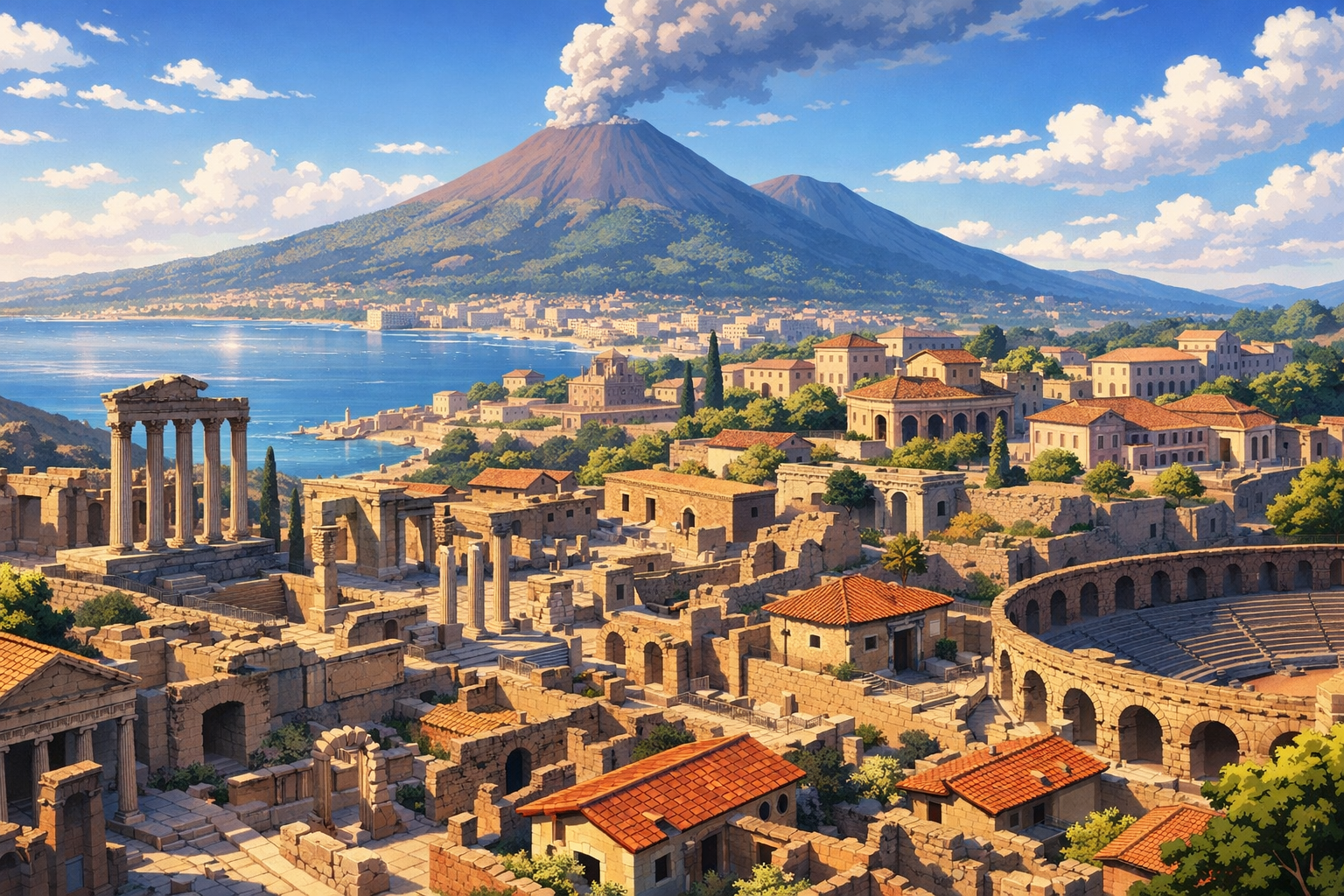
Trace the arc of ancient life around Vesuvius, from Naples to the ash-stilled streets of Pompeii and Herculaneum. Climb the crater, then discover lavish seaside villas at Oplontis and Stabiae and everyday treasures in Boscoreale, before returning to Naples with history still clinging to your shoes.

🧭 DAY-BY-DAY ITINERARY

Ready-made country and city routes with daily plans, sights, transport and accommodation. Buy PDF guides for independent travel.

🧭 DAY-BY-DAY ITINERARY


Day 1 — Naples: “tuning your eye” at the Archaeological Museum (MANN)

  • ✈️ Arrival in Naples (NAP) and check-in. During the day — Museo Archeologico Nazionale di Napoli (MANN): mosaics from the House of the Faun, Fourth Style frescoes, sculptures from the Farnese Collection. This is the best “key” to Pompeii and Herculaneum: the houses you see in the ruins you’ll connect with their original décor. Keep in mind the museum is large: allow 2.5–3 hours plus a coffee break in the cloister.

  • 🚶 Evening walk along the decumani of the historic center: feel the ancient layout of Neapolis, where the Greek street grid is still legible in the fabric of the city. Watch how dense medieval development “reinterprets” the ancient order — a useful comparison with the excavated cities by Vesuvius.


Day 2 — Naples: underground archaeology and bay panoramas

  • 🚶 In the morning — archaeological layers beneath the city (Napoli Sotterranea/metro “museum-stations” on the way to Piazza Garibaldi). This immersion in the city’s stratigraphy will help you “read” Pompeii as a multi-layered system. Then — a short walk out to the waterfront and Piazza del Plebiscito: the bay’s space shapes the key axes of how Naples and the whole bay are perceived, with traces of the AD 79 eruption.

  • 🛌 Evening rest: an early night before the “fieldwork” days in the excavations.

Day 3 — Pompeii (part 1): the forum, main arteries, and baths

  • 🚆 Circumvesuviana transfer: Napoli Garibaldi → Pompei Scavi–Villa dei Misteri (≈ 35–40 min). Entry via Porta Marina is convenient for starting at the Forum. Walk the axis Forum → Basilica → Temple of Apollo, then along Via dell’Abbondanza to the Stabian Baths: you’ll see how water and heat engineering “works” in a Roman city. Allow 4–5 hours of pure time + breaks.

  • 📸 At sunset — viewpoints by the Temple of Venus and the theatre portico: soft light brings out the plasticity of the masonry and frescoes.

Day 4 — Pompeii (part 2): houses and interiors + the Antiquarium

  • 🚶 Focus on houses: the House of the Faun (mosaics and atrium composition), the House of the Vettii (frescoes), the House of the Navigator/“Small Fountain” — different typologies and owners’ status are readable through layout and décor. After that — the Antiquarium (recommended entry/exit Piazza Esedra): context for the finds, plaster casts, thematic rooms. Plan 5 hours with a lunch break near Porta Marina.

Day 5 — Herculaneum: a city “in section” at the foot of Vesuvius

  • 🚆 Napoli Garibaldi → Ercolano Scavi (≈ 18–20 min). Herculaneum preserves storeys and beams: second floors, ceilings, wooden elements are visible. Walk the decumanus along the facades to the Houses with Black Halls and mosaics, look into the College of the Augustales and the boat sheds by the ancient shore — a dramatic page in the story of the eruption. 3–4 hours for the excavations + time for lunch.

  • 🖥️ After lunch — MAV (Virtual Archaeological Museum): reconstructions and AR scenes help “bring to life” what you saw on site and prepare you for the complex topography of Vesuvius.

Day 6 — Vesuvius: the “Gran Cono” crater + Oplontis (Villa of Poppaea)

  • 🚌 Vesuvio Express shuttle from Ercolano Scavi station to the Quota 1000 site (≈ 30–40 min), then the hike up to the crater (≈ 20–30 min one way). The landscape reveals the geometry of Somma–Vesuvius and the entire bay: you’ll understand why the cities ended up exactly here.

  • 🚆 Return to the Circumvesuviana and a short ride to Torre Annunziata–Oplonti (≈ 10–12 min). The Villa of Poppaea is the pinnacle of seaside-villa luxury: long peristyles, a pool, Second Style paintings, a “cinematic” palette and planning dramaturgy. 2–3 hours for the visit.

Day 7 — Boscoreale: Villa Regina and the Antiquarium (life beyond the city walls)

  • 🚆 To Villa Regina–Antiquarium station (≈ 10–15 min from Pompeii/Oplontis). Villa Regina is a rare “voice” of the rural economy: dolia in the wine room, a press, reconstructed vineyards. The Antiquarium explains the nature and daily life of the Pompeian ager — from agricultural cycles to fauna. Allow 2.5–3 hours, return by lunchtime and take a daytime rest.

Day 8 — Stabiae (Castellammare di Stabia): Villa Ariadne and Villa San Marco

  • 🚆 Circumvesuviana to Castellammare di Stabia (≈ 15–20 min), then on foot/taxi to the villas on Varano hill (≈ 20 min on foot to San Marco). Here — scale and panorama: enfilades, peristyles, triclinia with views of the bay. Set aside 3–4 hours to “read” both villas and compare them with the town houses of Pompeii.

Day 9 — Pompeii (part 3): amphitheater, “Pompeii for all,” outskirts and necropolises

  • 🚶 Entrance at Piazza Anfiteatro: the amphitheater (an early arena-and-barriers scheme), nearby — the Palaestra. Walk the accessible “Pompei per tutti” route with gentle slopes and pick up the “missed” houses of the eastern regions. On the way out — necropolises by the gates: epigraphy and rituals. 4–5 hours + time to rest.

Day 10 — Herculaneum: interior details + the ancient shoreline

  • 🚶 Return to Herculaneum for a targeted look at “second floors,” wooden grilles, lararia and kitchens. Go up to the upper terraces overlooking the “archaeological canyon”: you’ll see the burial cut sections and imagine the ancient shore. 3–4 hours and a leisurely lunch in the old Resina quarter.

Day 11 — Naples: wrap-up at MANN + free time

  • 🚆 Return to Naples. A short revisit to MANN focused on “your topics” (frescoes/mosaics/bronzes) — an excellent “synthesis” before departure. Then — free time: waterfront, coffee, souvenirs. In the evening — a final list of what you’ve “seen,” by key periods and typologies.

Day 12 — Departure: buffer for logistics

  • 🚌/🚆 Transfer to Naples Airport (Alibus/fixed-fare taxi) or to the railway station. If your flight is late — a short walk through the historic center for a “scale comparison”: Naples ↔ Pompeii/Herculaneum.

Flight tickets

eSIM for travel

Buy PDF guide

Buy PDF guide — 25.71 USD

PDF — 25.71 USD