
Buy PDF guide

Buy PDF guide — 25.90 USD

PDF — 25.90 USD

Easter Island

Easter Island

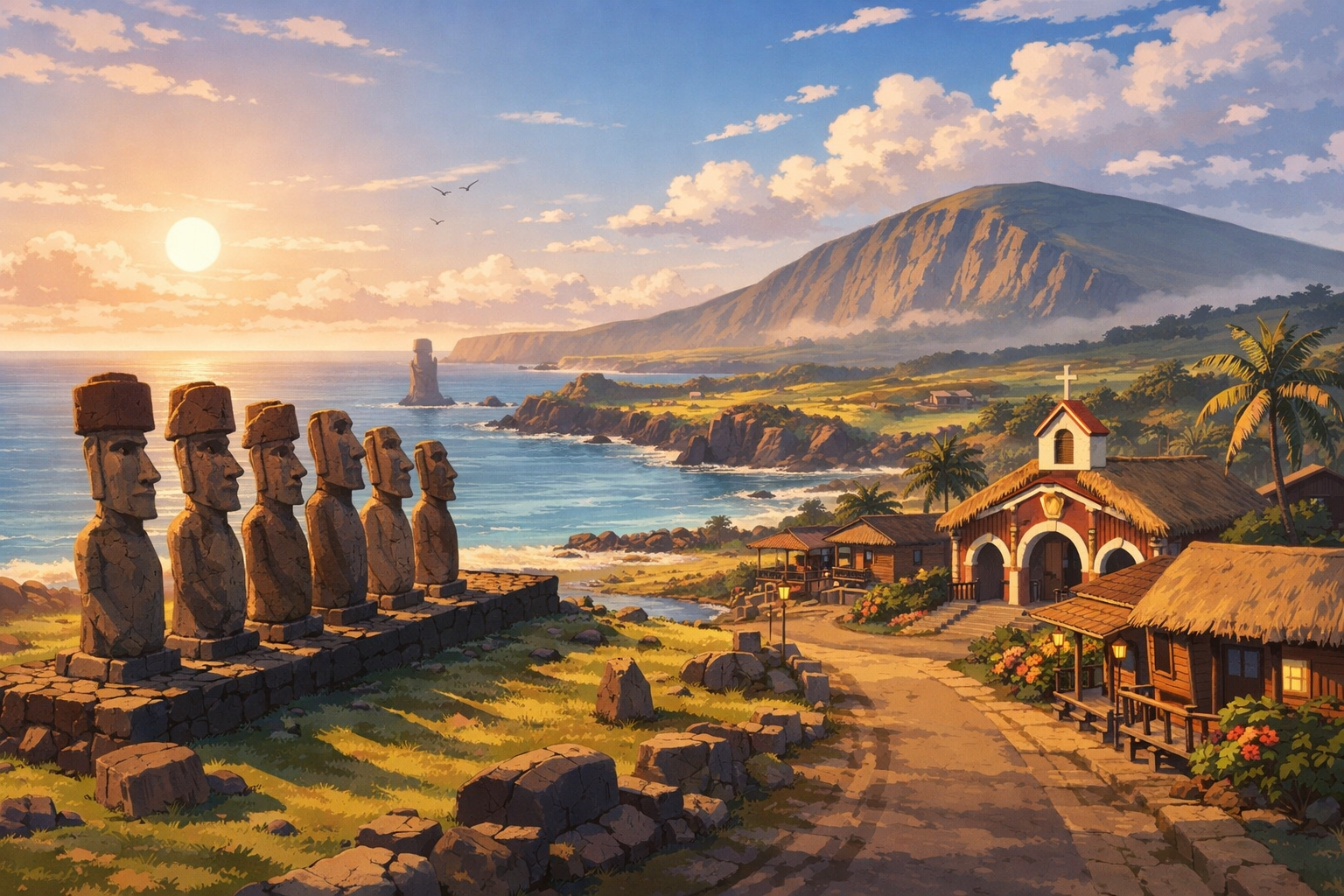
Fly from Santiago to remote Rapa Nui, where giant moai stand watch over windswept cliffs and the Pacific stretches endlessly in every direction. Easter Island feels both mysterious and deeply rooted, with dramatic volcanic landscapes, ancient ceremonial sites, and a culture unlike anywhere else in Chile.

🧭 DAY-BY-DAY ROUTE

Ready-made country and city routes with daily plans, sights, transport and accommodation. Buy PDF guides for independent travel.

🧭 DAY-BY-DAY ROUTE


Day 1 — Santiago: arrival and preparation for a remote island journey

  • 🚶 It’s best to keep the first day calm and practical: check into a hotel near the airport or in a convenient part of Santiago, get some sleep after the international flight, and prepare for the flight to Rapa Nui without rushing. It’s important to understand the logic of the trip: Easter Island is connected by regular commercial flights primarily through Santiago, and the journey to the island itself is no longer just an excursion, but a transition into an almost separate cultural world, where archaeology, the ocean, and volcanic terrain are read as one unified historical space.

  • 🕊️ In the evening — get an early rest. The flight to the island is long, so it’s better not to overload the schedule: check your accommodation booking, national park ticket, contact with your guide, and comfortable shoes for the rocky archaeological sites.


Day 2 — Flight Santiago → Rapa Nui (Hanga Roa) + Tahai Ceremonial Center

  • ✈️ Transfer: Santiago → Mataveri International Airport (IPC), Rapa Nui. The direct flight usually takes about 5 hours, after which the drive to your hotel in Hanga Roa is very short — most often 5–15 minutes, since the village and the airport are close together.

  • 🚶 After check-in and a short rest, head to Tahai Ceremonial Center — it is the perfect “first meeting” with the island. The complex is located not far from Hanga Roa, so it does not feel tiring on the day of arrival. Here, three restored ahu and the silhouettes of moai stand right by the ocean, and the soft evening light makes the stone seem almost alive. Tahai gives a very important first impression: you see not a separate statue, but an entire scene of an ancient ritual landscape, where the architecture of the platforms, the shoreline, the sky, and the wind work together. At sunset the place is especially expressive: the moai turn into dark vertical forms against the water, and the island begins to feel like a great sacred open-air theater.

Day 3 — Hanga Roa: Padre Sebastián Englert Museum + walk through the historic center

  • 🚶 Dedicate the morning to Museo Antropológico Padre Sebastián Englert — this is the best entry point into the history of Rapa Nui before field visits to the moai and ceremonial sites. The museum helps you see the people, craftsmanship, and belief system behind the monuments: here it becomes easier to understand that ahu are not just bases for statues, but complex ritual structures, and that the moai themselves were part of a broader social and spiritual order. Even if the collection feels intimate in scale, its value lies precisely in the context: after the museum, you begin to read the island not as a set of beautiful spots, but as a coherent cultural map.

  • 🚶 In the second half of the day — a relaxed walk around Hanga Roa. This is the island’s only town, and here the contrast between everyday life and the majestic antiquity all around is especially palpable. Walk to the waterfront, watch the surf, stop by craft shops, and return to the hotel early: tomorrow’s archaeological day is best started well rested.

Day 4 — Rano Kau + Orongo village: the Birdman cult and architecture on the crater’s edge

  • 🚗 Travel time: from Hanga Roa to the Rano Kau / Orongo sector is usually about 20–30 minutes by car or transfer. Plan an early departure to catch the soft light and fewer people at the viewpoints.

  • 🚶 Today’s route is one of the strongest on the island. Rano Kau reveals the volcanic nature of Rapa Nui: the huge crater with its green water mirror inside creates the feeling that you are looking into the ancient heart of the island. Nearby is Orongo — the ceremonial village associated with the Tangata Manu, or Birdman, cult. Here it is especially important to look not only at the stone houses, but also at their position on the edge of the cliff: this is architecture of extreme tension, facing the sea, the rocks, and the islets of Motu Nui, Motu Iti, and Motu Kao Kao. The place makes an almost mystical impression: the low stone forms seem to have grown into the ground, while the ocean panorama creates a sense of a boundary between the human world and the space of myth.

  • ☕ After the main walk, allow 45–60 minutes for rest and viewpoint stops. This is not a place to hurry through: Orongo reveals itself gradually, through the wind, silence, terrain, and the feeling of remoteness from the rest of the world.

Day 5 — East coast: Akahanga → Rano Raraku → Ahu Tongariki

  • 🚗 Travel time: Hanga Roa → Akahanga about 35–40 minutes; then another 15–20 minutes to Rano Raraku; from Rano Raraku to Ahu Tongariki just a few minutes. The day is best planned as a linear archaeological corridor along the eastern part of the island.

  • 🚶 This is one of the main days of the entire tour. Start with Akahanga — here the ruins of a village and fallen moai by the sea show the island not in a ceremonial way, but in a tragic historical dimension. Then head to Rano Raraku — the main quarry where the moai were created. This is, in essence, the “factory of sacred statues,” and it is here that it becomes clear just how extraordinary the vision of Rapa Nui culture was. On the slopes and in the ground you can see dozens of figures at different stages of completion: some seem to be just beginning to separate from the rock, others are almost ready for the journey. After the quarry, it makes sense to continue to Ahu Tongariki — the island’s largest restored platform with fifteen standing moai. After the “workshop” of Rano Raraku, Tongariki feels like the grand finale of the process: here the stone is no longer in extraction, but in monumental order, arranged facing the land with its back to the ocean. The space is very powerful and photogenic, but even more important is its architectural clarity: the platform, the line of statues, the horizon, and the sky combine into one of the strongest images in Polynesia.

Day 6 — Te Pito Kura + Anakena: monumentality and rest by an ancient shore

  • 🚗 Travel time: from Hanga Roa to Te Pito Kura usually about 35–40 minutes; then another 10–15 minutes to Anakena. After the intense day before, today calls for a gentler rhythm.

  • 🚶 In the morning visit Te Pito Kura — the site of the moai Paro, considered the largest of those transported from Rano Raraku. Here the scale of the engineering and ritual effort of the ancient society is especially tangible: even in its ruined state, the site conveys a sense of power and status. After that continue to Anakena — white sand, palm trees, and warm water create an almost idyllic image, but historically this is not just a beach, but an important place of memory associated with the legend of the arrival of Hotu Matu'a. Nearby stands Ahu Nau Nau with restored moai. The contrast is striking: among an almost tropical beach landscape stand ancient stone figures, and because of this Anakena is perceived not as a swimming area with archaeology, but as a rare place where natural beauty and the symbolic history of the island are joined especially harmoniously.

  • 🌴 After sightseeing, leave 1.5–2 hours for отдых by the water and lunch. In a twelve-day itinerary, such a “breathing” day matters: the island is better understood when archaeology, panoramas, and pauses alternate.

Day 7 — Puna Pau + Ahu Akivi: red pukao and one of the island’s most expressive platforms

  • 🚗 Travel time: to Puna Pau from Hanga Roa about 15–20 minutes; then to Ahu Akivi around 10–15 minutes. This is a convenient route without overly long drives.

  • 🚶 Puna Pau is not just another quarry, but a key to understanding the outward appearance of the moai. It was here that pukao — the distinctive “headdresses” or upper elements that change the perception of the statues and make their silhouette feel more complete — were made from red volcanic stone. The landscape of Puna Pau shows the craft side of the culture: you see the source of the material and unfinished forms, as if stepping into the production space of the ancient island. Then head to Ahu Akivi — one of the best-known platforms of Rapa Nui with seven moai. What matters here is not only the composition, but the open placement of the figures in the landscape itself: the site looks astonishingly pure, almost geometric, and the rhythm of the identically standing statues creates a rare feeling of calm monumental order. After the giant drama of Tongariki, this complex feels more composed and contemplative.

Day 8 — Vinapū and the architectural details of the southern sector

  • 🚗 Travel time: from Hanga Roa to Vinapū about 15–20 minutes. This is a relatively easy day logistically, and it is worth devoting not to the number of stops, but to the quality of observation.

  • 🚶 Vinapū is especially interesting for those who truly love architecture and stonework. Here the focus is not so much on the number of moai as on the platform masonry itself and the working of the stone. The complex is known for its carefully fitted blocks, which is why the site is often discussed in the context of the island’s highest construction culture. This is a good day for a “slow gaze”: come close to the platforms, study the lines of the stone, the rhythm of the joints, the interaction of material and surface. After powerful panoramic locations, Vinapū works as an intellectual pause — there is less theatricality here and more architectural precision.

  • ☕ In the second half of the day, you can return to Hanga Roa earlier and leave time for rest, a café, or another evening walk by the ocean. This rhythm helps keep the journey from turning into a race between locations.

Day 9 — Ana Te Pahu and the cave landscape: another side of the ancient island

  • 🚗 Travel time: to Ana Te Pahu from Hanga Roa about 15–20 minutes, plus time for the approach trail. Bring closed shoes and water.

  • 🚶 After several days among ahu and moai, it is useful to see another material side of Rapa Nui life — caves and shelters. Ana Te Pahu, the island’s largest lava cave, shows that the ancient world of Rapa Nui was made not only of ceremonial façades, but also of very practical spaces for survival, storage, and everyday life. The island’s volcanic essence is especially palpable here: passages, openings of light, damp air, plant roots, and dark vaults create an almost subterranean dimension of the route. This is not as grand a location as Tongariki or Anakena, but that is precisely why it is valuable: it helps you see Rapa Nui as a complex inhabited landscape, not only as a museum of moai.

Day 10 — Reserve archaeological day: revisit the strongest sites or take a private guided route

  • 🚙 It is wise to keep this day flexible. On Rapa Nui, weather, light, and your physical condition strongly affect the experience, so a reserve day is a great asset. It can be used for a return trip to Ahu Tongariki at sunrise, a more thoughtful visit to Rano Raraku, an additional trip to Anakena, or a custom route focused on the sites that interested you most.

  • 🚶 For a historical tour, this is not an “empty” day, but a day of deepening. A repeat visit on the island often turns out to be even stronger than the first: once the effect of novelty fades, you begin to notice architectural details, the mutual placement of platforms, traces of destruction and restoration, as well as the connection between the terrain and sacred geography.

Day 11 — Slow day in Hanga Roa: crafts, sea, and a final return to Tahai

  • 🚶 After a series of excursions, it is worth giving yourself a calm final day on the island. In the morning — a late breakfast and a walk around Hanga Roa; during the day you can buy books or items made by local artisans; and in the evening head once more to Tahai Ceremonial Center. Returning to a familiar place at the end of the route works especially well: now you look at the moai not as an exotic symbol, but as part of a complex historical system that you have already come to know through the quarry, platforms, villages, caves, and museum.

  • 🌅 A sunset at Tahai at the end of the trip is usually felt more deeply than on the day of arrival. It is a beautiful conclusion to the island part of the journey: archaeology here joins with a sense of distance, silence, and the dignity of the place.

Day 12 — Flight Rapa Nui → Santiago and end of the route

  • ✈️ Transfer: Hanga Roa / Mataveri Airport → Santiago. From most hotels, the airport is only a very short drive away, usually within 5–15 minutes, but on the island it is better not to leave for the airport at the last moment.

  • 🚶 It is best to leave this day without any additional program. After returning to Santiago, you can either connect directly to an international flight or spend one technical night in the city. By this point, the route usually comes together as a complete line: museum context → cult villages → moai quarry → monumental ahu → residential and natural spaces of the island. This is how Rapa Nui reveals itself not as a collection of famous photographs, but as one of the most powerful historical and architectural cultures of the Pacific.

Flight tickets

eSIM for travel

Buy PDF guide

Buy PDF guide — 25.90 USD

PDF — 25.90 USD