
Buy PDF guide

Buy PDF guide — 25.71 USD

PDF — 25.71 USD

NUREMBERG • OLD TOWN AND FORTRESS

NUREMBERG • OLD TOWN AND FORTRESS

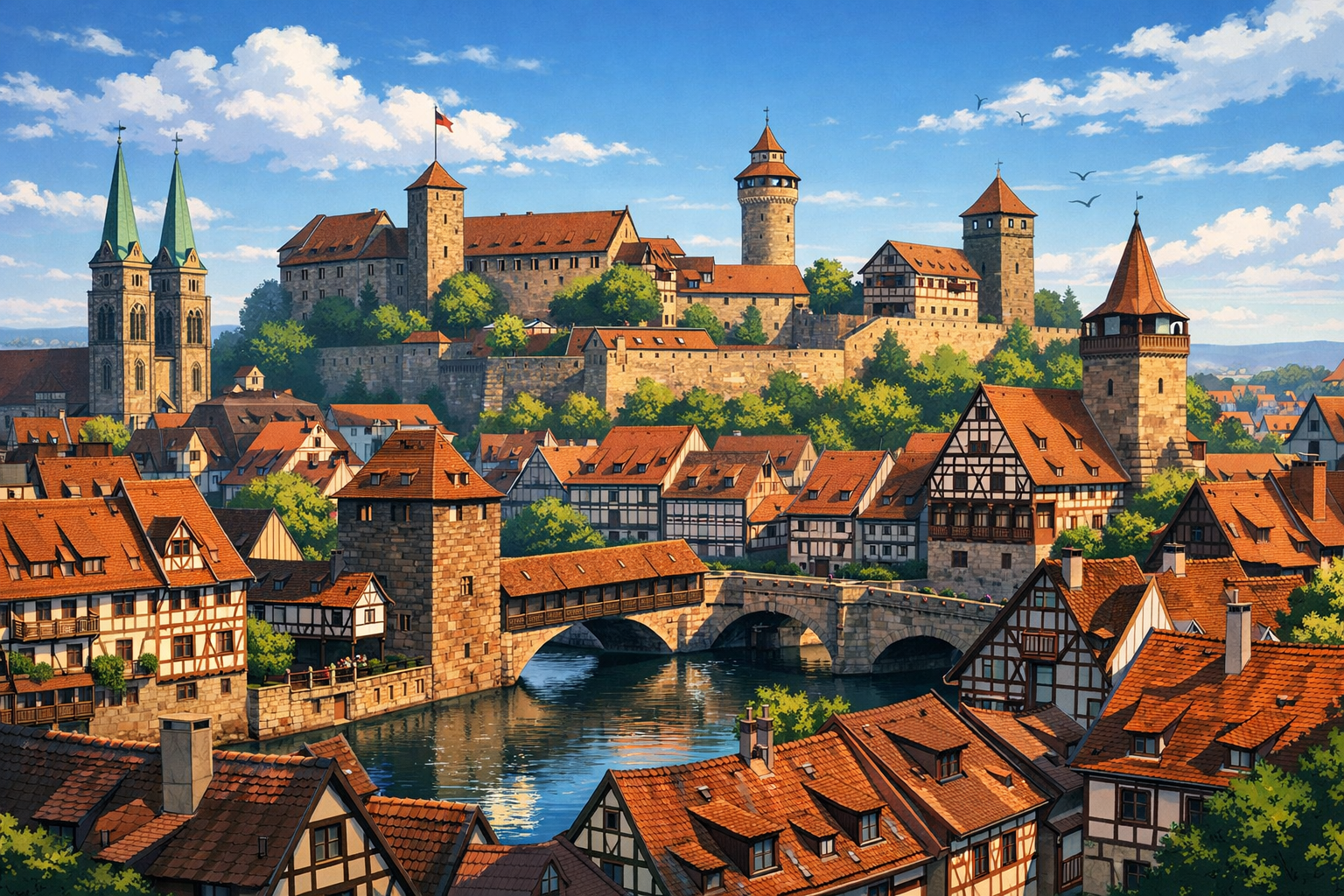
Step into Nuremberg’s storybook Old Town crowned by the Imperial Castle, then confront history at the former Nazi Party Rally Grounds around Dutzendteich and in the city’s haunting underground passages. Between lively museums and beer cellars, it’s an ideal base for day trips to Bamberg, Rothenburg ob der Tauber, and riverside Regensburg.

🧭 DAY-BY-DAY ITINERARY

Ready-made country and city routes with daily plans, sights, transport and accommodation. Buy PDF guides for independent travel.

🧭 DAY-BY-DAY ITINERARY


Day 1 — Arrival and “entering” the Old Town

  • ✈️/🚇 Transfer from Nuremberg Airport to the center: U2 metro line toward Röthenbach goes straight to Hauptbahnhof in ~12–13 minutes. Check-in and an easy walk along the Königstraße — Handwerkerhof — Lorenzkirche axis. It’s easy to “read” the medieval city here: building density, trading rows, the flow of people toward Hauptmarkt.

  • 🚶 Evening by the Schöner Brunnen and the façade of Frauenkirche at Hauptmarkt. At sunset, the contrast of marble details and red roof tiles is especially striking: a good moment to set your “optical calibration” for Franconian brick Gothic.


Day 2 — Kaiserburg (Imperial Castle) and bastions

  • 🚶 Kaiserburg Nuremberg is a complex where you can trace the evolution of medieval fortification: the Palas with its double chapel (a rare two-level type), the Sinwellturm as the dominant landmark, and the Tiefer Brunnen—a fortress’s engineering “lifeline.” Walk the terraces of the Burggarten and along the curtain walls: the city view reveals the link between terrain and defense.

  • ☕ A break in the shade of the walls at Bürgermeistergarten: views of the half-timbered gables of Weißgerbergasse and the sculptural roofscape of the Old Town—an ideal backdrop for concise notes on the fabrics of the 16th–17th centuries.

Day 3 — Dürer and the northern Sebald side of the Old Town

  • 🚶 The quarter by Tiergärtnertor: the Albrecht Dürer House museum (Albrecht-Dürer-Haus) is a rare late-medieval urban house showing everyday life, a workshop, and the era’s techniques. On the square there’s a dense ensemble of half-timbering and stone plinths; nearby are the Pilatushaus and a picturesque approach to the fortress.

  • 🚶 Weißgerbergasse is the street of artisans and dyers: long façades, overhanging upper floors, and the warm timber tones of restored structures. Compare Dürer’s “icon house” with the “mass” of the urban fabric—this is how you read everyday architecture versus a “museum piece.”

Day 4 — Germanisches Nationalmuseum and the “Way of Human Rights”

  • 🚶 The Germanisches Nationalmuseum (Kartäusergasse 1) is the largest cultural-historical collection in the German-speaking world. Build a route from late Gothic sculpture (Veit Stoss, Adam Kraft), interiors, and decorative arts to Art Nouveau. In the courtyard is Dani Karavan’s “Straße der Menschenrechte” (Way of Human Rights): an example of how public sculpture rethinks a museum’s urban threshold.

  • 🖼️ Afterwards—Neues Museum Nürnberg (Klarissenplatz): Volker Staab’s contemporary architecture with a concave glass façade, placing the old town and the present in dialogue. An important “counterpoint” to the Gothic and the fortress.

Day 5 — Underground Nuremberg: Felsengänge and the Historic Art Bunker

  • 🕳️ Tour of the Historische Felsengänge (Bergstraße 19): a network of cellars and passages carved into the castle sandstone—from beer cellars to a civil-defense system. The layers of history here are literal: vaults, ventilation, level markers—a textbook of “architecture underground.”

  • 🛡️ The Historischer Kunstbunker (Obere Schmiedgasse 52) is a bomb shelter where the city’s masterpieces were evacuated during WWII. Climate engineering, layered protection, and carefully planned storage logistics offer a rare look at the “invisible” infrastructure of heritage preservation.

Day 6 — City Museum in the Fembohaus and the Toy Museum

  • 🏛️ Stadtmuseum im Fembohaus (Burgstraße 15): a lavish Mannerist façade from the 1590s and a “house-encyclopedia” of city history—from interior “cabinets” and carved ceilings to Nuremberg’s multimedia panorama theater.

  • 🧸 Spielzeugmuseum (Karlstraße 13–15): for centuries, Nuremberg produced toys; the collection of wood, tin, model railways, and dolls offers a rare slice of everyday culture and design. A great “light” second half of the day.

Day 7 — Documentation Center and the Nazi Party Rally Grounds

  • 🏟️ The Documentation Center at the Nazi Party Rally Grounds (Bayernstraße 110): architecture as a propaganda tool—and its critical reading today. Follow the route around Dutzendteich: Kongresshalle, Zeppelinfeld, Große Straße—a ruler for scales, proportions, and axes designed for mass spectacles.

  • 🌳 A pause by the Dutzendteich lakes: calm water “dissolves” the rigid composition, giving space for reflection. In the evening, take the tram back to the center.

Day 8 — A transport hub of memory: DB Museum and the Museum of Communication

  • 🚆 DB Museum (Lessingstraße 6) is Germany’s oldest railway collection: from the “Adler” to models and salon cars. Understanding 19th–20th century railway infrastructure helps you read the growth of cities and industrial architecture.

  • ✉️ Nearby is the Museum für Kommunikation Nürnberg: visual codes, communications technology, interface design. A good “technology ↔ society ↔ form” pairing on the eve of trips to the surrounding region.

Day 9 — Bamberg (day trip)

  • 🚆 Round trip: Nürnberg Hbf → Bamberg Hbf (RE/S-Bahn, ~35–50 min; trains run frequently). Route: the Romanesque cathedral (four-tower silhouette and the “Bamberg Horseman” sculpture), the Old Town Hall on the island, “Little Venice,” climb up to Altenburg. The city is a textbook of medieval vertical landmarks and riverfront façades.

Day 10 — Rothenburg ob der Tauber (day trip)

  • 🚆 Nürnberg Hbf → Ansbach/Steinach → Rothenburg ob der Tauber (regional trains, usually with 1 transfer; ~1 h 45 min–2 h one way). A loop walk along the walls, Plönlein, and narrow fronts of half-timbered houses—rare wholeness of a medieval town. Return to Nuremberg in the evening.

Day 11 — Regensburg (day trip)

  • 🚆 Nürnberg Hbf → Regensburg Hbf (RE ~1 h 10 min–1 h 30 min). Route: the 12th-century Stone Bridge, the Gothic cathedral, Porta Praetoria—an ancient trace within the medieval fabric. Optional: trip to Walhalla (bus/taxi from Regensburg) for a Danube panorama.

Day 12 — The judgment of history and a final cadence

  • ⚖️ Memorium Nürnberger Prozesse (Bärenschanzstraße 72) in the Justizpalast complex: Courtroom 600, a multimedia account of the International Military Tribunal of 1945–1946—an important conceptual “afterword” to the day at Dutzendteich.

  • 🚶 A final walk through your favorite quarter (Sebald/Lorenz), coffee by the walls and a farewell look at the Kaiserburg terraces. Transfer to the airport via U2 (~12–13 minutes to Hauptbahnhof; then to Flughafen) or taxi/transfer depending on departure time.

Flight tickets

eSIM for travel

Buy PDF guide

Buy PDF guide — 25.71 USD

PDF — 25.71 USD