Buy PDF guide

Buy PDF guide — 12.90 USD

PDF — 12.90 USD

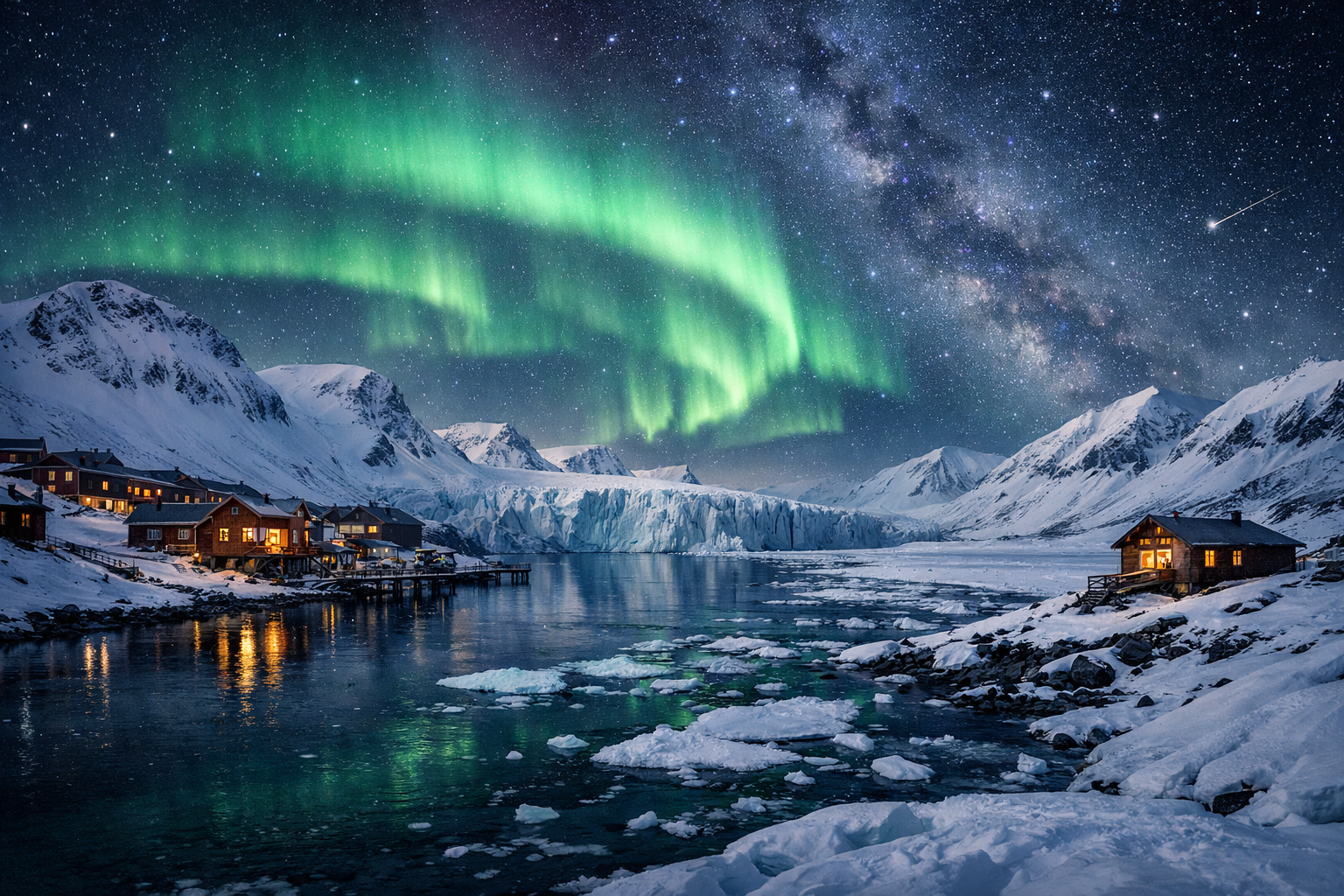
Norway, Svalbard. An expedition to the polar night region with observation of the starry sky, the northern lights, glaciers, and snow-covered Arctic valleys, only accompanied by local guides.

Norway, Svalbard. An expedition to the polar night region with observation of the starry sky, the northern lights, glaciers, and snow-covered Arctic valleys, only accompanied by local guides.

Journey into Svalbard’s polar night from Longyearbyen, where snow-covered valleys, blue ice caves, and silent Arctic wilderness unfold under a sky filled with stars. With local guides leading the way, you may witness the northern lights dancing above glaciers and the remote beauty of Bjørndalen before returning to town.

🧭 DAY-BY-DAY ROUTE

Ready-made country and city routes with daily plans, sights, transport and accommodation. Buy PDF guides for independent travel.

🧭 DAY-BY-DAY ROUTE


Day 1 — Longyearbyen: arrival in the polar night and first acquaintance with Arctic darkness

  • ✈️ Arrival at Svalbard Airport, Longyear (LYR) and transfer to Longyearbyen by airport shuttle, which usually meets all arrivals and drops passengers off at hotels. The drive to the center is short, about 10–15 minutes, but in winter allow extra time for baggage claim, warm gear, and an unhurried check-in.

  • 🏔️ Longyearbyen during the polar night season is one of the rarest places in Norway, where darkness becomes not an absence of impressions but the main natural event of the trip. From mid-November to late January, the sun does not rise above the horizon, and the usual change of day and night almost disappears. Instead, the traveler lives within the finest shades of blue, violet, and charcoal-black light, where snowy slopes, the Longyeardalen valley, and the scattered lights of the settlement create the feeling of the edge of the inhabited world. It is here that you especially understand why people choose Svalbard not for “checking a box,” but for its atmosphere — cold, quiet, cosmic, and almost unreal.

  • 🚶 After some rest — a short walk through central Longyearbyen only within the illuminated urban area: the church, a few cozy streets, views of the valley, and your first impressions of the Arctic air. It is important not to go beyond the settlement limits on your own: outside the safe zone, movement around Svalbard is allowed only with local guides, as strict wilderness safety requirements apply here, including the risk of encounters with polar bears and rapidly changing weather conditions.

  • 🌌 In the evening — an introductory guided aurora & stars walk with a local guide to the outskirts of Longyearbyen, where light pollution is already noticeably lower than in the center. This first outing should not be too long: after the flight, your body needs time to adapt to the cold, dry air, and total darkness. If the sky is clear, you may see bright winter constellations, bands of the Milky Way, and, with a favorable combination of cloud cover and geomagnetic activity, faint or vivid arcs of the northern lights. Aurora viewing is always a matter of probability: it cannot be guaranteed even in the ideal scenery of Svalbard.

  • 💤 The daily pace of this expedition is intentionally gentle: the difficulty is moderate, and the main goal is not to exhaust yourself with forced marches, but to build up energy for night outings and long periods of nature observation. The best start to the season is around the new moon or with a thin crescent, when there is less moonlight glare and a better chance of contrast in the starry sky, but even at full moon the landscape can look fantastic, because snow and ice begin to glow with reflected cold light.


Day 2 — Adventdalen: dark valleys, astro-landscapes, and aurora hunting with a guide

  • 🚙 On the second day, it makes sense to take a half-day pause for rest and a museum visit, and shift the main nature block to the second half of the “conditional day” and evening. After a late breakfast — free time, adjusting clothing layers, and checking the forecast for cloud cover, wind strength, temperature, moon phase, and geomagnetic conditions. For an astro trip, this is not a formality but one of the key success factors: even strong solar activity will not help if the valley is covered by dense clouds or a blizzard starts.

  • 🌨️ During the day — a short window for visiting Svalbard Museum to better understand the natural and historical context of the expedition. After this museum introduction, the dark valleys are perceived differently: as a space of survival, exploration, and an ongoing dialogue between humans and the Arctic.

  • 🌌 The day’s main outing — a guided evening expedition to Adventdalen, one of the most accessible yet striking valleys near Longyearbyen. Here the terrain opens into broad snow-filled basins, and the darkness works like a giant backdrop for celestial phenomena. When the sky is clear, the mountain ridges become only a thin black line, and above them stars flare into view in numbers that are almost never seen in cities. This spot is valued precisely for its combination of accessibility, safety within a group, and an expressive Arctic landscape.

  • ✨ During clear hours, the guide chooses a point with minimal glow from the settlement, taking into account the wind and snow conditions. If geomagnetic activity is sufficient, you may see the northern lights as milky arcs, green ribbons, or slowly moving curtains. Sometimes the spectacle develops gradually, and sometimes the sky remains calm all evening — and that is a normal part of the Arctic experience. Even without aurora, the outing is valuable in itself: in the silence of the polar night, the mountains, icy air, and scattering of stars create an almost meditative impression.

  • 📷 This is one of the best days for astrophotography: the valley works well for shots with snow-lit slopes, tracks in the snow, human silhouettes, and the sky. But equipment cools down quickly, batteries drain noticeably faster, and working without gloves is dangerous for your hands, so the outing remains expedition-style rather than “Instagram-style.” Plan your return to the hotel with enough time for a hot shower and sleep.

Day 3 — Ice cave and glacier: underground darkness, snow, and Arctic geology

  • 🛷 Today is devoted not only to the sky, but to the very substance of the Arctic — ice. Accompanied by local guides, head out on a winter excursion to an ice cave in the glacier area near Longyearbyen. The exact route and transport method depend on the season, snow conditions, wind, and the operator’s decisions: it may be snow transport with a short walk or a combined program. Such outings are not planned independently: safety on ice and in caves requires experience, equipment, and knowledge of current conditions.

  • 🧊 An ice cave in Svalbard is almost the opposite of sky observation, but in the context of the expedition it works perfectly. Outside, you are surrounded by dark valleys and open sky, while inside the glacier there is a fragile, transparent, bluish-gray world where the light of headlamps passes through layers of ancient snow and compacted ice. Ceilings of bubble ice, narrow passages, winding forms, and absolute silence create the feeling that you have stepped inside frozen time.

  • 🏔️ On the way, the guide usually explains glacier structure, seasonal changes, and how climate, wind, and snow shape this landscape. Even a short outing to a glacier area provides one of the strongest visual contrasts of the whole trip: white slopes, black rocky mountain ribs, bluish shades of ice, and a deep winter darkness that on Svalbard never looks flat.

  • ☕ After returning — a long rest. This is important because a moderate-difficulty expedition is built not on constant movement, but on alternating activity and recovery. In the evening, a short backup aurora-watch near the settlement or from a point suggested by the guide is possible if the forecast suddenly improves. On this day, it is especially wise not to force a second activity: after the glacier, the body has usually already had enough physical exertion.

  • 🔭 If it clears up at night, the polar night can give a rare effect of sky depth: against the backdrop of an almost complete absence of twilight, the stars seem not just bright, but three-dimensional. But again, it is important to remember: neither clear skies, nor aurora, nor interesting atmospheric phenomena such as faint lunar halos, light pillars, or snow haze can be promised in advance.

Day 4 — Bjørndalen and dark coastal spaces: sea, snow, and wide sky

  • 🌊 Today the route shifts toward coastal spaces and more open panoramas. Accompanied by a local guide, head to the Bjørndalen area or another permitted and safe point outside the settlement chosen by the operator according to current conditions. For hunting celestial phenomena, such locations are especially valuable: they offer a wider horizon, sometimes a better “window” between mountain massifs, and a more dramatic composition than the narrow streets of the settlement.

  • ❄️ Svalbard’s coastal winter landscape amazes not with brightness but with scale. The dark line of the sea, snowy embankments, icy wind, traces of blizzards on the surface, and rare lights in the distance create a feeling of almost planetary emptiness. Here you feel especially sharply that a trip to Svalbard is an expedition into an environment where humans do not dominate, but only temporarily exist. Even a short stop in such an area is remembered for a long time through the sound of snow under boots, the density of the cold, and the silence.

  • 🌌 From the perspective of sky observation, this is one of the most promising evenings of the route if three factors align: breaks in the cloud cover, moderate wind, and a not-too-bright Moon. In open places, the northern lights can feel especially impressive because their movement is visible across a large part of the sky at once. Sometimes it is only a pale strip above the horizon, sometimes rapidly changing curtains and rays. But even in a very successful season, neither the strength nor the duration of the phenomenon can be promised.

  • 🌠 During winter meteor shower periods, the guide may separately point out the chance to see individual meteors, especially under dark skies and without strong moonlight glare. However, meteor observation at such latitudes also depends entirely on many conditions aligning. The same applies to light pillars, lunar halos, frost on slopes, and rare optical effects — the Arctic is generous with atmosphere, but not with guarantees.

  • 🧭 Return to Longyearbyen late in the evening. It is precisely after such outings that the contrast of the settlement feels especially pleasant: a small island of warmth, light, and civilization amid an immense dark emptiness. This psychological effect is an important part of the true winter Svalbard experience.

Day 5 — Longyearbyen: cultural pause, Nordover, church, and backup night for aurora

  • 🖼️ After several intense nature outings, it is useful to make the day physically gentler. In the morning — a late breakfast and an unhurried visit to Nordover Art Centre. In Svalbard, contemporary art, northern light, landscape, and local identity combine surprisingly well: after dark valleys, ice caves, and windy plateaus, the exhibition space feels like an intellectual continuation of the expedition.

  • ⛪ Then it is worth visiting Svalbard Kirke — one of the northernmost churches in the world and an important cultural point in Longyearbyen. In an Arctic settlement, the church feels not only like a religious space, but also as a place of human warmth, community, and resilience. Against the backdrop of harsh nature, its calm atmosphere is especially touching.

  • ☕ During the day — full rest, drying clothes, sorting photos, and a reserve of time for changing plans according to the weather. In an expedition trip to Svalbard, this is not an “empty window,” but a strategic pause. If previous days were cloudy, today may be the day to move the main night outing. If the weather worsens, the day will still remain comfortable even without a distant excursion.

  • 🌌 In the evening — a backup guided aurora / star session. It is needed not for repetition, but for probability: it is better to allow several attempts for aurora and clear skies. The guide chooses the most suitable direction based on the latest forecast — closer to Adventdalen, toward more open terrain, or to a safe edge of the settlement. This flexible approach is far more realistic than a rigid fixed scenario.

  • 🌕 Pay separate attention to the Moon: if your trip falls on a bright full moon, the sky may seem less contrasty for stargazing, but the landscape itself becomes stunningly legible — snow, ridges, and valleys seem lit from within. If you come during the period around the new moon, the chance of a maximally dark sky and expressive astrophotography increases. Both scenarios are beautiful in their own way; they simply create different expedition aesthetics.

Day 6 — Longyearbyen: final walk, gear shopping, and departure

  • 🧳 It is best not to overload the last day. After breakfast — calm packing, a short walk around the settlement, and buying local souvenirs or warm accessories in outdoor shops. If your departure time allows, you can go once more to a viewpoint within the safe urban zone and take one last look at how the lights of Longyearbyen dissolve into the dark Arctic valley.

  • 🏔️ The finale of this route is not about “squeezing in one more location,” but about consolidating the impression. In six days, Svalbard reveals itself as a rare destination for those who travel specifically for natural phenomena: polar night, snow, mountains, glaciers, dark valleys, and the chance to see the sky in its northern, almost cosmic version. Here it becomes especially clear that the best moment of the trip often cannot be planned in advance: it is formed by clouds, wind, moonlight, silence, and a few minutes of suddenly living sky.

  • 🚐 Transfer to the airport by shuttle or taxi. In winter Svalbard, always arrive with extra time: the weather can make adjustments, and no one needs hypothermia before a flight.

  • ⚠️ Important final reminder: northern lights, meteors, clear starry skies, light pillars, lunar halos, cloud inversions, unusual moonlight on snow, and any other natural phenomena on such a route are probabilistic in nature. Their visibility depends on cloud cover, moon phase, solar activity, atmospheric transparency, wind, the condition of the snow surface, and current local restrictions. Bioluminescence and the southern lights are not relevant observation targets for this winter route in this region.

Flight tickets

eSIM for travel

Buy PDF guide

Buy PDF guide — 12.90 USD

PDF — 12.90 USD