
Buy PDF guide

Buy PDF guide — 12.90 USD

PDF — 12.90 USD

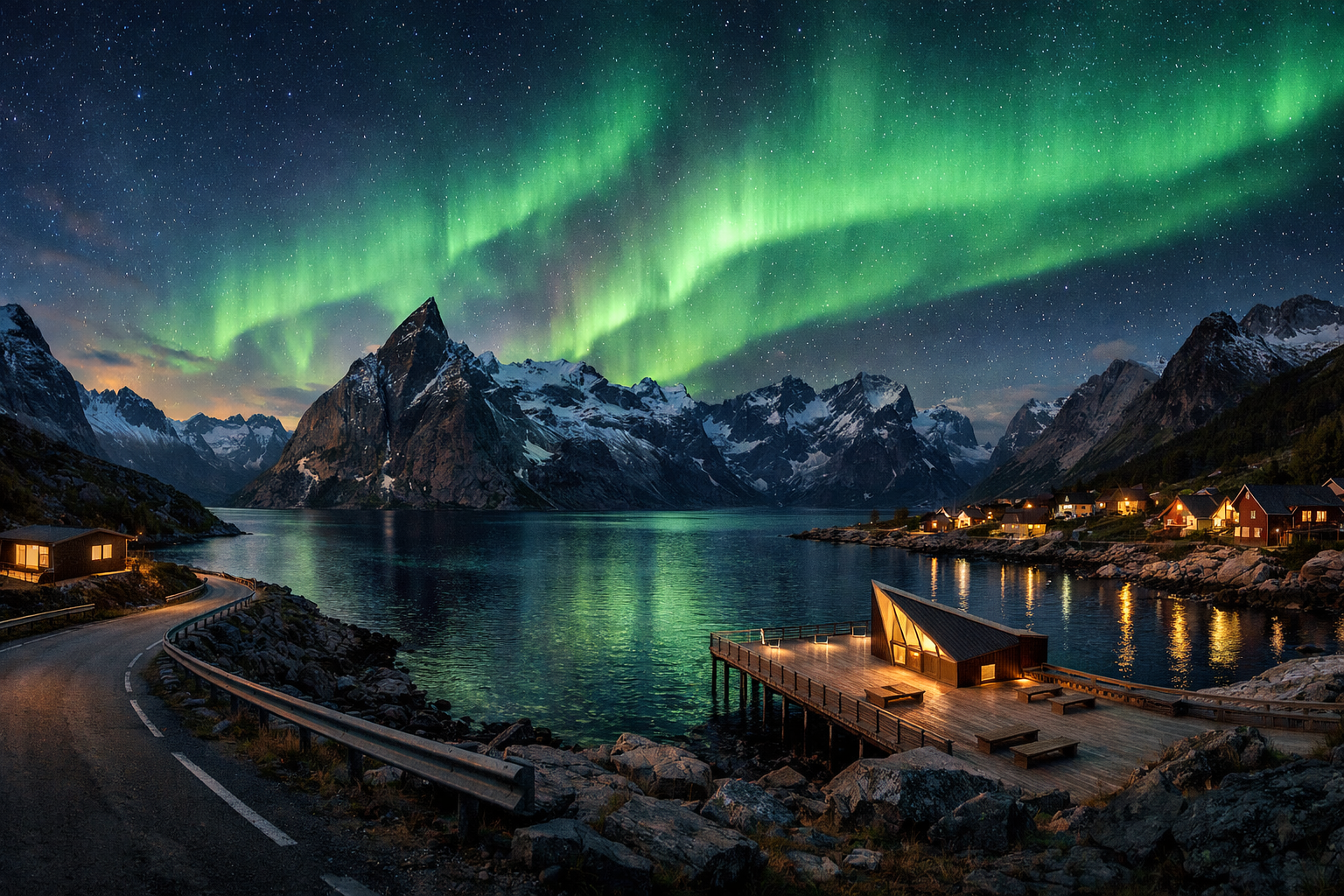
Norway, Senja Island. A journey along the national scenic routes with overnight stops by fjords, mountain passes, and open beaches for observing the Northern Lights.

Norway, Senja Island. A journey along the national scenic routes with overnight stops by fjords, mountain passes, and open beaches for observing the Northern Lights.

Discover Senja Island on a spectacular drive through one of Norway’s most dramatic landscapes, where winding scenic routes lead past deep fjords, rugged mountain passes, and wild Atlantic beaches. By night, settle into quiet coastal stays from Tungeneset to Mefjordvær and Hamn, with excellent chances to watch the Northern Lights shimmer across the Arctic sky.

🧭 DAY-BY-DAY ROUTE

Ready-made country and city routes with daily plans, sights, transport and accommodation. Buy PDF guides for independent travel.

🧭 DAY-BY-DAY ROUTE


Day 1 — Bardufoss → Finnsnes → Mefjordvær: entering the Arctic landscape

  • 🚗 After arriving in Bardufoss, it is convenient to rent a car and head toward Senja via Finnsnes without rushing. This is the most realistic winter entry into the route: the drive to Finnsnes usually takes about 45 minutes, and after that begins a gradual transition from mainland logistics to the harsher island geography. Even on the approach to Senja, the scenery becomes distinctly northern: narrow bands of water, a low sky, dark conifer patches, breaks in the clouds, and sudden clearings above the fjords. It is best not to overload this day with long activities: the main task is to arrive calmly, check in, buy groceries, and check the evening forecast for cloud cover, wind, and geomagnetic activity.

  • 🚗 Transfer: Bardufoss Airport → Finnsnes ≈ 45 minutes, Finnsnes → Mefjordvær/Mefjord Brygge ≈ 2 hr 20 min–2 hr 40 min depending on weather and road conditions. The overall route is comfortable for the first day, but in winter you should allow extra time for snow, ice, and short stops.

  • 🌌 In the evening, it is better to make a short first outing to the open coast near Mefjordvær or to one of the safe roadside points along the route without long walks. The Arctic darkness is felt especially strongly here: the mountains block part of the horizon, while the sea line creates wide openings in the sky. At new moon or close to it, the chances of a bright starry sky are higher, while under a full moon the sky still remains beautiful, but the contrast is weaker and faint aurora details are harder to see. The Northern Lights are possible only with a combination of clear breaks, sufficient solar activity, and locally dark skies — the outcome is always probabilistic and never guaranteed.

  • 🛟 First-night mode: avoid pulling into uncleared lay-bys, do not approach wet rocks by the water, and do not plan beach walks in stormy wind. The best observations often happen not at the most remote point, but where there is safe parking, stable footing, and a quick return to a warm room.


Day 2 — Tungeneset, Ersfjordstranda, and coastal spots for dark skies

  • 🚶 This day is dedicated to the classic points of the Senja National Scenic Route. In the morning and daytime, it is worth visiting Tungeneset — one of the most photogenic viewpoints on the island. The wooden boardwalk extends above the rocks between the fjords and gives an almost theatrical frontal view of the jagged Okshornan mountain silhouette. Even without extreme trekking, you can feel the scale of northern nature here: the sea is heavy and dark, the stone is rough and cold, and the air is literally filled with salt and wind.

  • 🚶 Then it makes sense to continue to Ersfjordstranda — the famous white beach deeply set into the mountain amphitheater of Ersfjord. By day, it is one of the most beautiful coastal locations on the route, and by night — potentially one of the best sky-watching points on the island thanks to the open sector above the water and relatively low light pollution. It is especially good here to watch faint green aurora arcs above the northern horizon if the clouds break in bands and clear windows appear between them.

  • 🚗 Local drives: Mefjordvær → Tungeneset ≈ 20–25 minutes, Tungeneset → Ersfjordstranda ≈ 10–15 minutes; even with stops and photo pauses, the day remains easy in terms of mileage and is well suited to a winter pace.

  • 🌠 If the trip falls during active meteor shower periods, for example the Geminids in December or the Quadrantids in early January, Ersfjordstranda and nearby open areas can provide a beautiful sky view. But observation intensity depends heavily on cloud cover, the Moon, and air transparency. Even at the shower’s peak, there is no guarantee that the sky will clear at exactly the right hours.

  • 🌊 On the coast of Senja, people sometimes talk about bioluminescent phenomena in the water, but this requires the right season, sea conditions, absence of a bright Moon, and local biological factors to align. Such observations are extremely unpredictable, so they should be treated only as a rare bonus, not as a mandatory part of the plan.

  • 🛟 For an evening sky hunt on the beach, warm windproof clothing, a headlamp with red light, a thermos, dry footwear, and strict control of time spent in the cold are essential. Do not go down to the water onto slippery rocks, and keep in mind the tide and wave conditions: the shore here is beautiful, but at night it should remain a place for short and disciplined observation.

Day 3 — Mefjordvær and the Segla area: fjords, mountains, and an evening trip to Fjordgård

  • 🚶 During the day, you can do a moderately challenging hiking part of the route in the Fjordgård area, choosing a safe seasonal format. A full winter ascent of Segla requires confidence, snow assessment, and sometimes experience moving in more demanding conditions, so for most travelers it is wiser to choose the lower scenic sections, a short hike to viewpoints near Fjordgård, or part of the route toward viewing positions for Segla and Hesten without necessarily attempting the summit. In the warmer shoulder season and on a dry trail, the classic Segla route takes about 3 hours 30 minutes, but in autumn and winter the timing, difficulty, and safety conditions change dramatically.

  • 🚶 The Fjordgård area is impressive even without heroic hiking. Here Senja shows its “Alpine” side: dark mountain walls rise almost straight out of the water, the fjord reaches deep into the island, and the houses of the fishing villages look almost toy-like against the backdrop of stone massifs. This is one of those landscapes where it is interesting not only to walk, but also simply to stop, listen to the silence, watch clouds catch on the ridges, and wait for short flashes of sunlight over the water.

  • 🚗 Drive: Mefjordvær → Fjordgård and back usually takes about 1 hr 30 min–2 hr total, depending on road conditions and the number of stops. This makes the day full but not overloaded.

  • 🌌 In the evening, you can repeat the “hunting for clear windows” tactic: first check the local cloud forecast, then choose not one fixed point but 2–3 backup coastal locations within an hour’s drive. On Senja this is especially important: one fjord may be completely covered by cloud, while the neighboring one may be unexpectedly clear. This kind of flexible outing works for aurora viewing, not a blind bet on one open spot.

  • ☁️ On cold, calm nights, beautiful cloud inversions or low fog layers are possible in sheltered parts of the fjords. These cannot be promised in advance, but during clear intervals they create an almost cosmic effect: peaks and stars remain above a soft “sea of clouds,” and with a faint aurora the scenes become especially atmospheric.

Day 4 — Bergsbotn, Bøvær, and Hamn: the strongest panoramas of western Senja

  • 🚗 Today the route shifts farther south along the Senja National Scenic Route toward Bergsbotn and Hamn. This is one of the most beautiful driving days of the whole trip. The Bergsbotn viewpoint literally hangs above Bergsfjord and offers a wide, almost cinematic panorama: the water stretches deep between the mountains, the village looks tiny, and the perspective itself seems made for watching the changing northern light. Even in overcast weather, this place makes a strong impression, and on a clear frosty day it looks almost unreal.

  • 🚶 On the way, it is worth making calm stops in Bøvær or at coastal lay-bys if the surface and parking are safe. Here the character of Senja as an island of contrasts is especially visible: the harsh outer ocean line lies beside sheltered fjord basins, and short drives completely change the mood of the landscape. This is an ideal day for unhurried photography, observing the light, and choosing a night base with a good view of the sky.

  • 🚗 Drive: Mefjordvær → Bergsbotn ≈ 55–65 minutes, Bergsbotn → Hamn ≈ 25–35 minutes. Even with viewpoint stops and a winter pace, the day remains very realistic.

  • 🌌 Staying in Hamn is especially convenient for evening and night observations. The coast around it offers a combination of open water, a bay, piers, and darker areas outside the central lighting. If the Moon is faint or below the horizon and the cloud cover is broken, this is a good base for patient waiting. In some rooms and public areas, the scenery itself becomes part of the experience: you can see the sea, the outlines of the mountains, and the movement of light above the horizon. But even in such a place, the Northern Lights remain only a possibility, not a promise.

  • 🛟 At night around the piers and wet boardwalks, you need to be especially careful: planks and stone ice over quickly. For beautiful photos, it is better to use shoreline and parking areas with stable surfaces rather than going out to the edge of piers in darkness and wind.

Day 5 — Hamn, Tranøybotn, and the edge of wilderness: a quiet day shaped by light and weather

  • 🚶 It is best to make the fifth day gentler so you keep energy for night outings and do not turn the route into a race. In the morning, you can simply enjoy Hamn itself: the harbor, mountain slopes, reflections of boats in the water, short walks along the shore, and the long Arctic light, which from September to March shifts from soft gold to bluish steel twilight. This is a day not for “collecting more sights,” but for settling into the rhythm of the place.

  • 🚗 During the day, it is worth making a trip toward Tranøybotn — the gateway area to Ånderdalen National Park. Tranøybotn has parking, toilets, and an accessible walking section near the park boundary, so it is a good way to experience the quieter, more forested side of Senja without demanding trekking. After the marine landscapes of the western part of the island, this area feels different: less dramatic drop toward the ocean, more of a sense of northern taiga, bogs, freshwater, and inner silence.

  • 🚗 Drive: Hamn → Tranøybotn/Ånderdalen entrance area ≈ 1 hr 20 min–1 hr 35 min one way. It is best planned as a daytime round trip with an early return to the western side of the island before dark.

  • 🌌 In the evening — the second main attempt at sky watching. Tactically, it is useful to choose between Hamn, Bergsbotn, and open coastal sections based on actual cloud cover. Sometimes the best scenario is not to wait for a strong aurora, but simply to enjoy a clear Arctic sky: the Milky Way on dark moonless nights, bright winter constellations, shimmer above black water, occasional meteors, and moon tracks over the fjord. In the Arctic, even “just a clear night” becomes a full event in itself.

  • 📡 Before going out to observe, be sure to check updated cloud maps, wind strength, road conditions, moonrise and moonset times, as well as local weather-related restrictions. On a road trip in Senja, the winner is not the one who stands in the frost the longest, but the one who knows when to move 20–40 minutes to a clearer pocket.

Day 6 — Hamn → Finnsnes → Bardufoss: returning with a time buffer

  • 🚗 The final day is best planned without adventurous morning detours. Senja is beautiful, but in winter any delay caused by wind, precipitation, or slow-moving road equipment can eat into your buffer before the flight. So the optimal scenario is a calm breakfast, an early departure from Hamn, a short pause in Finnsnes, and a return to Bardufoss with extra time in hand.

  • 🚗 Drive: Hamn → Finnsnes ≈ 2 hr 15 min–2 hr 30 min, Finnsnes → Bardufoss Airport ≈ 45 minutes. In snowfall, crosswinds, and winter road conditions, be sure to allow an additional reserve of at least 45–60 minutes.

  • 🌌 If your departure is not early and the sky unexpectedly clears in the morning or during the night before leaving, do not try at all costs to add one more long nature stop. For the finale, it is better to choose a short safe observation right by your base or at a parking spot you already know than to risk the route for one last attempt. On trips focused on natural phenomena, what matters is not maximizing the checklist, but the quality of individual moments — one clear window, one quiet beach, one strong fjord view is more than enough for Senja to stay in memory for a long time.

Flight tickets

eSIM for travel

Buy PDF guide

Buy PDF guide — 12.90 USD

PDF — 12.90 USD