
Buy PDF guide

Buy PDF guide — 12.90 USD

PDF — 12.90 USD

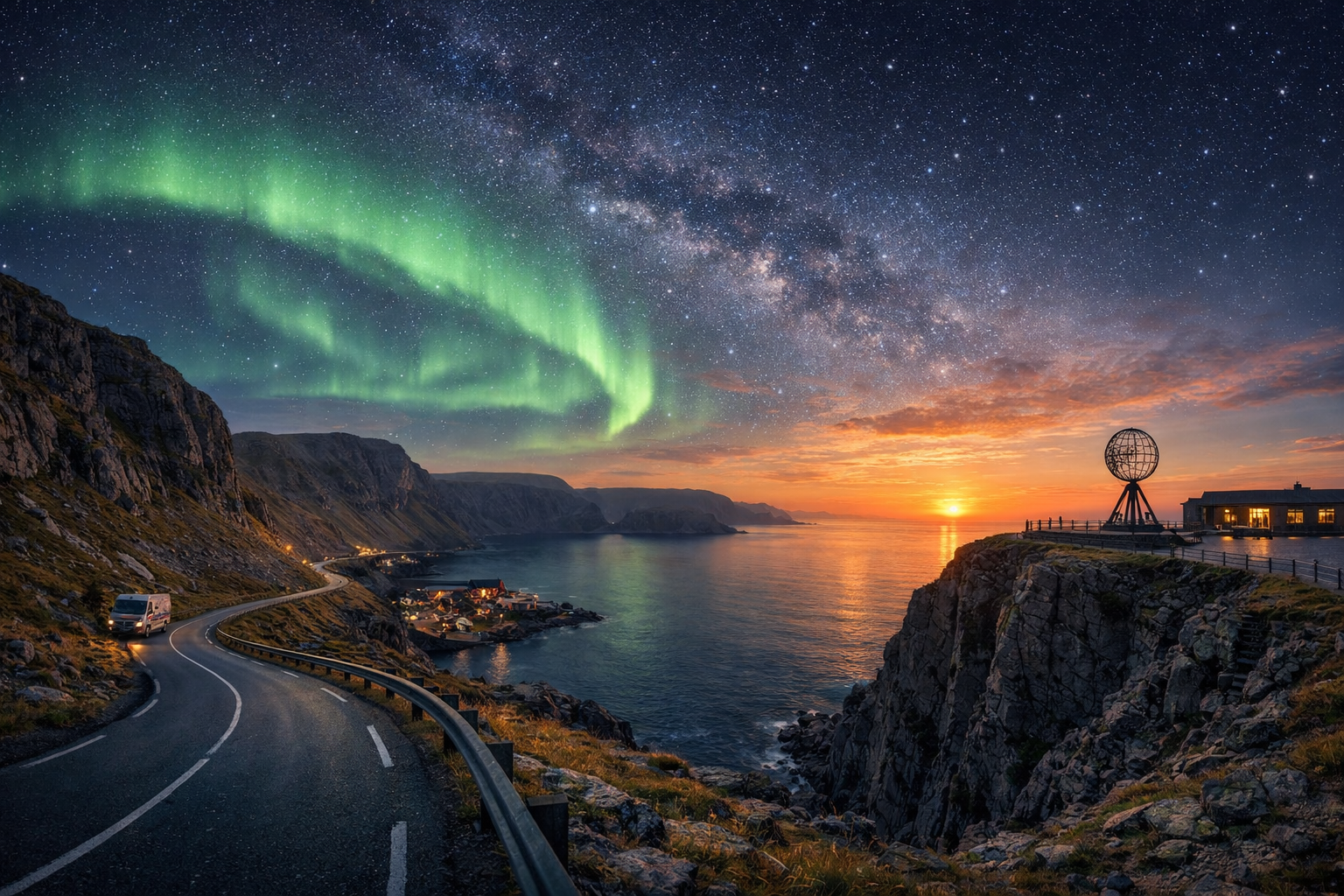
Norway, North Cape. A road trip to the northern coast of Europe for the midnight sun in summer or the northern lights and long starry nights in autumn.

Norway, North Cape. A road trip to the northern coast of Europe for the midnight sun in summer or the northern lights and long starry nights in autumn.

Drive to the edge of Europe on a spectacular northern road trip from Alta to North Cape, passing quiet fishing villages, dramatic coastlines, and endless Arctic horizons. Come in summer for the midnight sun, or in autumn for glowing northern lights and long, star-filled nights above the Barents Sea.

🧭 DAY-BY-DAY ROUTE

Ready-made country and city routes with daily plans, sights, transport and accommodation. Buy PDF guides for independent travel.

🧭 DAY-BY-DAY ROUTE


Day 1 — Alta: arrival, picking up the car, gentle acclimatization to the Arctic light

  • 🚗 The easiest place to start the route is Alta — it is the largest transport hub in western Finnmark, where it is easier to fly in, rent a car, and calmly adapt to the northern rhythm of the trip. It’s only a few minutes by car from the airport to the city center, so the first day is not overloaded with a long drive: this matters if you arrive after several connections or find yourself immediately in the unusual light conditions of the Arctic. In summer, you are greeted by an almost endless evening; in the aurora season, by a quick immersion into a long palette of twilight and night, where even a simple walk to the river or the edge of town already gives a feeling of the true north.

  • 🌌 In the evening, it’s better to spend time not on a classic “city tour,” but on setting up the trip around the main goal — natural phenomena and the sky. For the summer version of the route, it helps to check the time of the midnight sun and choose an open spot with a view toward the northwestern horizon. For the autumn-winter and spring version, it is worth assessing cloud cover, wind strength, the Moon phase, and the geomagnetic activity forecast in advance. A bright Moon can noticeably “wash out” faint structures of the northern lights and dim stars, so ideally the darkest outings are best planned closer to the new moon or during hours when the Moon is low above the horizon. Even so, aurora remains a probabilistic phenomenon even on a good night: you may get perfect clarity and no active bursts at all, or, on the contrary, a sudden window of luck after a long wait.

  • 🚶 For an evening walk in Alta, the waterfronts and calmer areas outside the brightest center are a good choice. The town is not very large, but light pollution in the center is still noticeable, so this is more a day for adaptation and for testing your camera, tripod, warm clothes, shoes, and your comfort with driving on northern roads. If you are traveling in aurora season, there is no need to rush into the very first “hunt” right after arrival: it is safer to get some sleep, check the car, keep the tank above half full, and from the next day head out to darker and more dramatic coastlines.


Day 2 — Alta → Honningsvåg: the great northern road through tundra and fjords

  • 🚗 Drive: Alta → Honningsvåg via E6 and E69, approximately 3 hr 30 min – 4 hr 30 min of pure driving time without long stops. In practice, it’s better to allow 6–8 hours for the whole day including breaks for food, photos, and rest.

  • 🛣️ This is not just a technical transfer, but a full Arctic road journey where the trip gradually takes you from the more “urban” Alta into a landscape of sparse vegetation, cold bays, plateaus, and windy stretches with a real sense of Europe’s edge. As you approach the island of Magerøya, the scenery becomes harsher and more dramatic: fewer trees, more stone, sky, and sea. Even in summer you can feel the northern severity here, and in the cold season the road demands discipline, patience, and constant attention to the weather.

  • 🌫️ In aurora season, this day is especially important from a viewing-strategy perspective. Honningsvåg and the areas around North Cape often create a powerful emotional impression, but the open ocean coast can be cloudier and windier than inland areas. So on the way it is useful to watch not only the general forecast, but also local cloud windows: sometimes the right strategy is to check in, have dinner, rest, and only then decide whether to drive to the North Cape plateau at night, look for a dark point near Skarsvåg, or stay closer to base. For stargazing you need clear skies, moderate wind, relative darkness, and the absence of dense sea haze — and all of this changes faster here than in southern Europe.

  • 🌌 After checking into Honningsvåg, it’s worth spending the evening calmly. In summer, a first outing to a viewpoint for the midnight sun over the Barents Sea is possible: here the light does not fade, but turns into a long golden-steel glow along the horizon. In the northern lights season, take a short test drive outside the center, where there are fewer streetlights and better chances of seeing arches or blurred green ribbons above the dark line of the sea. But safety is important: at night, do not pull off onto questionable shoulders, do not leave the car where it might obstruct equipment or other drivers, and always keep an extra layer of clothing, a thermos, and a charged phone in the car.

Day 3 — Honningsvåg → North Cape: the main plateau, the ocean’s edge, and chasing the light

  • 🚗 Drive: Honningsvåg → North Cape via E69, about 35 km one way, usually 35–45 minutes excluding stops. Return by the same route.

  • 🌍 North Cape is not just a geographic symbol, but one of those places where you physically feel the scale of space. The plateau rises above the cold sea, and before you opens an almost abstract landscape of stone, wind, horizon, and sky. In summer, this is one of the strongest places to experience the midnight sun: the disk can hang above the sea without dipping below the edge of the world and keep the whole landscape in a strange amber glow for hours. This is not a “sunset” in the usual sense, but a slow polar transformation of light — exactly what people come here for.

  • ✨ In aurora season, North Cape works differently. There is never a full guarantee: the coast may be closed in by clouds, and geomagnetic activity may be weak. But if clear skies, moderate wind, and a dark enough phase of the night come together, the plateau offers the rare feeling of watching the aurora literally above the edge of the ocean. With weak activity, you may see only a pale arc, more visible to the camera than to the eye; with stronger activity, vertical rays, moving curtains, and flickering that feels almost physical. All of this is probabilistic and depends on solar activity, atmospheric transparency, and local cloud cover.

  • 📷 For photographers and night-sky lovers, this place requires preparation. The wind on the plateau can be very strong even in summer, so you need a sturdy tripod and hand protection. In the cold season, it is especially important to monitor the road condition and possible traffic restrictions: in bad weather, convoys or other driving regimes may be introduced on the road to North Cape. It’s best not to plan a rigid scenario of “absolutely be on the plateau at midnight” — instead, build in several options and be ready to shift your outing to match a weather window.

  • 🏛️ Before or after heading onto the plateau, you can plan a visit to North Cape Hall — a convenient point with basic infrastructure, where the harsh landscape gains a cultural and historical dimension. But the real value of the day is still outside: in the line of the ocean, the low sun, the silence between gusts of wind, and the rare feeling of being at the northern edge of Europe’s mainland.

Day 4 — Skarsvåg and Kirkeporten: dark locations, fishing-village north, and a sky without extra light

  • 🚗 Drive: Honningsvåg → Skarsvåg, about 25–30 minutes by car one way. The short approach makes the day flexible and easy to adapt to the weather.

  • 🎣 Skarsvåg often feels more intimate and more “real” than the famous North Cape plateau. This is a small northern fishing village where the Arctic landscape is perceived not as a scene for a postcard, but as an everyday living environment. It is here that you really feel the central pulse of the route: you are traveling not only to a famous point on the map, but also for the state of the northern space where light, sea, and sky set the rhythm for everything else.

  • 🥾 The main natural goal of the day is the trail to Kirkeporten, a natural stone arch with a striking view toward North Cape. In summer, during the midnight sun period, this is one of the most poetic places on the whole route: at the right time, the low sun moves along the horizon line and lights the rocks with an almost unreal soft glow. If you get lucky with clear weather, the scene looks like a theatrical set made of stone and fire. In autumn and winter, the place is already interesting as a viewpoint for the long blue night, the stars, and possibly the aurora, if the sky is clear enough.

  • 🌌 For sky watching, the Skarsvåg area is often more convenient than Honningsvåg: fewer streetlights, more of a feeling of darkness and remoteness. But this advantage only works with a responsible approach. In the aurora and stargazing season, you need to assess the trail condition, the wind, ice, snow crust, and return time. In unfamiliar terrain at night, it’s better not to go far without experience, but to choose safe short viewpoints near the car or walk the trail in daylight first so you understand the terrain afterward. Neither the northern lights, nor meteors, nor a clear starry sky can ever be promised in advance: under the same forecast, reality in the Arctic can change very quickly.

  • 🐦 In the warm season, this day can be complemented by a marine nature activity in the Gjesvær and Gjesværstappan archipelago area, if you want to add birds and ocean life to the sky theme. But for the logic of the route, it is better not to overload the day: its strength lies precisely in its slowness, a second outing to a dark spot in the evening, and the chance to choose between soft golden polar light and a deep northern night.

Day 5 — Honningsvåg → Havøysund: a wild coastal road as a backup sky scenario

  • 🚗 Drive: Honningsvåg → Havøysund via Olderfjord and Scenic Route Havøysund, usually about 2 hr 30 min – 3 hr 15 min one way without long stops. This is a full day, so it’s better to leave early and not rush.

  • 🛣️ The Havøysund National Tourist Route is one of the most expressive backup routes on the northern coast and at the same time a fully worthwhile destination in its own right. It often remains in the shadow of North Cape, although in character it may fit the idea of traveling for natural phenomena even better: less of a “must-see point,” more road, open space, wind, sea, and silence. Here you understand especially well that sky watching in the Arctic is not only about the aurora burst itself or the sight of the midnight sun, but also about moving slowly through an almost uninhabited landscape in which the sky constantly dominates over humans.

  • 🌊 On the way, it is worth stopping at the official viewpoints of the tourist route, for example around Storberget and Selvika. These places are beautiful in any weather: on a clear day the coast seems strict and graphic, while in low cloud it becomes dramatic and almost cinematic. For a summer route, this is a magnificent line for watching the midnight light over the sea, and in aurora season it can offer potentially good dark windows far from larger settlements. However, an open coastline also means a higher risk of wind, dampness, sea haze, and sudden cloud cover, so the day’s plan should always remain flexible.

  • ⭐ If the night promises to be clear and relatively moonless, Havøysund and its surroundings may become one of the best locations on the route for a deep feeling of northern darkness. Here it is easy to imagine a meteor shower, if one is active on your travel dates, or a faint Arctic aurora that would go unnoticed in a brighter place. But any such observations depend on many factors: cloud cover, air humidity, aerosols, solar activity, and the local horizon relief. Under a bright Moon or haze, even an excellent “dark” spot on the map may fail to deliver the expected picture.

  • 🧭 This day is especially good as strategic insurance for the route. If North Cape was clouded over, Scenic Route Havøysund may give you the best light of the trip. And if the sky doesn’t cooperate here either, you still get an impressive stand-alone road adventure — one of those rare northern routes where the landscape is so complete that it becomes the main event itself.

Day 6 — Havøysund / Honningsvåg → Alta: return, museum finale, and a reserve for one last sky attempt

  • 🚗 Drive: Havøysund → Alta about 3 hr 30 min – 4 hr 15 min; if you return directly from Honningsvåg, estimate roughly 3 hr 30 min – 4 hr 30 min. If you have a flight the same day, it is better to allow a large buffer for weather and road stops.

  • 🏛️ It is convenient to make the final day calmer and more substantial. After several days of wind, ocean, and road observations, Alta rounds off the route well with the Alta Museum / World Heritage Center for Rock Art and the contemporary architecture of the Northern Lights Cathedral. This is not a “distraction” from the sky theme, but its cultural framing: in the north, nature has always been not a backdrop, but the foundation of lifestyle, memory, and worldview.

  • 🌌 If you spend the night in Alta before flying out the next day, the evening can be kept as a reserve for one last attempt to see the natural phenomenon that escaped you throughout the trip. Sometimes it is exactly such a final evening that brings a clear gap in the clouds or a short but expressive aurora display. In summer, it may be an especially peaceful farewell to the endless light, when there is no longer any race for kilometers, only a quiet northern evening. But even here, no result can be promised: a northern trip for light and sky is valuable precisely because of the combination of expectation, attentiveness, and readiness to accept nature as it appears on a given day.

  • ⚠️ Before ending the route, check the forecast, the road condition, the car return rules, and your arrival time at the airport once again. The same basic safety principles apply in every season: do not drive when tired, do not plan nighttime runs “on the last tank,” do not head into unknown terrain without assessing the route in daylight, and always follow official road reports. The midnight sun, the northern lights, meteors, cloud inversions, bioluminescent effects, and simply a perfect starry sky — all of these are gifts, not promises. The best result here almost always comes to those who leave the place the right to remain unpredictable.

Flight tickets

eSIM for travel

Buy PDF guide

Buy PDF guide — 12.90 USD

PDF — 12.90 USD