
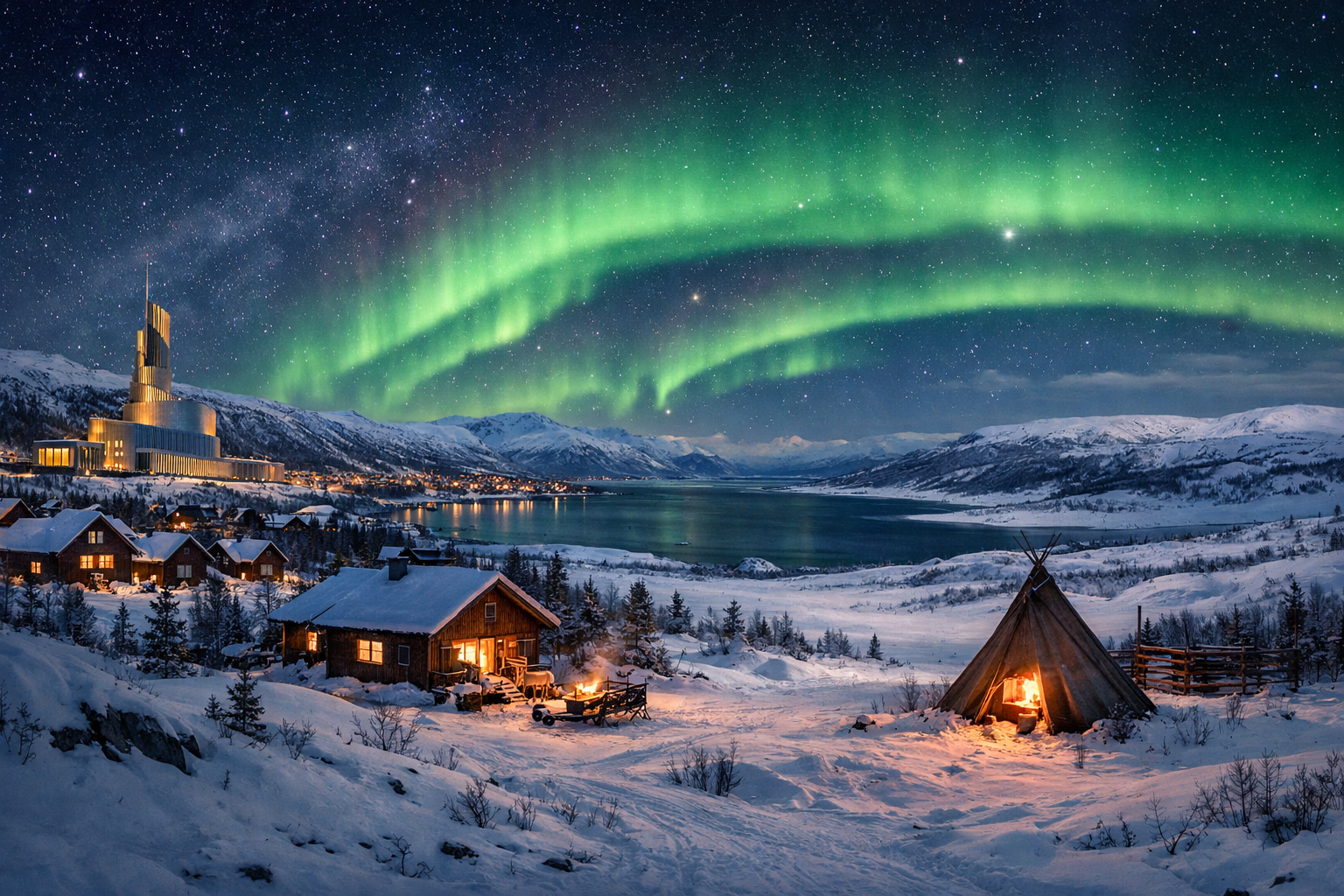
Day 1 — Alta: arrival, adapting to the polar night, and the first aurora outing
✈️ Arrival in Alta — one of the most convenient Arctic hubs in northern Norway for a short winter route. The airport is close to town, so even on the day of arrival you can check in without exhausting transfers, get some rest after the journey, and still make it out for your first evening trip. For this kind of journey, it is best to choose the period from late October to March, while the deepest polar night and the most expressive “blue twilight” are usually felt in December and January. If your main goal is specifically starry skies and aurora hunting, the periods around the new moon or days with a thin lunar crescent are especially favorable: weak moonlight helps reveal the structure of the sky better, although even under a bright moon a strong aurora can look impressive.
🚗 After picking up the car, it is wise not to overload the first day with a long loop route: the urban part of Alta, the waterfront, and a short drive beyond the light dome are enough. Alta itself is known as a convenient base for observing aurora borealis thanks to its northern location, dry winter air, and relatively quick access to dark spots. But it is important to remember: no guide, no forecast, and no route can guarantee the northern lights. Visibility depends on cloud cover, the strength and structure of the aurora, local light pollution, atmospheric clarity, and your willingness to wait for the right window.
⛪ Before dusk, you can take an easy walk to the Northern Lights Cathedral — Nordlyskatedralen, a modern symbol of Alta. Its spiral silhouette looks especially beautiful in the deep blue-violet tones of the Arctic evening, when the snow begins reflecting the city lights and the sky gradually darkens into an almost inky shade. It is a good first stop to feel the contrast between civilization and the vast northern space, which will reveal itself more and more as the journey continues.
🌌 The first night drive is best planned as a “weather scouting” outing: go not for one specific point, but for the clearest section of sky. Depending on the cloud forecast, you can head toward Sorrisniva, in the direction of Kåfjord, or to darker stretches of road away from the center. It is important to avoid stopping on narrow parts of the highway, to park only where the car is completely off the roadway, and to bring reflective gear, a headlamp with a red mode, a thermos, and spare warm layers. In temperatures well below freezing, even a short photo stop in the wind quickly becomes a challenge.
💤 It is worth ending the night in Alta without excessive heroics: if the sky closes in, it is better to go to bed earlier and save your strength for the following days. On an Arctic trip, the winner is not the one who freezes the longest by the roadside, but the one who adapts flexibly to the weather, road conditions, and the rhythm of the body.