
Buy PDF guide

Buy PDF guide — 16.90 USD

PDF — 16.90 USD

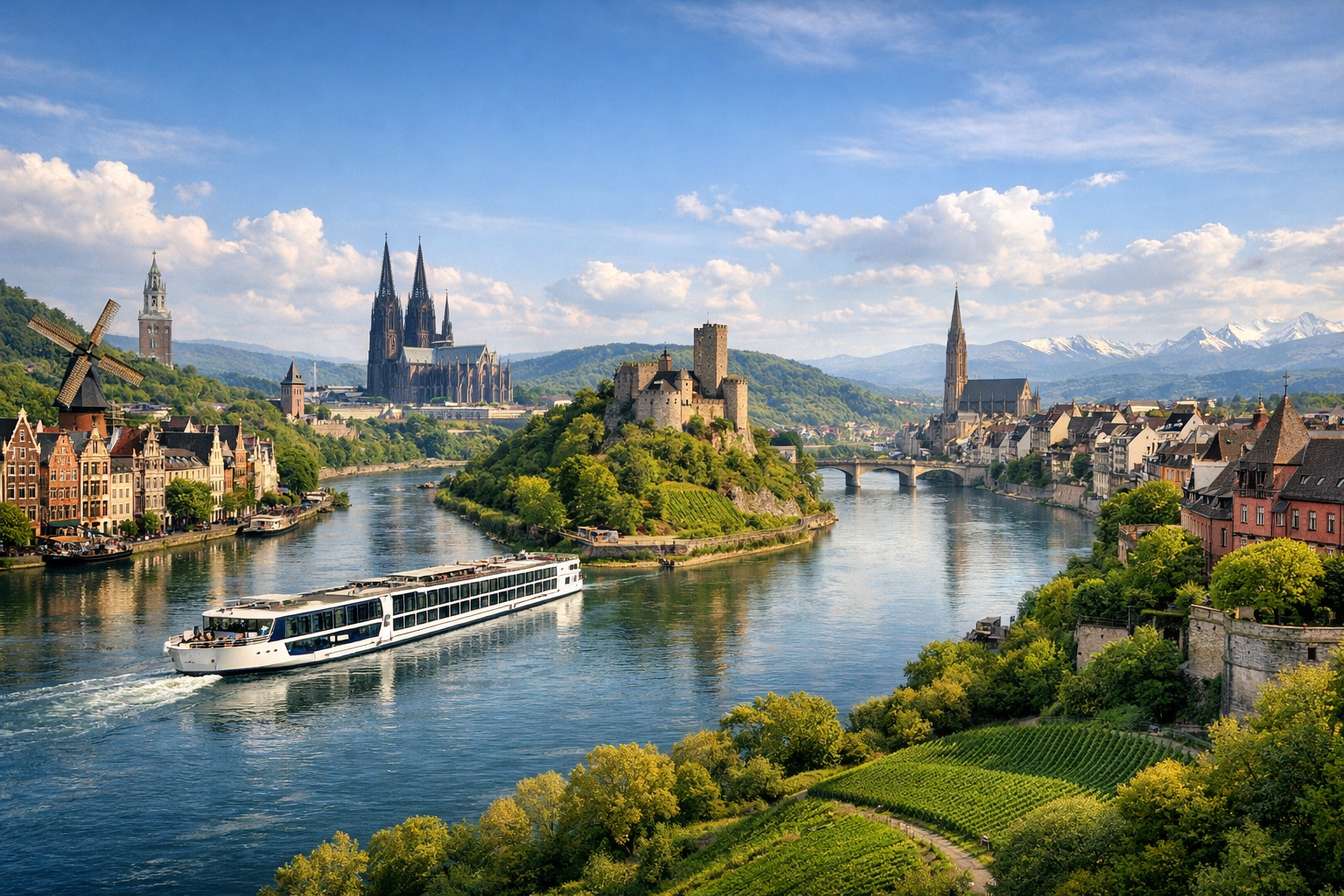
The Netherlands, Germany, and Switzerland. A river cruise on the Rhine from Amsterdam via Cologne, Koblenz, the Rhine castle valley, and Strasbourg to Basel.

The Netherlands, Germany, and Switzerland. A river cruise on the Rhine from Amsterdam via Cologne, Koblenz, the Rhine castle valley, and Strasbourg to Basel.

Sail from Amsterdam to Basel on a Rhine journey that weaves together the easy charm of the Netherlands, Germany’s storybook river towns, and the elegant scenery of Switzerland. Along the way, discover Cologne and Koblenz, drift through the castle-studded Rhine Valley, and arrive in Strasbourg before the river leads you to Basel.

🧭 DAY-BY-DAY ROUTE

Ready-made country and city routes with daily plans, sights, transport and accommodation. Buy PDF guides for independent travel.

🧭 DAY-BY-DAY ROUTE


Day 1 — Amsterdam: boarding the river cruise

  • 🚢 It makes perfect sense to start the route in Amsterdam, where cruise ships take passengers at Passenger Terminal Amsterdam on Piet Heinkade — a convenient point not far from the city center and Amsterdam Centraal station. For a Rhine river cruise, it is best to arrive in the city at least a few hours before boarding, and ideally the day before: check-in, baggage drop, document checks, and cabin allocation all take time, and the sailing schedule does not wait for late arrivals. Entry requirements for the Netherlands, Germany, France, and Switzerland should be checked in advance depending on your nationality, but for a route like this the usual essentials are a passport, a Schengen visa if required, cruise documents, insurance, and compliance with permitted stay limits. On the Rhine, cruise high season usually falls in spring, summer, and early autumn: this is when the embankments, vineyards, and castle-covered slopes are especially beautiful, but schedule adjustments are also possible because of water levels, so it is best to treat the timetable as a living document.

  • 🚶 If you arrive early, you can devote your first day in Amsterdam to an easy walk without overloading yourself: along the IJ, toward the historic center, around the canal ring, and past old facades, where the city reveals itself not as a noisy capital but as an elegant water-based civilization. Amsterdam is especially good before a cruise because it sets exactly the right rhythm: you are already by the water, with bridges, moored vessels, old warehouses, and reflections in the canals all around you. In the evening, it is worth going to bed early: the next day is already a full river passage, and on a cruise, comfort depends greatly on how gently you ease into the routine.

  • ⏱️ Boarding-day practice: arrive at the port 2–3 hours before embarkation, keep your hand luggage with medicines and documents separate from your main baggage, and bring a light windbreaker on deck — even in summer it can be cool and windy on the river.


Day 2 — Passage Amsterdam → Cologne

  • 🚢 The second day is an important “long river day,” when the ship travels from the Netherlands into Germany, gradually changing the scenery from a northern urban landscape to a more classic Rhine one. These are exactly the passages that create the magic of a river cruise: no one wastes energy on suitcases, transfers, and hotels, while the world itself changes behind panoramic windows. On board, there are usually safety briefings, route introductions, the first navigation information, and an overview of upcoming stops. For the passenger, this is the best day to feel the ship’s rhythm: where breakfast is most comfortable, when there are fewer people on the open deck, which side is better for watching the riverbank scenes, and how to balance excursions with rest.

  • 🌊 In terms of route realism, such a passage is entirely logical: Rhine river cruises regularly connect Amsterdam with Cologne, and then take guests farther south along the most beautiful section of the valley. During the day, it is worth simply staying on board and enjoying the journey: on the water, this is not an “empty day” but one of the main parts of the experience. On the Rhine, it is interesting to watch locks in operation, cargo barges, passenger lines, and the discipline of river traffic — this is a living European transport artery, not just a postcard.

  • 🛟 An important water-related detail: on a river cruise, you should not leave unsecured belongings on deck, especially hats, scarves, and light bags; during docking and when passing under bridges, access restrictions to exterior areas must be observed, and crew announcements should be followed without improvisation. Even on a calm river, safety is built on discipline.

Day 3 — Cologne: cathedral, waterfront, and old town

  • ⚓ Arrival in Cologne usually gives you a convenient city window for a shore excursion: the piers on the Rhine embankment are close to the historic center, so the day turns out rich but not exhausting. Cologne is a city where the Rhine feels not like decoration but like the backbone of urban life. From the deck you can see bridges, towers, and the long waterfront, and once ashore everything quickly comes together into the recognizable European picture of a great river city.

  • 🚶 The main dominant feature is Cologne Cathedral, one of the most impressive Gothic churches in Europe, literally rising above the station and old center. Its gigantic silhouette feels almost theatrical: no matter how many photos you have seen, the scale in person is far more overwhelming. Inside, it does not feel like museum sterility but like a living vertical of medieval faith, stone, light, and silence. It is important to remember that the cathedral remains an active church, so tourist visits are restricted during services; it is best to enter respectfully, without rushing, and ready to adapt to the church’s rhythm.

  • 🚶 After the cathedral, it is ideal to walk through the old town and along the Rhine embankment. Here Cologne reveals itself in a warmer and less monumental way: narrow streets, beer halls, squares, facades, river wind, and the feeling that the city is always looking toward the water. If time allows, you can add Museum Ludwig next to the cathedral — a good contrast to medieval grandeur, especially if you want to balance church architecture with modern art. It is best to return to the ship without delay: stops on a river cruise are precise, and the vessel does not adjust to individual walks.

Day 4 — Koblenz: the mouth of the Moselle and Deutsches Eck

  • ⚓ Koblenz is one of the most natural and beautiful stops on this route, because it is here that the geography of the Rhine is felt especially clearly. The city stands at the meeting point of the Rhine and the Moselle, and its famous Deutsches Eck is not just a viewpoint but a powerful symbol of a place where a great river gathers history, transport, and landscape into a single image. For a river traveler, Koblenz is excellent because there is no need to go far: the essence of the location lies almost right by the water.

  • 🚶 A walk through Koblenz pleasantly combines grandeur and calm. First comes the Deutsches Eck headland with views of the river confluence and the constant movement of vessels, then you can walk along the embankments, look at the cable car to Ehrenbreitstein Fortress, and slowly drift into the old quarters. The atmosphere here is less “postcard-touristy” than in some of the valley’s wine towns, but much more focused and river-centered. This is a city you understand not through a single facade, but through the rhythm of water, embankments, and viewpoints.

  • 🚶 If you want a cultural pause, it is worth stopping by Ludwig Museum Koblenz at Deutsches Eck: it is a compact but interesting spot for modern French art right in a historic setting. However, it is better not to overload the day, because one of the most spectacular stretches of the entire cruise still lies ahead. The best strategy is to return to the ship a little earlier, take a good place on the top deck or by a panoramic window, and be ready for tomorrow’s passage through the valley of castles.

Day 5 — Rhine castle valley: Upper Middle Rhine Valley

  • 🚢 This is the climax of the whole route: the ship passes through the Upper Middle Rhine Valley — the stretch between historic towns, vineyards, cliffs, and castles that is known as one of Europe’s most famous river landscapes and is included on the UNESCO World Heritage List. Here the Rhine becomes truly romantic: the banks draw closer, and on the slopes fortresses, terraced vineyards, watchtowers, and old settlements appear one after another, as if created not for modern logistics but for old legends, ballads, and engravings.

  • 🏰 During the passage, the views of fortresses above Braubach, Sankt Goar, Oberwesel, and the surrounding area are especially memorable, as is the famous Lorelei Rock. But the main secret of this day is not to try to “collect checkmarks,” but simply to watch. A river cruise works better here than any bus excursion: you do not drop out of the landscape, you glide inside it, slowly and continuously. In clear weather, it is best to spend almost the whole day on the open deck, but with protection from the sun and wind; in the cooler season, alternate between the deck and the lounge so you do not freeze.

  • 📸 Practical advice: charge your phone and camera in advance, but do not look at the valley only through a screen. The strongest impressions here are born not at the moment of the photo, but in the live sense of scale — when a castle appears on the slope, disappears behind a bend in the river, gives way to the next one, and the ship gently carries you farther south.

Day 6 — Strasbourg: an Alsatian stop on the way to the Upper Rhine

  • ⚓ Strasbourg on a river route feels like a transition into a different cultural tone. After the German part of the Rhine, the city welcomes you with a Franco-Alsatian character: more decorative, more gourmet, a little softer in color and mood, but still very much defined by water. For many cruise lines, Strasbourg is one of the key Rhine stops, and that makes sense: it has a strong historic setting, convenient logistics, a beautiful old center, and clear, easy-to-understand shore excursions.

  • 🚶 The best route is to Strasbourg Notre-Dame Cathedral and then on to the Grande Île and Petite France quarters. The cathedral makes a powerful impression with its carved facade, verticality, and famous astronomical clock; around it, the city feels assembled like an antique jewel box. Petite France, meanwhile, offers a different kind of beauty: canals, little bridges, half-timbered houses, flowers, reflections in the water, and a quiet cinematic quality. This is that rare case where a walk looks festive in almost any season.

  • 🚶 During a stop in Strasbourg, it is important not to try to embrace too much. It is better to choose a dense but short loop: the cathedral, the historic island, one good lunch or coffee, a little free time on the embankments — and then return to the ship without stress. If the cruise company docks in the southern port zone, a transfer or organized excursion is especially convenient, because the river pier itself may not be in the historic center.

Day 7 — Passage Strasbourg → Basel

  • 🚢 The penultimate day again brings you back to the very essence of river travel: movement on the water. The ship goes up the Upper Rhine toward Switzerland, and the landscape gradually becomes stricter, cleaner, and more “composed.” This is no longer the romantic valley of castles, but a different Rhine — practical, disciplined, international, leading to Basel, where the borders and transport systems of several countries meet.

  • 🌤️ This day is especially good for rest. After several shore excursions, it is useful to slow down: have a calm breakfast, read on deck, watch the banks go by, sort through photos, and mentally retrace the route. On a river cruise, such days are no less important than stops, because they are what turn the trip from a set of points into a complete story.

  • 🧭 In organizational terms, it is worth confirming the final disembarkation in advance: on cruises ending in Basel, the actual docking may be either in Basel itself or in a neighboring port area of the agglomeration, depending on the ship, water level, and operational conditions. So on this day, it is useful to prepare your luggage, check your transfer to the airport or the station, and avoid planning anything rigidly tied to time for the evening.

Day 8 — Basel: disembarkation and a calm end to the journey

  • ⚓ Basel is a worthy finale to a Rhine cruise: the city does not shout, it speaks confidently and clearly. Here you can feel that the Rhine is not just a beautiful line, but a European system connecting countries, languages, and ways of life. After disembarkation, it is better not to rush straight to the airport if your schedule allows: even a few hours in Basel make the end of the journey feel fuller and less abrupt.

  • 🚶 For a short finale, the old center, the embankments, the area around the Münster, and one of the city’s strong museums are all excellent choices. Basel does not try to overwhelm the tourist head-on, but it quickly wins you over with the precision of its details: trams, bridges, calm squares, museum culture, restrained architecture, and the sense that everything here works without fuss. After the romantic landscapes of the Middle Rhine, such an ending is especially pleasant — it frames the trip within a modern European setting.

  • 🚌 If you are flying out of EuroAirport Basel Mulhouse Freiburg, allow extra travel time from the city: a direct bus connects the airport with Basel SBB, and from there it is easy to continue from the center or your hotel. For those staying overnight, it is sensible to choose a hotel near Basel SBB or in the center to make both your walk and your departure easier. The final advice is simple: do not schedule your flight too early in the morning on disembarkation day unless necessity leaves you no choice.

Flight tickets

eSIM for travel

Buy PDF guide

Buy PDF guide — 16.90 USD

PDF — 16.90 USD