
Buy PDF guide

Buy PDF guide — 8.90 USD

PDF — 8.90 USD

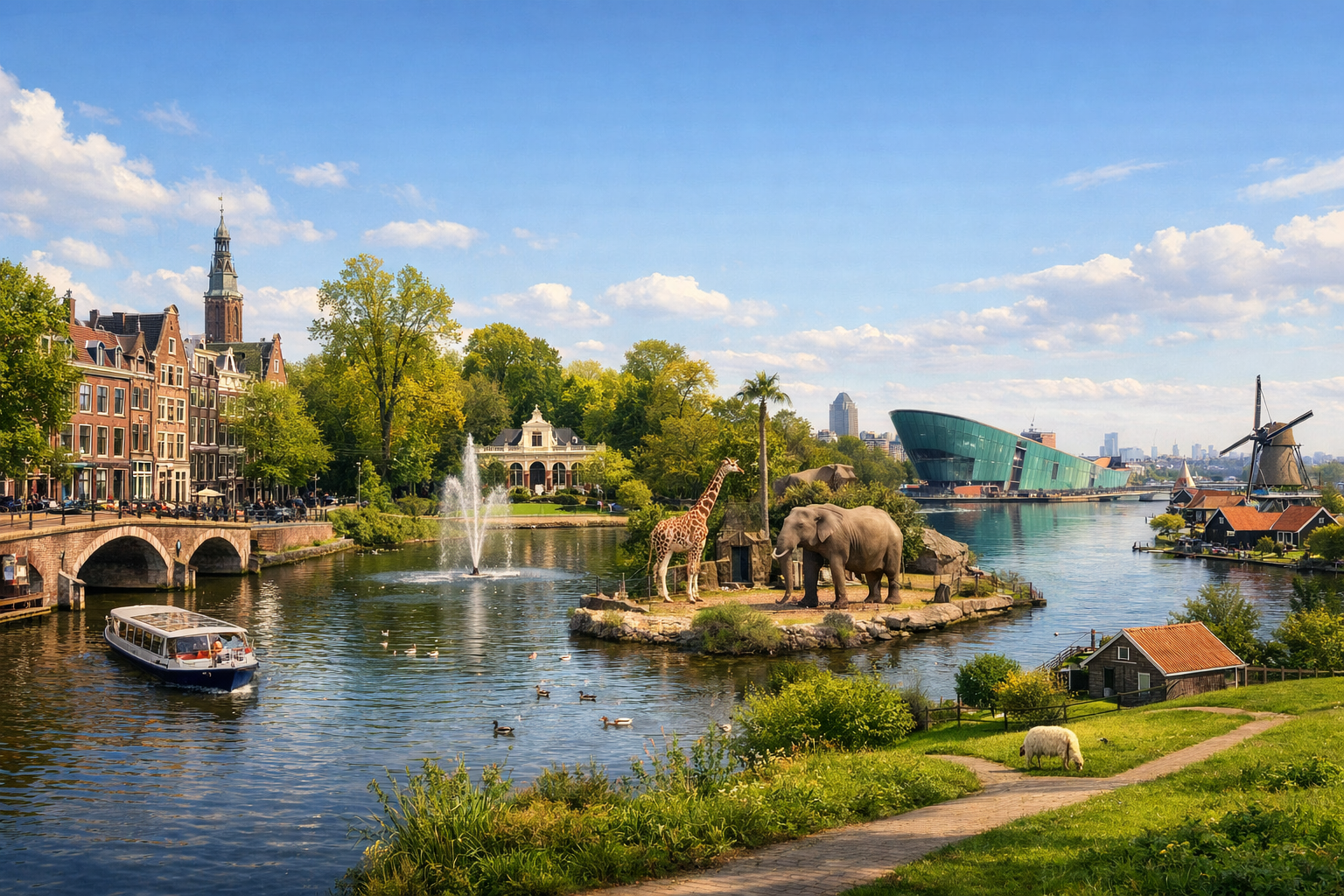
Netherlands, Amsterdam. Family walks along the canals, Vondelpark, ARTIS Zoo, the children's spaces of the NEMO museum, and a short trip to Zaanse Schans; Children's age: 1–3 years old.

Netherlands, Amsterdam. Family walks along the canals, Vondelpark, ARTIS Zoo, the children's spaces of the NEMO museum, and a short trip to Zaanse Schans; Children's age: 1–3 years old.

Amsterdam is wonderfully easy with little ones, from gentle canal-side strolls and playground breaks in Vondelpark to wide-eyed moments at ARTIS Zoo and the hands-on children’s spaces at NEMO. For a charming change of scene, take a short trip to Zaanse Schans, where windmills, open skies, and farm animals make a perfect outing before heading back to the city.

🧭 ROUTE BY DAY

Ready-made country and city routes with daily plans, sights, transport and accommodation. Buy PDF guides for independent travel.

🧭 ROUTE BY DAY


Day 1 — Amsterdam: a gentle introduction to the canals and Vondelpark

  • 🚆 If you arrive via Schiphol, the calmest option for a family with a stroller is the direct train to Amsterdam Centraal in about 17 minutes, with no need to travel in a car seat and with an easy-to-understand transfer setup. If you want one ticket for the trip from the airport plus city transport, the Amsterdam Travel Ticket is convenient; for travel only within the city, GVB tickets are suitable. For children under 3, city transport is especially convenient when traveling with parents: you can bring a stroller free of charge, but it must be placed in the designated area, and passengers in wheelchairs always have priority.

  • 🏨 After check-in, don’t plan a heavy day: with a child aged 1–3, it’s better to choose a hotel with an elevator, a family room, or at least the option to add a crib, and keep the first outing short. The best rhythm is a late breakfast or snack after the journey, then one long walk and an early return for a daytime nap. Areas around Centrum, Oosterdok, Plantage, and Museumplein are especially convenient because it’s easy to get around from here by tram and you don’t need to build complicated routes.

  • 🚶 Start with a calm family walk along the canals in central Amsterdam. For ages 1–3, it’s better not to turn this day into a museum marathon, but simply stroll along the wide embankments, watch the boats, bridges, and cyclists, and choose 1–2 short stops for coffee and a child’s snack. The canals here are not about “checking a box,” but about the atmosphere: water, narrow houses, houseboats, quiet little bridges, and constantly changing light create a very cinematic first impression of the city. Keep safety in mind: near the water’s edge, the child should be held by the hand or kept in the stroller, and on bridges you need to stay alert because of bicycle traffic.

  • 🌿 In the second half of the day, head to Vondelpark — it’s the best format for adapting after the trip. There’s no strict plan here: you can simply walk along the wide paths, look at the ponds and trees, let your child have short safe runs, have a snack on a bench, and take your time. For toddlers, the park is great precisely because of the freedom of pace: if your child gets tired, you can turn around and head back without losing the meaning of the day. In spring and summer, it’s especially pleasant here because there’s lots of greenery, shade, and space for pauses.

  • 🍽️ For families with little children, the day should end early. It’s better to plan dinner near the hotel so that after Vondelpark you don’t have to cross the whole city again. A practical rule for this route: no more than 2 meaningful stops per day, a mandatory pause for sleep or quiet rest during the day, water and snacks always with you, and use the toilet at every major stop even if “no one needs it yet.” This is especially helpful in Amsterdam, where among the beautiful neighborhoods it’s easy to end up with unexpectedly long walking stretches.


Day 2 — Amsterdam: ARTIS and the Plantage district

  • 🚋 In the morning, head to ARTIS Amsterdam Royal Zoo, one of the most convenient family options in the city. Zoo address: Plantage Kerklaan 38–40, 1018 CZ Amsterdam. From Amsterdam Centraal, it’s convenient to get here by tram 14 to the ARTIS/Holocaust Museum stop or by metro to Waterlooplein with a short walk. For a family with a child aged 1–3, it’s best to arrive at opening time or shortly after: there’s less fatigue in the morning, it’s easier to get through the entrance, and the animals are often more active.

  • 🦒 ARTIS is a day that shouldn’t be overloaded with anything else major. For toddlers, the main value of the zoo is not “seeing everything,” but the gentle pace of observation: large animals, birds, water, green avenues, open spaces, and the ability to stop often. The grounds are fairly full, so it’s wiser to accept in advance that you’ll cover only part of the route, but calmly. This is especially important with a stroller: it’s better to move in loops from one interesting area to another and take breaks for snacks, diaper changes, and rest.

  • 👶 The zoo is excellent for children aged 1–3, but you shouldn’t promise them a long “big day of adventure.” At this age, short emotional episodes work best: look at a giraffe, stand by the water, point out birds, let them move around in a safe area, then sit back in the stroller. Plan for at least one long pause inside. Also keep in mind that at this age a child may be frightened by noise, crowds, or sudden sounds near some enclosures — stay flexible and be ready to shorten the visit.

  • 🍴 After lunch, don’t add a second major museum. Instead, stay in the Plantage area and end the day with a very short walk along the quiet streets or a return to the hotel for a nap. It’s a beautiful green district with a more relaxed atmosphere than the very center, and it works especially well for a family format. If you still have energy, you can walk just a little and look around without the goal of “doing the maximum.”

  • ⚠️ An important family note: ARTIS is a walking destination, not an amusement park, so there are usually no strict height restrictions for the main experiences. But that’s exactly what makes it a good place for toddlers: there’s no need to choose activities by height, worry about being turned away from rides, or explain to a child why they “still can’t.” Everything is built around observation, movement, and a calm rhythm.

Day 3 — Amsterdam: NEMO Science Museum and the water at Oosterdok

  • 🧪 Today’s main stop is NEMO Science Museum, address: Oosterdok 2, 1011 VX Amsterdam. The museum operates with time slots, so it’s better to buy tickets in advance and choose either an early time or, on the contrary, a calmer afternoon slot. It’s especially important for families to know the current rule: admission is paid from age 4, and entry is free for children aged 1–3. This makes NEMO a very convenient option even on a short trip if your goal is specifically the children’s spaces and a sensory introduction to science, rather than a full tour of the exhibition.

  • 👧 For ages 1–3, NEMO should be approached selectively. Not every floor and not every zone will be equally interesting for a toddler, but certain interactive spaces, movement, light, shapes, buttons, simple mechanical elements, and the unusual architecture of the building itself work very well. Your task here is not to “walk through the whole museum,” but to choose safe and not overly noisy sections where your child can explore the world a little with hands and eyes. If your toddler is sensitive to noise and crowds, come at a less busy time and immediately allow for the possibility of leaving early.

  • 🚶 After the museum, it’s a very good idea to take a short walk around Oosterdok. The area around the water, modern embankments, and boats helps a child switch gears after a busy indoor space. It’s a successful combination for a family day: first a structured indoor activity, then air, open space, and simple observation of city life by the water. You can walk just a little, stop for a snack, and return to the hotel without rushing.

  • 🍼 In practical terms, NEMO is convenient because it’s a clear family-oriented stop with infrastructure, but even in a good museum a child aged 1–3 gets tired faster than an adult. Bring a change of clothes, water, a light snack, and don’t put more than one must-do activity on this day. If your child naps during the day, it’s better either to arrive at opening and return to the hotel for nap time, or else time the visit around a stroller nap.

  • ⚠️ Important age-related note: part of the science exhibits are designed for older children and adults, so don’t promise your toddler a “museum entirely for little kids.” For a family with a child aged 1–3, the point of the visit is a few successful child-friendly zones, a visual wow effect, and gentle interactivity. If your child is overloaded, it’s better to end the day early than to try to “complete the program.”

Day 4 — short trip to Zaanse Schans

  • 🚆 On the fourth day, plan a short outing to Zaandijk Zaanse Schans. This is a realistic and not too tiring trip for a family with a small child: from Amsterdam Centraal to Zaandijk Zaanse Schans station it is usually about 17–20 minutes by train, after which a walk remains to the windmills and the village itself. This format — train plus a short walk — works well for ages 1–3 if you leave early and don’t try to spend the entire day there.

  • 🌬️ Zaanse Schans is a very photogenic piece of Holland with windmills, wooden houses, canals, little bridges, and open views. For a toddler, it is not an “excursion site” in the strict sense, but a large safely structured setting: water, wind, boats, animals in the surroundings, greenery, wooden facades, and the feeling of a fairy-tale village. It’s a good place simply to walk slowly, stop, look at the windmills, and not pressure yourself with a list of must-see museums.

  • 👨‍👩‍👧‍👦 The family secret of this trip is to keep it truly short. Don’t try to visit all the workshops and all the indoor sites. With a child aged 1–3, it’s much better to make 2–3 beautiful stops, allow time to walk or sit in the stroller, have a snack, and by lunch or early afternoon already head back to Amsterdam. If it’s windy or rainy, the open area by the windmills feels noticeably colder than in the city, so an extra clothing layer and a rain cover for the stroller are essential.

  • 🚶 The route on site is best planned on the principle of “see it, don’t exhaust yourself”: leave the station, take the calm road to the historic area, enjoy the views of the windmills and canals, take a short family walk, then return the same way. For a stroller, this format is more convenient than trying to go on long side detours. Watch out for wooden walkways, little bridges, and proximity to the water — it’s better not to let your child walk ahead of you.

  • 🌆 After returning to Amsterdam, leave the second half of the day empty or almost empty: at most a quiet walk near the hotel, an early dinner, and packing. This is a logical ending to a 4-day route: you’ve already had canals, a park, a zoo, a science space, and one short trip out of town. For a family with a toddler, that’s full but still reasonable and without overload.

Flight tickets

eSIM for travel

Buy PDF guide

Buy PDF guide — 8.90 USD

PDF — 8.90 USD