
Buy PDF guide

Buy PDF guide — 10.90 USD

PDF — 10.90 USD

The Netherlands, Amsterdam and surroundings. Getting acquainted with Amsterdam’s canals, museums, the Zaanse Schans area, Haarlem, and Volendam by trains, buses, and ferries

The Netherlands, Amsterdam and surroundings. Getting acquainted with Amsterdam’s canals, museums, the Zaanse Schans area, Haarlem, and Volendam by trains, buses, and ferries

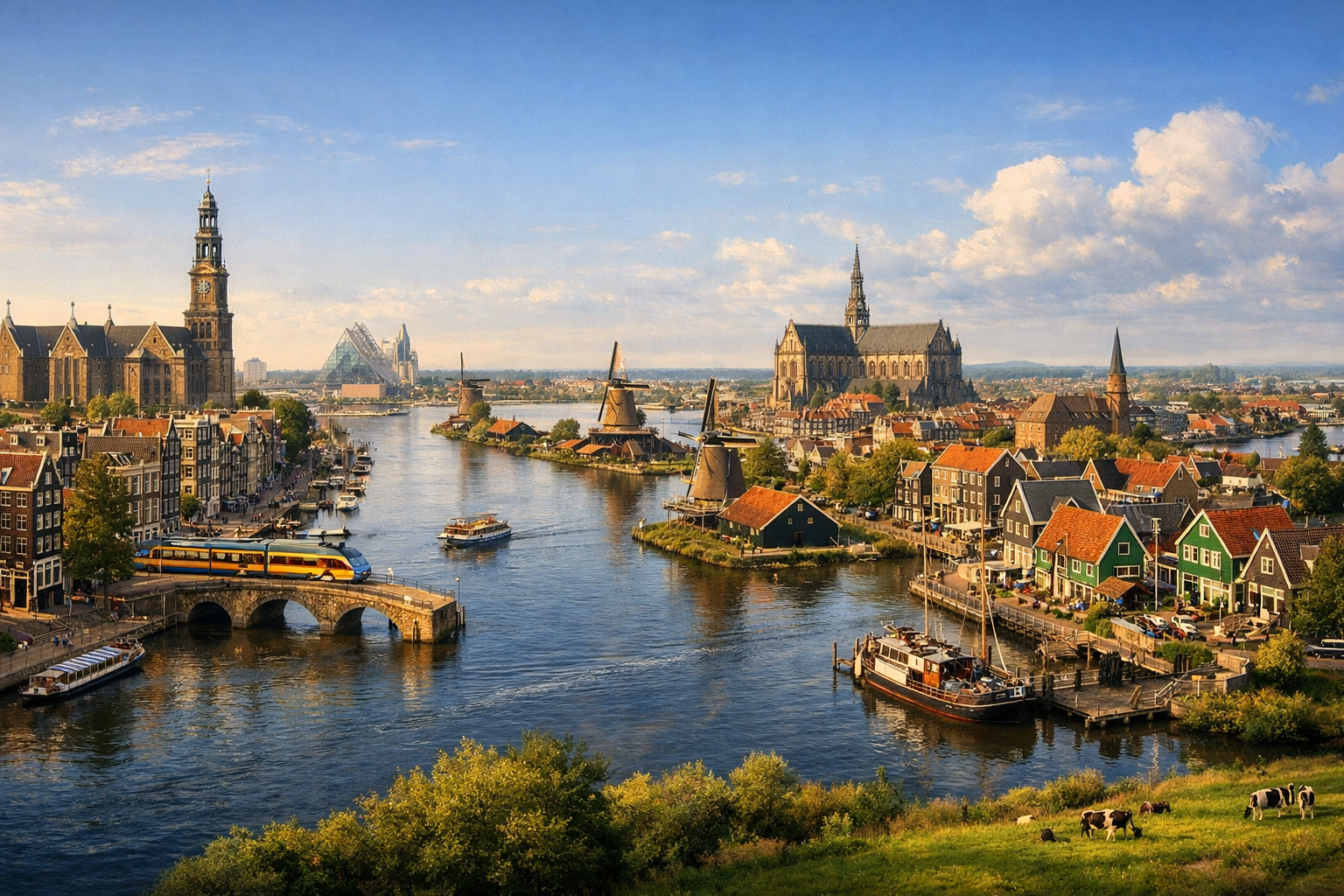
Discover Amsterdam and its surroundings on a relaxed journey through canal-lined streets, world-class museums, and classic Dutch landscapes. Travel easily by train, bus, and ferry from the city to the windmills of Zaanse Schans, the charm of Haarlem, and the harbor atmosphere of Volendam before returning via Amsterdam-Noord.

🧭 DAY-BY-DAY ROUTE

Ready-made country and city routes with daily plans, sights, transport and accommodation. Buy PDF guides for independent travel.

🧭 DAY-BY-DAY ROUTE


Day 1 — Amsterdam: canals, the center, and the city’s museum rhythm

  • 🚶 It’s best to devote the first day to getting acquainted with the very Amsterdam many people have seen on postcards: narrow gabled houses, arches of bridges over the water, bicycles by the railings, and the soft northern light that makes the city feel both very old and very alive at once. Start your walk from the central part of the city and gradually move into the 17th-century canal belt — Herengracht, Keizersgracht, and Prinsengracht. This is where the logic of historic Amsterdam is felt especially well: not ceremonial “capital-city grandeur,” but an almost intimate beauty, where every street seems made for a slow pace, conversations, and coffee stops. For couples, this is one of the city’s most atmospheric areas; for solo travelers, it is a convenient starting point; and for lovers of urban culture, it is a living textbook on how a trading city became a cultural capital.

  • 🏛️ In the second half of the day, head to the museum quarter. The best choice for day one is the Rijksmuseum, the country’s main national museum, where Dutch history unfolds through painting, everyday objects, decorative arts, and famous Golden Age masterpieces. Even if you do not plan to spend half a day in the museum, the space itself works as a powerful introduction to the country’s character: here you can see how the sea, trade, science, bourgeois culture, and artistic freedom shaped the Netherlands. After the museum, it is pleasant to walk around Museumplein, where the atmosphere feels more open and contemporary: students, tourists, and locals sit on the grass, and the area feels like a calm cultural pause after the dense city center.

  • ⏱️ The day’s logistics are easy and realistic: from Amsterdam Centraal to the museum quarter, you can get there by tram or metro with a short walk, while within the historic center it is best to move around on foot. Set aside 3–4 hours with stops for walking along the canals and bridges, 2 to 3 hours for the museum, and another 1–1.5 hours for a late lunch, rest, and a relaxed evening. If you want a final accent, end the day with an evening walk along Prinsengracht: when warm lights come on in the windows and the bridges reflect in the water, Amsterdam reveals itself at its most beautiful.


Day 2 — Zaanse Schans: windmills, wooden houses, and industrial history

  • 🚆 In the morning, head from Amsterdam to Zaanse Schans — one of the easiest and at the same time most expressive trips out of the city without a car. This is not a “distant countryside excursion,” but a very simple route by public transport: you can get there by train with a short walk after, or directly by regional bus. The Zaanse Schans area itself is a postcard version of the Netherlands, but not in a banal sense. Here, old green wooden houses, barns, canals, and famous windmills stand not as scenery, but as part of the historic industrial landscape of the Zaan region, where one of Europe’s early industrial economies once thrived.

  • 🌿 Once there, it is worth walking slowly and without rushing. The best way to experience Zaanse Schans is not just to take photos of the windmills, but to stroll along the waterfront, listen to the creaking wood, the smell of water and wind, peek into workshops and museums, and see how the landscape combines rural idyll with a history of labor. It is especially enjoyable here for couples and for those who like visually striking but not tiring routes: the paths are easy to follow, the distances are short, and the views are constantly changing. In the April–October season, the place looks especially rewarding: the greenery becomes brighter, the water sparkles, and the walk easily pairs with cafés and open-air spaces.

  • 🏛️ To add substance to the day, visit the Zaans Museum, where the region’s history is presented not dryly, but through crafts, industry, design, and everyday culture. If you still have energy and interest, you can add one of the small museum houses or windmills. Allow about 35–50 minutes each way depending on the exact transport, 4–5 hours for the walk and museum itself, and another hour for lunch and rest. In the evening, it is easy to return to Amsterdam by the same route and spend a calm evening without major transfers.

Day 3 — Haarlem: an intimate city of museums, courtyards, and old streets

  • 🚆 Haarlem is the perfect day trip from Amsterdam for those who want to see a quieter, more elegant, and at times even more “local” side of North Holland. The train ride is short and very convenient, and the city itself is compact: from the station, you can walk to the historic center at an easy pace and without complicated navigation. Haarlem is often loved by those who find Amsterdam too noisy: there is water here too, brick facades, old squares, and beautiful streets, but the rhythm is noticeably gentler. This is one of the best cities on the route for couples, solo travelers, and anyone who enjoys wandering without a strict plan.

  • 🏛️ Start at Grote Markt and St. Bavo’s Church, then move into the side streets, where Haarlem reveals itself through courtyards, independent shop windows, small coffee places, and an almost theatrically beautiful urban fabric. The main cultural anchors of the day are Teylers Museum and Frans Hals Museum. The first feels like a museum of the Enlightenment, where science, art, and the passion for collecting came together in a historic interior; the second offers a more artistic and “Dutch” perspective, focusing on painting and urban culture. If you choose one museum, the day will feel easier and more relaxed; if you choose two, it will be fuller but still realistic.

  • ⏱️ For the trip Amsterdam Centraal → Haarlem, about 15–20 minutes by train is usually enough, while another 10–20 minutes will go to walking approaches in the city depending on the points you choose. It is worth leaving 2–3 hours for strolling through the center and the square, 1.5 to 2 hours for each museum, plus time for lunch by the water or on the square. Returning in the evening is very simple: trains run frequently, so the day does not require a strict time schedule. This is one of the most comfortable days of the route, where you can take your time and simply enjoy the city atmosphere.

Day 4 — Volendam: fishing waterfront, harbor, and the maritime character of North Holland

  • 🚌 Volendam brings a different mood: after canals and museums, you enter the world of old fishing Holland, where the main scenery is created by the harbor, boats, wooden facades, seagulls, sea air, and open views over the water. From Amsterdam, it is easy to get here by regional bus without a car, which makes Volendam an excellent choice for an easy day trip. The town itself is very photogenic, but its strength is not only in the beautiful waterfront: here you can feel the history of life by the sea, dependence on water, trade, and fishing, as well as that “northern” simplicity that contrasts so well with metropolitan Amsterdam.

  • 🚶 It is best to build the day here around a relaxed walk along the harbor and old center. Volendam suits those who do not want an overloaded plan: the distances are small, orientation is easy, and the landscape invites rest. For couples, this is a romantic point with water views and the chance to sit on the waterfront for a long time; for younger travelers, it is a convenient and vivid outing for atmosphere, photographs, and seafood; for solo travelers, it is a rare opportunity to see Dutch coastal culture in a very accessible format.

  • 🏛️ If you want to add a more meaningful layer, you can visit the Volendams Museum to better understand local identity, traditional costume, daily life, and the history of the community. Allow roughly 30–40 minutes one way by bus from Amsterdam, and 3–5 hours for Volendam itself depending on your pace, lunch, and the museum. In good weather, it is especially pleasant to stay into the second half of the day: the light over the water becomes softer, and the harbor looks even more picturesque. Returning by the same bus to Amsterdam makes the day simple and low-stress.

Day 5 — Amsterdam-Noord: free ferry across the IJ, cinema, modern architecture, and the finale of the trip

  • ⛴️ On the final day, it is worth seeing Amsterdam from yet another side — not museum-historic, but more modern, creative, and urban. To do this, simply take the free ferry from Amsterdam Centraal across the IJ river. The crossing itself is already an important part of the experience: only a few minutes, but it feels as if you are stepping into another Amsterdam. On the northern bank, the city becomes broader, bolder in its architecture, and a little less “postcard-like,” but more alive in terms of contemporary culture, design, and urban experimentation.

  • 🎬 A convenient route for the day is the area around Buiksloterweg and Overhoeks. Here it is easy to combine the Eye Filmmuseum, a striking modern space on the IJ waterfront, with a walk along the promenade and a panoramic finale to the trip. Eye suits even those who do not consider themselves film buffs: the building itself, the water views, the exhibition environment, and the atmosphere of a cultural hub make it a very successful stop. Nearby is THIS IS HOLLAND — a lighter, more entertainment-oriented format that can be added as an option if you want one last vivid attraction instead of another big museum.

  • 🚶 The logistics of this day are almost ideal: from the central station to the ferry is only a matter of minutes on foot, the ferry ride itself takes about 3 minutes and runs frequently, and after that all the key points of the area are walkable. Allow 4–5 hours for the museum and walk, plus another 1–2 hours for coffee with a view of the water, a late lunch, and an unhurried farewell to the city. This kind of finale is especially good for a car-free route: it shows how convenient Amsterdam is for traveling on foot and by public transport, and leaves the feeling not of a “box checked,” but of a complete urban experience.

Flight tickets

eSIM for travel

Buy PDF guide

Buy PDF guide — 10.90 USD

PDF — 10.90 USD