
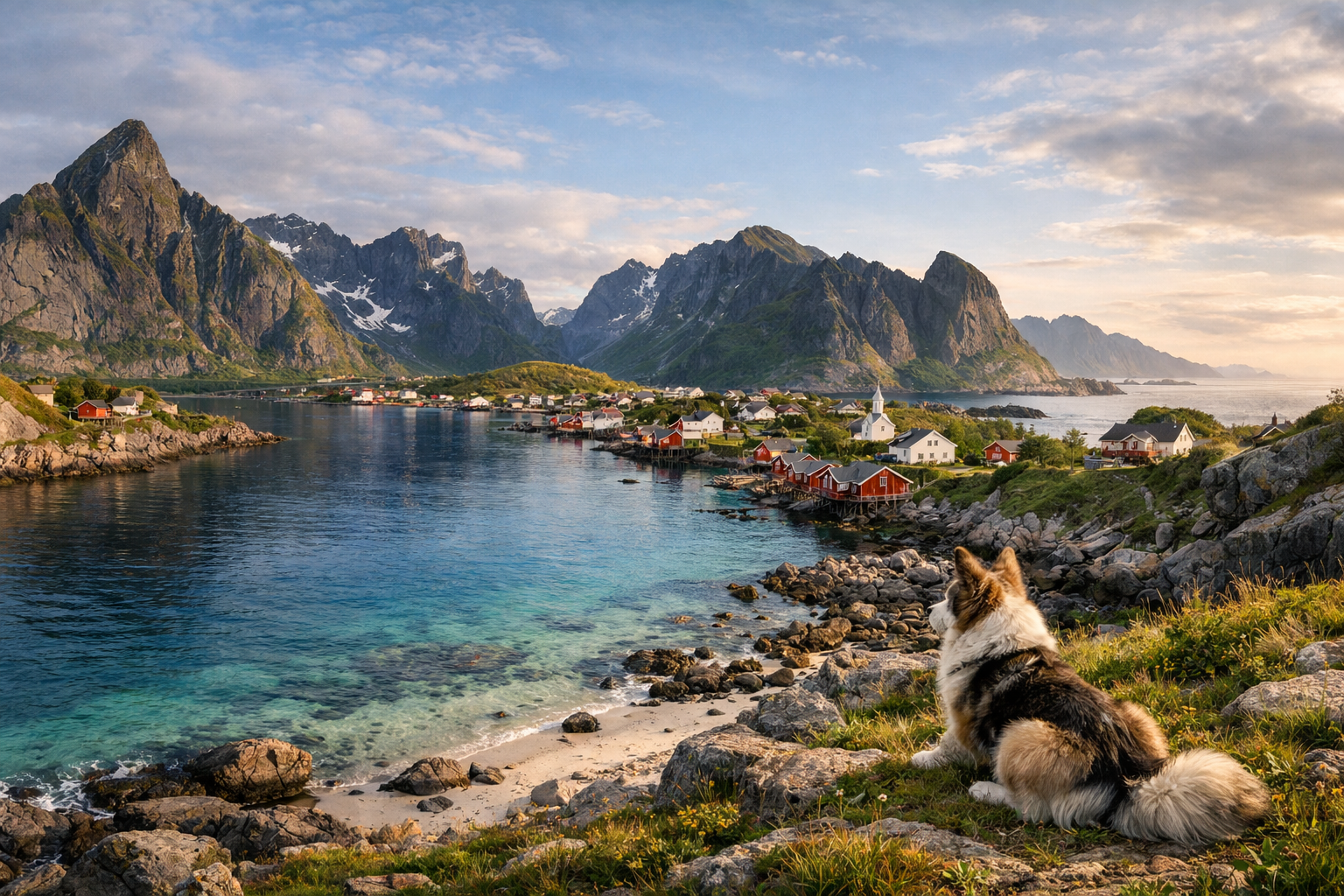
Day 1 — Svolvær: arrival, waterfronts, and a gentle adaptation for your pet
✈️ An optimistic and realistic start to the route is flying into Svolvær Airport, Helle, or via Harstad/Narvik Airport, Evenes with a transfer onward along the E10. For traveling with a dog, this option is convenient because on the first day you do not need to rush straight into long hikes: Svolvær offers infrastructure, shops, waterfront promenades, veterinary and medical help nearby, and a relatively calm rhythm for acclimatizing after the journey. The town itself sits between the water, boat piers, and jagged granite peaks; here it is easy to feel how the Lofoten Islands live by the sea: dried fish, working harbors, gulls, boats, and light that changes literally every fifteen minutes.
🚶 For the first day, it is better to choose an easy walk: stroll around Svinøya and along Svolvær harbor without overloading the dog right after the flight. In the evening, you can walk to the breakwaters and viewpoints by the water, where it is especially beautiful to watch fishing boats and reflections in the cold bay. This is not a wild “postcard-perfect” trek, but a deliberate adaptation day: it is easier for your pet to recover after the trip, go to the toilet at a calm pace, eat on its usual schedule, and get enough sleep before the longer walks of the following days.
🐾 Pets: this route is designed primarily for travel with a dog; it is also usually easiest to travel with a cat or ferret if the accommodation and carrier confirm it. For air travel, the rules are set by the airline, not the airport: usually you need a pre-approved place for the animal, an approved carrier/container, and compliance with size and weight limits. In the cabin, as a rule, only small dogs and cats in a carrier under the seat are allowed; larger dogs travel in the cargo hold in a rigid container. For Widerøe, SAS, and Norwegian, the conditions and limits for weight, dimensions, and routes differ, so they must always be rechecked before buying tickets.
🚌🚆 Local transport with a pet: there are no trains in the Lofoten Islands themselves, but if the route is combined with mainland Norway, Vy trains have separate pet rules, including restrictions by carriage zones and separate conditions for larger dogs; if a replacement bus is used, transport of an animal may not be guaranteed. For Nordland/Reis buses, conditions should also be checked before traveling: the region has public transport, but you must verify the specific departure and boarding rules. On ferries and express boats, the rules depend on the operator; with a dog, travel is usually allowed, but the onboard placement and animal control requirements must be clarified in advance. A muzzle is not always listed as mandatory by default, but for a large dog it is sensible to carry one as a backup in case the operator requires it or boarding is crowded.
🩺 Veterinary entry requirements for Norway with a dog: a microchip is required; a rabies vaccination; a veterinary passport or other acceptable identification document; and mandatory treatment against tapeworms before entering Norway. If you are flying from outside the EU/EEA, additional documents may be needed and in some cases a rabies antibody serology test — this depends on the country of departure. It is safer to prepare a separate folder with original documents and not rely only on digital copies. Always recheck the exact treatment timing and accepted document formats for your departure country before travel.
🏥 The nearest veterinary help for the start of the route: Lofoten Dyreklinikk in the Leknes/Gravdal area — one of the key clinics in the region for dogs, cats, and other pets. From Svolvær, getting there takes longer than you would want in an emergency, so on the first day it is especially important to monitor your pet’s condition after the flight: water, a short walk, no jumping on rocks, and no sudden food change.
🦆 Rules for walking a dog in Lofoten nature matter from day one: in the archipelago, the principle is to keep your dog on a leash, and in the national park and on popular routes this is especially important because of birds, sheep, and other vulnerable wildlife. Norway has a general seasonal leash rule in spring and summer, and in some local areas of Flakstad the restrictions are extended because of grazing. For the Lofoten Islands, a safe practical rule is simple: treat the leash as mandatory almost everywhere, especially on the coast, beaches, and mountain trails.