
Buy PDF guide

Buy PDF guide — 8.90 USD

PDF — 8.90 USD

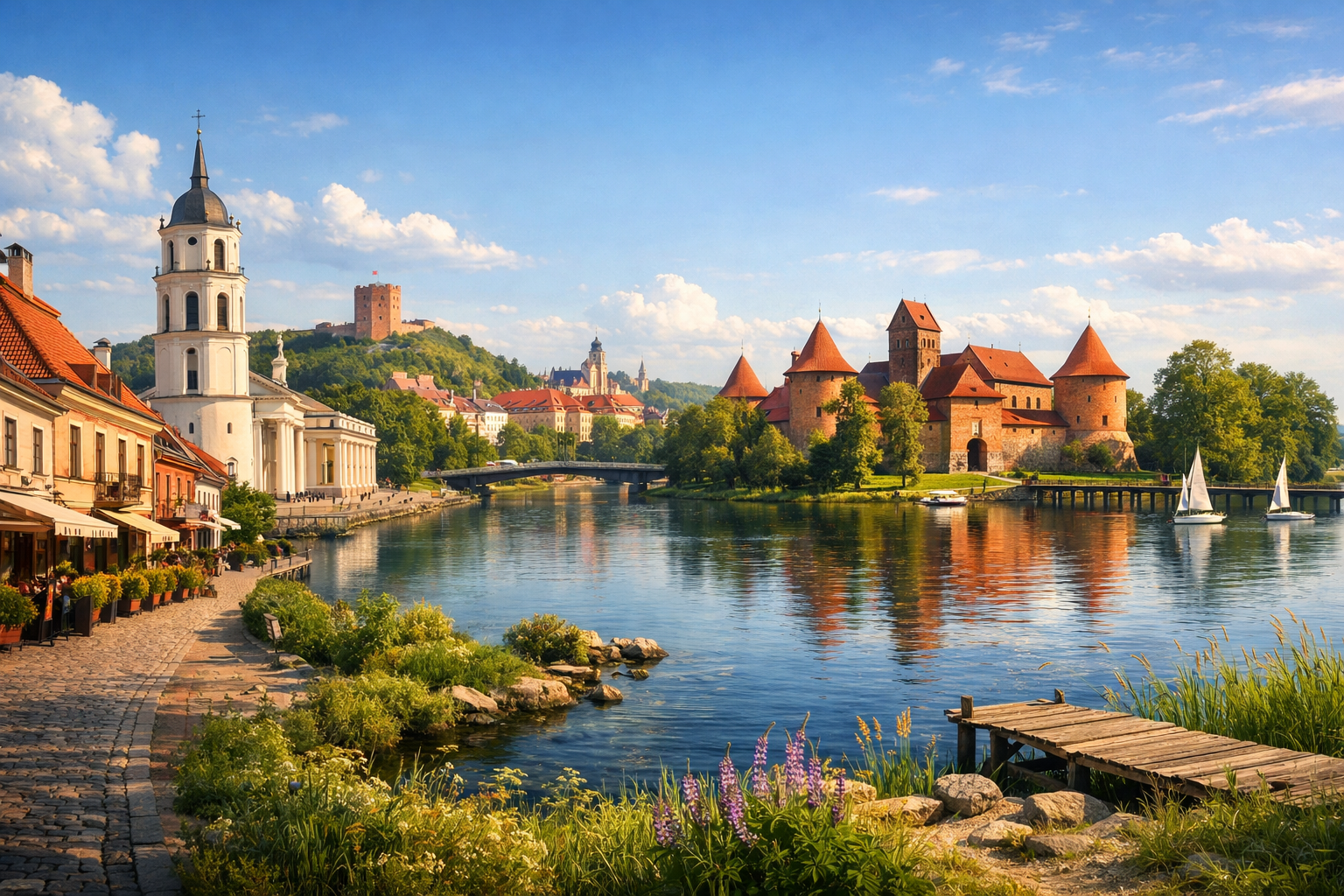
Lithuania, Vilnius and Trakai. An inexpensive trip around Vilnius Old Town and Trakai Island Castle using buses and staying in a hostel. Season: May–September.

Lithuania, Vilnius and Trakai. An inexpensive trip around Vilnius Old Town and Trakai Island Castle using buses and staying in a hostel. Season: May–September.

Discover Lithuania on a budget with a relaxed trip from Vilnius to Trakai and back. Wander the baroque lanes of Vilnius Old Town, then catch a bus to Trakai to see its fairy-tale island castle set among quiet lakes.

🧭 DAY-BY-DAY ROUTE

Ready-made country and city routes with daily plans, sights, transport and accommodation. Buy PDF guides for independent travel.

🧭 DAY-BY-DAY ROUTE


Day 1 — Vilnius: first introduction to the Old Town

  • 🚍 If you arrive at Vilnius Airport, the city center is easy to reach by public transport: buses No. 1, 2, 88, and 3G run from the airport into town; the trip to the central area usually takes about 20–35 minutes depending on traffic and your stop. It is a good budget-friendly start to the route: no taxi, no complicated transfers, and quick access to the Old Town.

  • 🏨 After checking into the hostel, give yourself a little time to rest, shower, and enjoy a calm late breakfast or coffee. For a low-cost trip, Vilnius is very convenient: many key spots are within walking distance of each other, and the Old Town itself does not require rushing — it is best experienced as a living set of Baroque facades, church towers, arches, courtyards, and narrow streets where the mood of the space changes almost at every turn.

  • 🚶 Start your walk at the Gate of Dawn, one of the city’s most famous symbols and a rare surviving fragment of the old defensive walls. Then continue deeper into the Old Town along Aušros Vartų Street toward Town Hall Square. Along the way, the city unfolds very gently: first as a medieval trading hub, then as a Baroque center with Catholic churches, monastic courtyards, and houses with neat light-colored facades. Vilnius does not overwhelm with scale like big capitals do, but charms precisely with its human rhythm — here it is pleasant not to “check off sights,” but simply to walk, look up at the gables, notice sign details, and from time to time turn into side alleys.

  • ⛪ In the second half of the day, it is worth heading to the ensemble of Vilnius University with its inner courtyards, then continuing to Cathedral Square. Here you already feel a different tone of the city: more space, more grandeur, and the snow-white facade of the cathedral together with the freestanding bell tower creates an almost Italian-feeling urban setting. If you still have energy, you can walk up toward Gediminas Tower or simply stroll along the foot of the hill to meet the evening with beautiful views over the red roofs of the Old Town.

  • 🌆 In the evening, it is best to keep the plan light: dinner around Pilies or Vokiečių, a short walk through the illuminated streets of the Old Town, and an early return to the hostel. For a budget trip, this is the ideal rhythm: a first day without overload, with adaptation after the journey and a gentle immersion into the atmosphere of Vilnius.


Day 2 — Vilnius: Užupis, panoramas, and a museum day

  • 🚶 Dedicate the second day to a deeper acquaintance with Vilnius and start with the Užupis district. It is easy to reach on foot from the center in 10–20 minutes, depending on where you are staying. This quarter is often called the freest and most artistic corner of the city: there is less grandeur here than on the central streets of the Old Town, but more intimacy, old houses, stairways, workshops, small courtyards, and the feeling that the city suddenly starts speaking more quietly and personally.

  • 🎨 Walk along the Vilnia River, find the famous Constitution of Užupis on the wall, and then make your way leisurely to Bernardine Garden. It is one of the most pleasant city parks for a pause: well-kept alleys, green lawns, fountains, and views of the hills make it an excellent place for a daytime rest. In summer and during the warm months from May to September, it is especially pleasant here just to sit in the shade, have a snack, and give your legs a break before the next block of walking.

  • 🏛️ After lunch, it is a good idea to combine the walk with one of the museums. For a modern cultural highlight, MO muziejus is a great choice — a striking contemporary art museum located on the edge of the Old Town. If you want history and a sense of state scale, head to the National Museum – Palace of the Grand Dukes of Lithuania near Cathedral Square. This museum is especially good because it helps you feel Vilnius not only as a beautiful city, but also as the former capital of a major Central and Eastern European state where Lithuanian, Polish, Russian, Jewish, and Western European influences intersected.

  • 📸 Toward evening, climb to the viewpoint by Gediminas Tower or choose a calmer option — a walk around Cathedral Square and Gedimino Avenue. In the golden hour, the city is especially photogenic: white facades begin to glow, red roofs become richer, and church towers rise out of the urban fabric like vertical markers of the whole panorama. It is one of those evenings when Vilnius feels at once like a capital and a very cozy European city without bustle.

  • 💤 Spend the night again in the same hostel in Vilnius. This format is convenient and economical: there is no need to change your base, pack up your things, and adjust to several check-ins, which means that the next day you can leave for Trakai lightly and calmly.

Day 3 — Trakai: island castle, Karaim street, and lakes

  • 🚌 Today is the main outing of the route. From Vilnius to Trakai, it is convenient to travel by intercity bus from the bus station or by local train/rail service toward Trakai; the journey itself usually takes about 30–40 minutes, and then you will need a short walk from the station or bus stop to the historic center and the lakeside part of town. This is a realistic and affordable day trip without renting a car: leave in the morning, spend a full day there, and return to Vilnius in the evening.

  • 🏰 The main goal is Trakų Salos pilis, Trakai’s island castle on Lake Galvė. In summer and the warm season, it looks almost fairy-tale-like: brick walls and towers rise directly above the water, and the long wooden bridge makes the approach to the fortress an experience in itself. It is one of Lithuania’s most expressive medieval monuments — not only because of its architecture, but also thanks to the rare landscape where the fortress does not dominate harshly, but seems to grow naturally out of the lake scenery. Inside, it is worth allowing time for the museum exhibition and a calm walk around the courtyards so that you do not limit the visit to just a photo of the facade.

  • 🚶 After the castle, be sure to walk along Karaimų Street — it is one of the most atmospheric parts of Trakai. The recognizable wooden buildings connected with the Karaim community, resettled here back in the era of the Grand Duchy of Lithuania, have been preserved here. Low colorful houses, lake air, little traffic, and the feeling of a small historic town create a very gentle, almost resort-like rhythm. This is Trakai not as a “postcard,” but as a living place: calm, slightly provincial, and therefore especially charming.

  • 🥟 For lunch, it makes sense to try Karaim kibinai — the local gastronomic classic. After eating, do not rush to leave right away: along the lake shores there are excellent stretches for a walk where you can simply look at the water, boats, green banks, and the reflections of the towers. In good weather, Trakai gives the impression of a place of rest that is not only historic, but almost like a summer retreat — with air, space, and a rare sense of quiet so close to the capital.

  • 🚍 It is better to plan your return to Vilnius in the second half of the day with some time to spare, without relying on the very last departure. Keep the evening in the capital as free as possible: a light dinner, laundry if needed, packing, and rest. This rhythm helps you avoid overload and makes the third day genuinely full, but not exhausting.

Day 4 — Vilnius: relaxed finish, souvenirs, and departure

  • ☕ It is best to make the last day gentle and without long transfers. After breakfast, devote a few hours to the areas of Vilnius that you liked most during the previous days: you can walk along Pilies again, browse bookstores and souvenir shops, return to Town Hall Square, or choose a slow walk through Bernardinų sodas. This kind of finale is especially good for a short trip: instead of trying to “squeeze in one more location,” you give the city a chance to finish the impression beautifully.

  • 🏛️ If you did not manage to visit a museum on the second day, today you can complete that cultural block — for example, visit MO muziejus or one of the branches of the National Museum of Lithuania. An alternative for good weather is simply to go up to a viewpoint for a farewell panorama. From above, it is especially noticeable how green and compact Vilnius is: church towers, tiled roofs, and hills come together here into a unified, very harmonious picture.

  • 🛍️ For a budget format, it is convenient to leave a little time for shopping at a supermarket or market before the journey: water, snacks, small local sweets, and inexpensive food souvenirs are often more practical than standard tourist trinkets. If you are leaving via the airport, allow extra time for the trip from the center — usually about 20–35 minutes by city bus, plus some waiting time.

  • 🛡️ In conclusion, it is important to remember general safety: Lithuania is considered a safe country for travel, and the Vilnius—Trakai route is well suited even for an independent low-cost trip. Nevertheless, you should observe normal caution on public transport, in tourist areas, at stations, and in car parks: keep documents and money on you, do not leave belongings unattended, and check return schedules in advance.

Flight tickets

eSIM for travel

Buy PDF guide

Buy PDF guide — 8.90 USD

PDF — 8.90 USD