
Buy PDF guide

Buy PDF guide — 6.90 USD

PDF — 6.90 USD

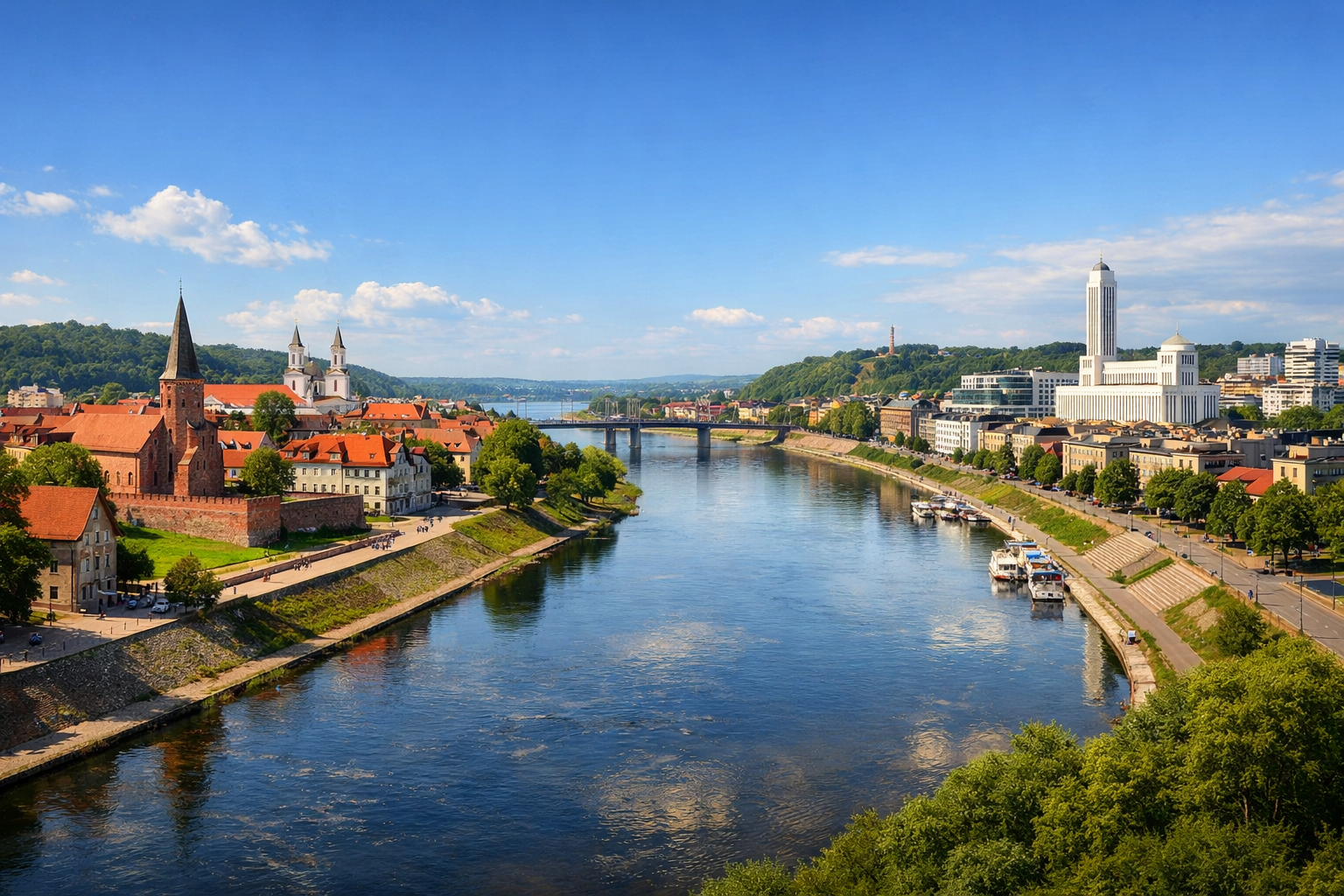
Lithuania, Kaunas. A budget city break with walks through the Old Town, modernist districts, embankments, and museums. Season: May - September.

Lithuania, Kaunas. A budget city break with walks through the Old Town, modernist districts, embankments, and museums. Season: May - September.

Discover Kaunas on a budget with three easy days of cobbled Old Town streets, striking modernist architecture, and relaxed walks along the river embankments. From café stops and museum visits to golden evenings by the water, Kaunas is at its best from May to September.

🧭 DAY-BY-DAY ITINERARY

Ready-made country and city routes with daily plans, sights, transport and accommodation. Buy PDF guides for independent travel.

🧭 DAY-BY-DAY ITINERARY


Day 1 — Kaunas: Old Town, castle, and the river confluence

  • 🚶 Start your introduction to Kaunas in the Old Town — one of the coziest and most visually cohesive historic areas in the Baltics. This is a place best enjoyed on foot without rushing: narrow cobbled streets, Gothic and Renaissance facades, quiet courtyards, church towers, and the feeling of a city that does not try to impress with noise but reveals itself gradually. It makes sense to head to Kaunas Castle and the square beside it, then continue along Pilies and onward to Town Hall Square. The castle itself matters not only as a photo spot: it is the city’s oldest defensive symbol, connected with the era of the medieval frontier, and the surrounding area conveys well how Kaunas grew at the intersection of trade, rivers, and military history.

  • 🚶 From the castle, be sure to walk to the area where the Nemunas and Neris meet. It is one of the most pleasant places for a slow walk in the warm season: wide skies, water, green slopes, a gentle breeze, and the rare feeling of openness right beside the historic center. From May to September it is especially nice to take a long pause here without a fixed agenda — sit on a bench, stroll along the paths, take photos with the rivers in the background, and simply catch your breath after the journey. It is convenient to plan the route so that the first half of the day covers the main historic sights and the second half is left for a relaxed promenade.

  • 🏛️ After your walk, visit Kaunas City Museum – Kaunas Castle, Pilies g. 17. This is a compact museum inside one of the city’s main historic landmarks, where the evolution of both the castle and Kaunas itself — from a medieval fortress to an important urban center — comes across clearly. The format works well for a short budget visit: the museum is not overwhelming, but complements the walk with facts, artifacts, and visual context.

  • 🚶 Then continue to Kaunas Town Hall and the surroundings of Vilniaus gatvė. The white town hall, often called the “white swan,” creates one of the most elegant urban scenes in Kaunas. Nearby, it is pleasant to wander without a strict plan: look into archways, admire churches and facades of former merchant houses, and catch the city’s evening rhythm. For dinner, it is better to choose a simple café or a daytime set menu away from the most touristy line — that way the budget stays intact while the atmosphere remains the same.

  • ⏱️ Logistically, the day is very comfortable: if you stay in the center or the Old Town, almost the entire route can be done on foot. Transfers between key points usually take 10–20 minutes, it makes sense to allow 45–60 minutes for the castle museum, and the full walk with stops, coffee, and rest fills a complete but not tiring day.


Day 2 — Kaunas: modernist center, Laisvės alėja, and museums

  • 🚶 Dedicate the second day to the Kaunas that made the city truly special on a European scale. Kaunas interwar modernism is included on the UNESCO World Heritage List as a rare and cohesive urban ensemble from the period when the city was the temporary capital of Lithuania and was rapidly turning into a modern European center. The best way to begin is from Laisvės alėja and gradually move into the New Town quarters, where modernist architecture appears not as isolated monuments but as a whole urban fabric: the rhythm of facades, rounded corners, geometric balconies, stairwells, shop windows, inner courtyards, and the sense of calm, confident urbanism of the 1920s and 1930s.

  • 🏛️ One of the most striking stops will be Art Deco Museum, Gedimino g. 48. This is not just a collection of objects, but almost a theatrical immersion into everyday life in interwar Kaunas: a restored apartment interior, furniture details, lamps, decorative solutions, and the very atmosphere of private urban life. It is an especially successful stop in the route because after walking past the facades and streets, modernism stops being an abstract architectural style and turns into a living environment in which people actually lived, hosted guests, read, worked, and dreamed of a modern European future.

  • 🏛️ Next, it is worth walking to M. K. Čiurlionis National Museum of Art, V. Putvinskio g. 55. Even if you are not planning a big museum day, this museum works perfectly as the cultural anchor of the route. It is connected with one of Lithuania’s most important painters and composers, and the area around the museum itself fits well with the theme of interwar Kaunas. Nearby is also Devils’ Museum, V. Putvinskio g. 64 — one of the city’s most unusual institutions. If it is open during your trip, you can add it as a vivid contrast: after strict architecture and classical art, an ironic, almost folkloric collection that makes the day less academic.

  • 🚶 In the second half of the day, leave time simply for Laisvės alėja — this long pedestrian boulevard is especially pleasant in the warmer months. Here it is easy to feel everyday Kaunas: unhurried, student-oriented, in places very European, yet without capital-city overload. Along the way you can make an inexpensive stop for soup, pastries, coffee, or a business lunch. If you still have energy, add a short climb to the Žaliakalnis district or a walk to historic public buildings to see even more expressive modernist facades.

  • ⏱️ This day is also realistic without rushing: from the Old Town to the central modernist quarters you can walk in about 20–30 minutes, and between the main points in the center it is usually an 8–15 minute walk. It is reasonable to allow about 1 hour for Art Deco Museum, 1–1.5 hours for the Čiurlionis Museum, plus separate time for rest and coffee so that the route remains enjoyable rather than turning into a sightseeing marathon.

Day 3 — Kaunas: embankments, Pažaislis, and a calm finale

  • 🚌 It is best to make the third day lighter and greener, so the trip ends not only with the city but also with water, space, and quiet. In the morning, head toward Kaunas Reservoir and Pažaislis Monastery. From the center, it is usually more convenient to get here by public transport or taxi than on foot. If you choose a bus or trolleybus with a transfer, the journey often takes around 30–45 minutes depending on your starting point; by taxi it is noticeably faster. For a budget trip, the best option is to go there in the morning after a relaxed breakfast and plan for an unhurried pace right away.

  • 🚶 Pažaislis is a completely different face of Kaunas. After medieval streets and modernist avenues, here comes a sense of silence, monastic symmetry, and nature by the water. The Pažaislis Monastery ensemble itself is one of the most beautiful Baroque places in Lithuania, and the surrounding grounds make it especially suitable for a summer route: shaded alleys, views of the reservoir, peaceful paths, and an almost resort-like mood. This is a good day not for the number of stops, but for the quality of the experience.

  • 🏛️ If you want to add a museum element, you can visit Sacral Heritage Museum at Pažaislis Monastery, T. Masiulio g. 31. Such a visit goes well with a walk around the ensemble because it helps you see not only the beauty of the place but also its cultural and religious depth. An alternative for those who prefer more urban history could be Sugihara House Museum, Vaižganto g. 30, connected with the memory of Japanese diplomat Chiune Sugihara and the tragic events of the 20th century. But on a short three-day route, it is better to choose just one so as not to overload the day with transfers.

  • 🚶 After Pažaislis, return to the center and leave the final hours for a light walk along the embankments or a return to your favorite part of the city — for example, walking through the Old Town again without a checklist of sights. That is exactly the charm of Kaunas: the city is compact, does not overwhelm with its scale, and gives you the chance on the last evening to simply be inside its rhythm. A good finale is an inexpensive dinner, a short walk along Laisvės alėja, or heading to the water at sunset.

  • ⏱️ In terms of time, this is the most relaxed day of the route. For the trip to Pažaislis and back, including waiting for transport, it is worth allowing about 1.5–2 hours in total; for the ensemble itself and the walk — 2–3 hours; and if you want the museum, another 45–60 minutes. That still leaves you enough time for rest, a late lunch, and a gentle end to the trip without fatigue.

Flight tickets

eSIM for travel

Buy PDF guide

Buy PDF guide — 6.90 USD

PDF — 6.90 USD