
Buy PDF guide

Buy PDF guide — 8.90 USD

PDF — 8.90 USD

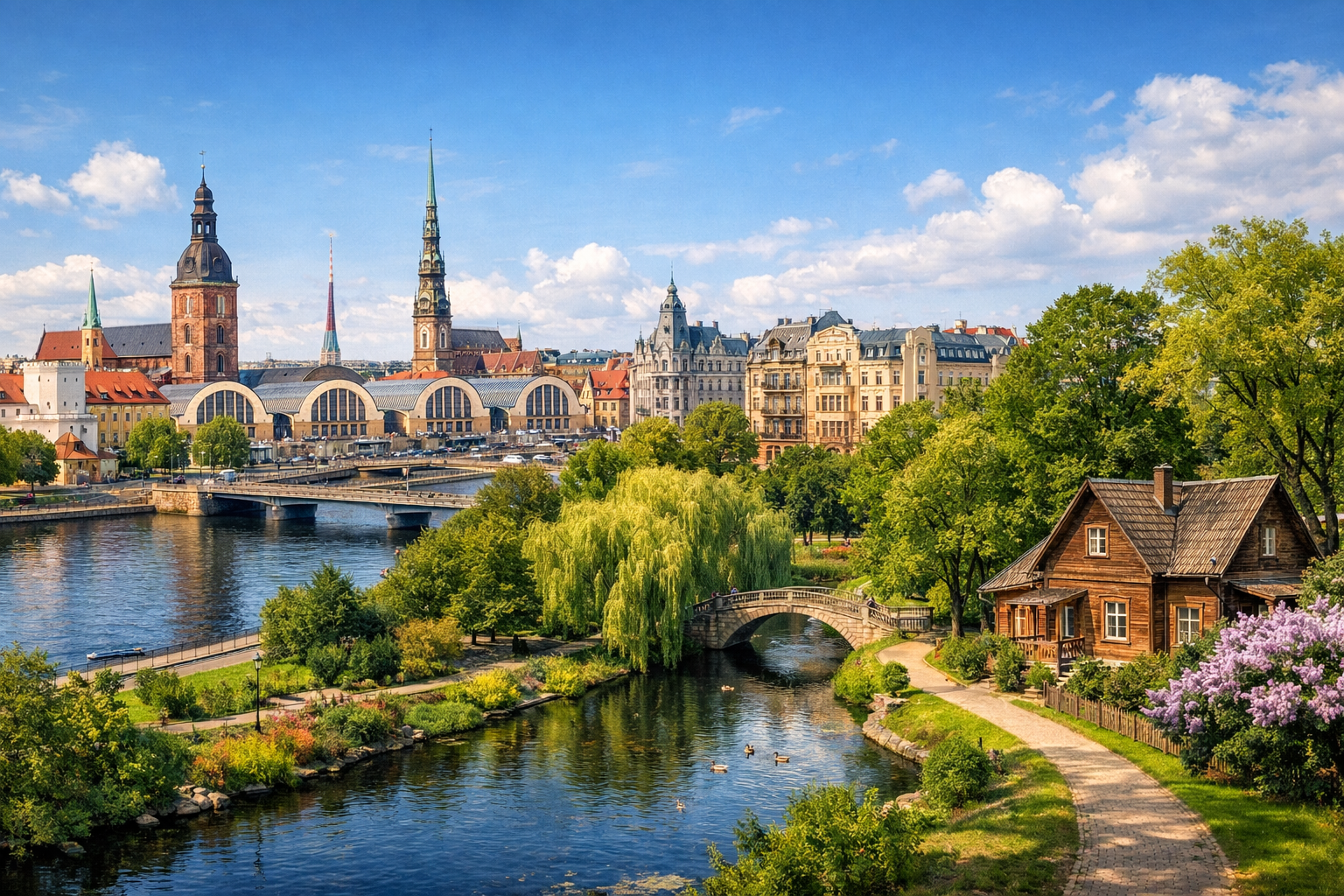
Latvia, Riga. A budget trip through the Old Town, the Art Nouveau district, the Central Market, parks, and the wooden neighborhoods of the Latvian capital. Season: May - September.

Latvia, Riga. A budget trip through the Old Town, the Art Nouveau district, the Central Market, parks, and the wooden neighborhoods of the Latvian capital. Season: May - September.

Discover Riga, where medieval streets, grand Art Nouveau facades, and the buzz of the Central Market come together in one of the Baltic’s most rewarding budget breaks. From leafy parks to the quiet charm of its wooden neighborhoods, Latvia’s capital is at its best from May to September.

🧭 DAY-BY-DAY ITINERARY

Ready-made country and city routes with daily plans, sights, transport and accommodation. Buy PDF guides for independent travel.

🧭 DAY-BY-DAY ITINERARY


Day 1 — Riga: Old Town and the boulevard ring

  • 🚶 Start getting to know Riga with the Old Town — Vecrīga, the most atmospheric and cinematic district of the Latvian capital. Here, the medieval street layout, stone facades, church spires, squares, arcades, and old merchant houses come together to create the rare feeling of a city where Northern Europe, the Hanseatic world, and Baltic history are literally visible at every turn. It’s best to build your walk without rushing: the House of the Blackheads, Town Hall Square, the narrow lanes around Riga Cathedral, the Three Brothers, the Swedish Gate, St. Peter’s Church, and the Daugava embankment are all within walking distance of one another. The Old Town is especially beautiful in the morning, when the cobblestones have not yet been overheated by the sun and the squares are not yet crowded with dense groups of tour visitors. This is where you can best feel the scale of Riga: it is not an open-air museum, but a living urban center where cafés, small galleries, pastry shops, and bookstores work side by side with Gothic and Baroque architecture.

  • 🏛️ If you want to add a museum focus to the first day, stop by the Museum of the History of Riga and Navigation at Palasta iela 4. It is one of the most logical museums for the start of a trip: it helps you see Riga not only as a beautiful tourist backdrop, but as an old trading and port city shaped by ties to the sea, crafts, and international trade. After the museum, it is pleasant to continue the route through Dome Square to the quiet side streets and then reach Bastion Hill and the canal — a green belt that embraces the historic center.

  • 🌳 In the second half of the day, switch to the boulevard ring: Bastejkalns Park, the Freedom Monument, Vērmanes Garden, and the city canals create a completely different Riga — lighter, airier, and more relaxed. It is the ideal contrast to the medieval density of Vecrīga. The walk between the parks does not take much time, but it gives a very good rhythm to a budget trip: you alternate intense sightseeing with rest on benches, a coffee break, and calm 10–20 minute walks. In the warm season from May to September, the boulevard ring is especially beautiful: lawns, tree canopies, canal water, and central facades make the city look elegant without feeling heavy.

  • ⏱️ The day’s logistics are convenient and realistic: from the central station area to the Old Town is about a 5–15 minute walk, and almost everything within the route can be done without transport. Allow a full day for the museum, a slow walk, lunch, and rest in the parks without overloading yourself. This matters for the first day: Riga reveals itself best not in a race through a checklist, but in the rhythm of unhurried urban strolling.


Day 2 — Riga: Art Nouveau district, museums, and the center

  • 🚶 Dedicate the second day to Riga’s Art Nouveau — one of the main reasons people come to Riga not only as lovers of old towns, but also as architecture enthusiasts. It is best to start with Alberta iela and the neighboring streets of the Quiet Centre. Here, facades are turned into theatrical sets: mascarons, female heads, ornaments, mythological figures, the vertical lines of bay windows, decorative lines, and sculptural details make even a short walk a true visual event. Riga does not simply “have a few beautiful buildings” — here Art Nouveau shapes entire quarters, and that is exactly what makes such a strong impression. Walk slowly and look upward: many of the most striking elements are not at shop-window level, but high above the street.

  • 🏛️ Be sure to visit the Riga Art Nouveau Museum at Alberta iela 12. Its value lies in showing Art Nouveau not only as facade beauty, but also as the lifestyle of prosperous urban Riga at the beginning of the 20th century. The interiors, staircases, decor, furniture, everyday details, and the atmosphere of the museum apartment itself help you imagine how this architectural style lived from within. After the museum, it is convenient to continue toward the Latvian National Museum of Art, address: Jaņa Rozentāla laukums 1. This is another layer of impressions: not only the city’s architecture, but also art that helps you feel Latvia more deeply as a cultural space, not just a weekend-trip destination.

  • 🌿 After the museum part, give yourself a break in Esplanāde — a large city park next to the museum. It is a very good place to rest: historic buildings all around, plenty of greenery, open space, and a pleasant feeling of being in the center without the bustle of the Old Town. Then you can walk along Elizabetes iela and other streets of the central district, where Art Nouveau stands side by side with stricter urban architecture and reveals itself not as a ceremonial showcase, but as a natural fabric of the city.

  • ⏱️ In terms of timing, the day is comfortable and budget-friendly: from the Old Town to Alberta iela is about a 15–20 minute walk, and between the key points in the center it is usually 10–15 minutes on foot. This makes it possible to spend almost nothing on public transport during the day and save your energy. In the evening, you can return via the Freedom Monument and the boulevards — this will close the route beautifully and give a sense of a complete urban composition.

Day 3 — Riga: Central Market, Academy of Sciences, and embankments

  • 🚶 The third day is the most “lived-in” and everyday, so you can see Riga not only in its ceremonial form, but as it really is. Start with the Central Market — one of the city’s symbols and one of the brightest places for a budget traveler. The enormous pavilions housed in historic hangars offer something no museum can provide: the rhythm of everyday urban life. Here you feel Riga as a trading, gastronomic, and very grounded city — with fish, bread, cheeses, berries, seasonal vegetables, smoked foods, sweets, and small local cafés. This place is convenient not only for walking around, but also for an inexpensive lunch or food snacks throughout the day.

  • 🏙️ After the market, walk toward Latgale Suburb and the building of the Latvian Academy of Sciences. Even if you do not go up to the viewing platform, the district itself offers an interesting contrast to the restored facades of the center: there is more ordinary urban life here, more Soviet and pre-war layers, more traffic movement, and a less touristy atmosphere. From the market, it is also easy to reach the canal and the edge of the Old Town, to once again see how compactly and logically Riga is laid out.

  • 🌊 In the second half of the day, take a calmer walk along the Daugava embankment. From here, Riga’s silhouette reads beautifully: the spires of the old center, bridges, river space, and a wide sky. In the warm season, this stretch is especially pleasant for relaxing after the bustle of the market. You can pause on a bench, take panoramic photos, and simply feel the scale of the city, which seems intimate in the center but suddenly opens up by the river as a full-fledged northern capital.

  • ⏱️ The day’s logistics are very simple: from the Old Town to the Central Market is about a 10–15 minute walk, and from the market to the embankment and back toward the center are just more short walks. This is one of the most convenient days of the route in terms of the balance of impressions and expenses. It is only important to remember basic caution: Latvia is considered a safe country for travel, but in Riga’s tourist areas, at stations, markets, on public transport, and in car parks, you should keep normal attention on your belongings and documents.

Day 4 — Riga: Pārdaugava, parks, and wooden neighborhoods

  • 🚋 Dedicate the final day to the Riga that tourists often miss when they limit themselves to the center — the left bank of the Daugava and the wooden quarters of Pārdaugava. It is easy to get here by public transport or a short taxi ride, but part of the route can also be combined with a walk across the bridges if the weather is good. This day is especially valuable for those who love not only postcard sights, but also urban texture: old wooden buildings, local markets, courtyards, low-rise streets, and green spaces.

  • 🏘️ The main point of the day is Kalnciema Quarter, known for its wooden Riga atmosphere. Here you will find restored 19th-century houses, a courtyard with market and cultural life, an intimate scale, and a very pleasant feeling of an area where the city shows its less ceremonial but more intimate face. In good weather, it is one of the best places for a calm finale to the trip: you can walk between the houses, look into a local market or event, have a coffee, and feel how the mood of Pārdaugava differs from the right-bank center.

  • 🌳 Then switch to the green part of the day: Arkādija Park, Victory Park, or the walking areas by Māras dīķis offer space, quiet, and rest after three busy days. These places matter not only as a “breather,” but also as part of Riga’s urban identity: the capital of Latvia is valued not only for its architecture, but also for its rare combination in a central city of water, trees, broad alleys, and neighborhoods where you do not feel the constant pressure of a big city.

  • ⏱️ For a route around Pārdaugava, it makes sense to allow for more pauses and fewer rigid commitments. Travel within the day usually takes 15–30 minutes, depending on your base and chosen transport. This is a good day for a gentle end to the journey, buying the last souvenirs, having a calm lunch, and returning to the hotel without rushing. If you rent a car or use car sharing, pay especially close attention to parking and do not leave valuables in plain sight: even in a safe country, basic urban caution remains a good habit.

Flight tickets

eSIM for travel

Buy PDF guide

Buy PDF guide — 8.90 USD

PDF — 8.90 USD