
Buy PDF guide

Buy PDF guide — 25.90 USD

PDF — 25.90 USD

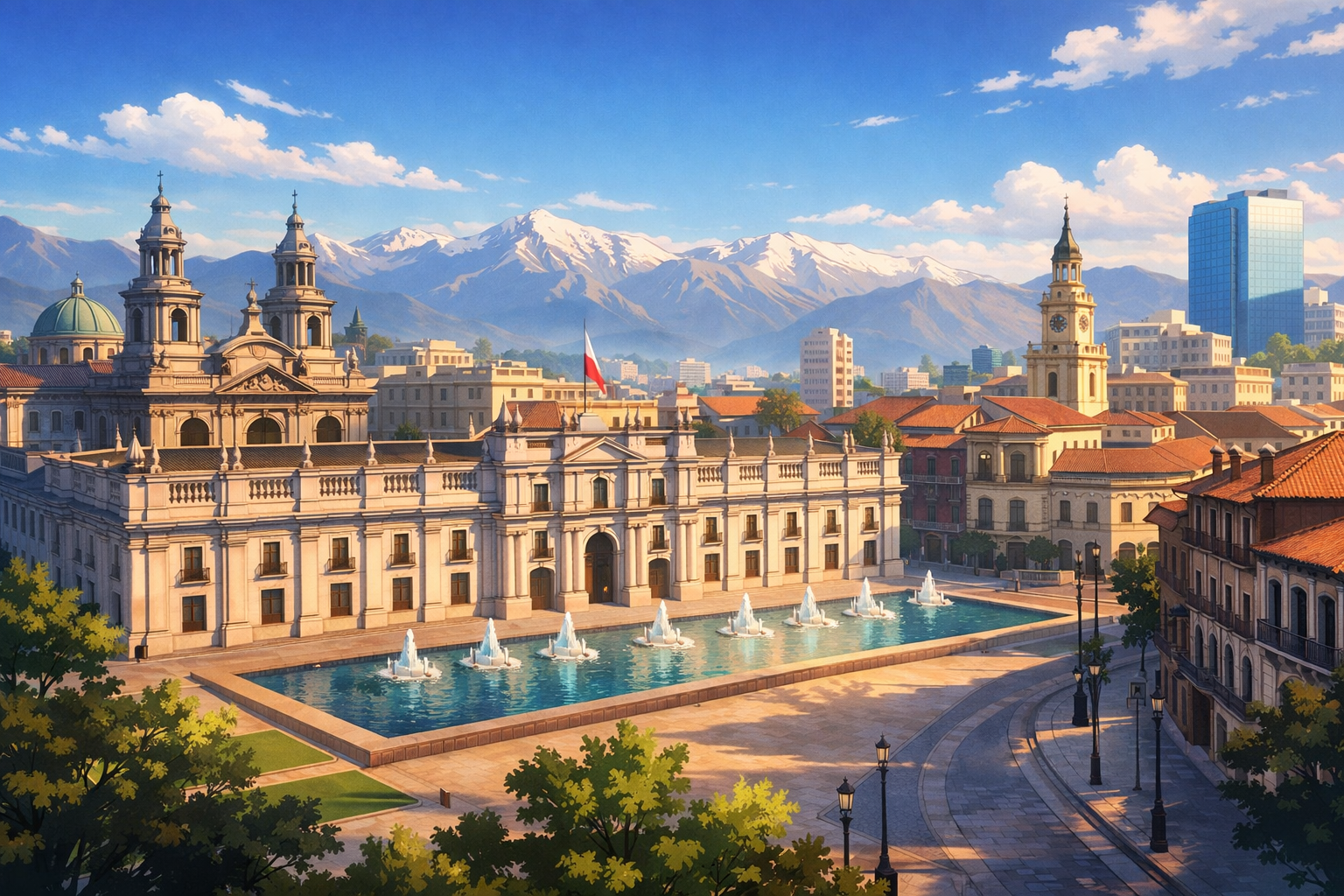
La Moneda and the historic center of Santiago

La Moneda and the historic center of Santiago

Discover the heart of Santiago around La Moneda and its historic center, where grand colonial buildings, lively squares, and acclaimed museums bring Chile’s past and present together. Climb the city’s urban hills for sweeping views, then wander streets full of history, culture, and everyday energy.

🧭 DAY-BY-DAY ITINERARY

Ready-made country and city routes with daily plans, sights, transport and accommodation. Buy PDF guides for independent travel.

🧭 DAY-BY-DAY ITINERARY


Day 1 — Santiago: arrival, getting acquainted with the La Moneda area and Plaza de la Ciudadanía

  • ✈️ After arriving at Santiago airport, allow about 45–70 minutes for the transfer to the center, depending on traffic. It is best to plan your stay in a hotel in the historic or near-historic zone so that the main sights on the route are reachable on foot or by a short metro ride.

  • 🚶 On the first day, do not overload your schedule: start with the area around Palacio de La Moneda and Plaza de la Ciudadanía. This is not just the administrative heart of the capital, but a space where the scale of republican Santiago is felt especially clearly: strict facades, wide vistas, the stone geometry of the square, and deliberate monumentality create a very distinctly “capital city” rhythm. An evening walk around La Moneda is ideal for easing into the city: the architecture can be read calmly, and around it you can easily sense the connection between the colonial past, neoclassical statehood, and modern urban life.


Day 2 — Santiago: Palacio de La Moneda and the cultural center beneath the square

  • 🚶 Devote the day to the ensemble of Palacio de La Moneda and Centro Cultural La Moneda. The palace itself is one of the most important examples of neoclassicism in South America, associated with the architect Joaquín Toesca; it is worth seeing not as a “standalone building” but as a political and architectural symbol of the country. The space in front of it functions as a stage for state representation, while the underground cultural center adds an interesting layer of contemporary museum experience directly beneath the official ensemble. This is a rare case when an itinerary allows you in a single day to compare monumental state architecture with current cultural infrastructure embedded in a historic context.

  • ☕ After the main visit, leave 1–1.5 hours for a break and coffee around Alameda or Paseo Bulnes: the day will be visually насыщенный, and a pause will help you better “assemble” your impression of the complex.

Day 3 — Santiago: the historic center, Plaza de Armas, and the city core of colonial origin

  • 🚶 Today, walk through the classic core of old Santiago: from the La Moneda area to Plaza de Armas, the walk usually takes about 20–25 minutes at a comfortable pace. Along the way, the structure of the old center is clearly visible—straight streets, a dense grid of blocks, and a succession of administrative and commercial facades. Plaza de Armas is important not only as the central square, but also as the point where the colonial logic of the city’s foundation can be felt most clearly. Here, history is easy to read in layers: from early Spanish urbanism to republican rebuilding and modern everyday city life.

  • 🚶 Devote the second half of the day to a slow walk along the neighboring streets—Compañía, Bandera, Merced. This is the best way to see how business activity, preserved patrician volumes, church buildings, museums, and everyday urban flows coexist in the center of Santiago.

Day 4 — Santiago: Museo Histórico Nacional and a panorama of urban history

  • 🏛️ Museo Histórico Nacional on Plaza de Armas is an ideal “anchor point” for understanding what you see on the streets. The exhibition helps connect the architecture of the center with Chile’s political history, colonial structure, independence, and republican development. It is especially valuable that the museum is located right in the heart of the old city: you are not just looking at artifacts, but immediately relating them to the surrounding urban space.

  • 🚶 Allow about 3–4 hours for the museum and the square, then take a lunch break. After resting, you can go up Torre Benjamín Vicuña Mackenna, if access is open: this helps you literally see the historic center from above and understand its scale, density, and composition.

Day 5 — Santiago: Museo Chileno de Arte Precolombino and the deeper context of the territory

  • 🏛️ This day is important for broadening the itinerary’s perspective. Museo Chileno de Arte Precolombino shows that the history of Chilean territory and of the Americas as a whole begins long before colonial Santiago. The museum building itself also deserves attention: a strict historic volume in the city center becomes a container for much older cultural layers. After several days in the colonial and republican core, such a visit is especially valuable: it changes the scale of perception and reminds you that the architectural history of the city is only one of the later chapters in a vast continental story.

  • 🚶 From Plaza de Armas to the museum, it is convenient to walk about 5–10 minutes. After the museum, leave time for a leisurely stroll around the block and a short rest: the density of impressions here is high, and the exhibitions usually require attentive reading of details.

Day 6 — Santiago: Museo de Santiago Casa Colorada and the history of the city itself

  • 🏛️ Casa Colorada is one of the most expressive historic civic houses in central Santiago. What is especially interesting here is not only the content of the exhibition devoted to the city, but also the architectural container itself: the house allows you to feel the scale of urban life in past centuries, the intimacy of courtyard culture, and the material presence of the old center. Unlike ceremonial state ensembles, Casa Colorada shows a more human, everyday, “domestic” layer of urban history.

  • 🚶 Combine the museum with a walking stroll along Merced and the surrounding streets. For this day, 2–3 museum hours and another 2 hours for a walk with a café stop are enough. This pace helps you avoid fatigue and perceive the historic center not as a list of points, but as a continuous urban fabric.

Day 7 — Santiago: Iglesia y Museo San Francisco — colonial solidity and religious architecture

  • ⛪ The San Francisco complex is one of the key stops for anyone interested in the ancient and early architectural layers of Santiago. It is one of the oldest surviving ensembles in the city, having endured earthquakes and numerous urban transformations. A different time is especially tangible here: the heavier plasticity of the walls, religious silence, the monastic logic of the space, and the particular “resilience” of colonial construction. The museum at the complex adds artistic and spiritual context, thanks to which the ensemble can be read not only as a monument, but as a living carrier of historical memory.

  • 🚶 From the La Moneda area to San Francisco, you can walk in about 10–15 minutes. Plan your visit for the first half of the day, and after lunch—rest or a short walk along Alameda, to give yourself time to reflect calmly on what you have seen.

Day 8 — Santiago: Cerro Santa Lucía — the urban hill as an architectural and landscape theater

  • 🌿 Cerro Santa Lucía is no less important to the route than the museums: it is a place where natural relief, the memory of fortifications, 19th-century strolling culture, and panoramic perception of the center come together into a single image of the city. The climb here is not difficult, but it is worth allowing 2–3 hours with stops: staircases, terraces, viewpoints, and decorative elements form an almost theatrical sequence of scenes. From the hill, you can see especially well how Santiago’s historic center is connected with the city’s later development.

  • ☕ It is best to come in the morning or closer to sunset, when the light is softer. After the climb, be sure to plan a rest break: even a light route with changes in elevation is noticeably tiring if you have already had a busy museum program before that.

Day 9 — Santiago: rereading the La Moneda area, Paseo Bulnes, and the civic architecture of the center

  • 🚶 After several days in museums and on old squares, it is useful to return to the La Moneda area with a “trained eye.” Now the facades, scales, and spatial axes are read differently: you better understand how the state center is embedded in the old urban grid, how the open spaces are organized, and why this district makes such a strong impression of discipline and representation. Walk from Plaza de la Ciudadanía to Paseo Bulnes and the neighboring blocks, paying attention to the rhythm of the facades, the perspectives, and the transitions between the administrative, memorial, and everyday city.

  • 🚶 This day can be made lighter: 3–4 hours of walking, a long lunch, and an evening without a rigid program. Such an “airy” day is needed so that you do not burn out on a dense historic route.

Day 10 — Santiago: a free museum and architecture day in the center

  • 🏛️ Use the day to revisit the place you liked most: Centro Cultural La Moneda, Museo Histórico Nacional, Museo Chileno de Arte Precolombino, or Casa Colorada. This is not a “backup” day, but an important part of a thoughtful historical tour: it is precisely on a second visit that you often notice architectural details, proportions, spatial routing, and connections between sites that slipped by the first time.

  • 🚶 If you do not need a repeat museum, devote the day to a slower exploration of the historic center: arcades, church facades, inner courtyards, intersections of old streets, and small squares. Keep the pace moderate and leave at least 1.5 hours for rest in the middle of the day.

Day 11 — Santiago: a final panorama of history — from the colonial layer to the republican one

  • 🚶 Today, create a route of echoes: start at San Francisco, then move toward La Moneda, and after that to Plaza de Armas and the museums around it. Such a walk takes almost the whole day with breaks, but it is especially valuable because it allows you to literally experience with your feet the architectural evolution of the center: the oldest religious fabric, then the republican gesture of the state, then the colonial core of the square and museum interpretations of history.

  • ☕ Be sure to include lunch and a short rest between route segments. The walking sequence San Francisco → La Moneda → Plaza de Armas with museums and stops usually takes 6–8 hours at a comfortable cultural pace.

Day 12 — Santiago: a calm wrap-up, book shopping, and departure

  • 🚶 It is best to keep the final day light. In the morning, you can take a short final walk around your favorite location—Plaza de la Ciudadanía, Cerro Santa Lucía, or Plaza de Armas—and then get ready for departure at an unhurried pace. This kind of ending works especially well after an intense architectural route: the city no longer presses on you with novelty, but is perceived as a familiar historic environment with clear accents and rhythms.

  • ✈️ For the trip from central Santiago to the airport, people usually allow about 45–70 minutes, and during busier hours—with extra buffer time. If your flight is international, it is better to leave early and avoid planning a busy program on the day of departure.

Flight tickets

eSIM for travel

Buy PDF guide

Buy PDF guide — 25.90 USD

PDF — 25.90 USD