
Buy PDF guide

Buy PDF guide — 6.90 USD

PDF — 6.90 USD

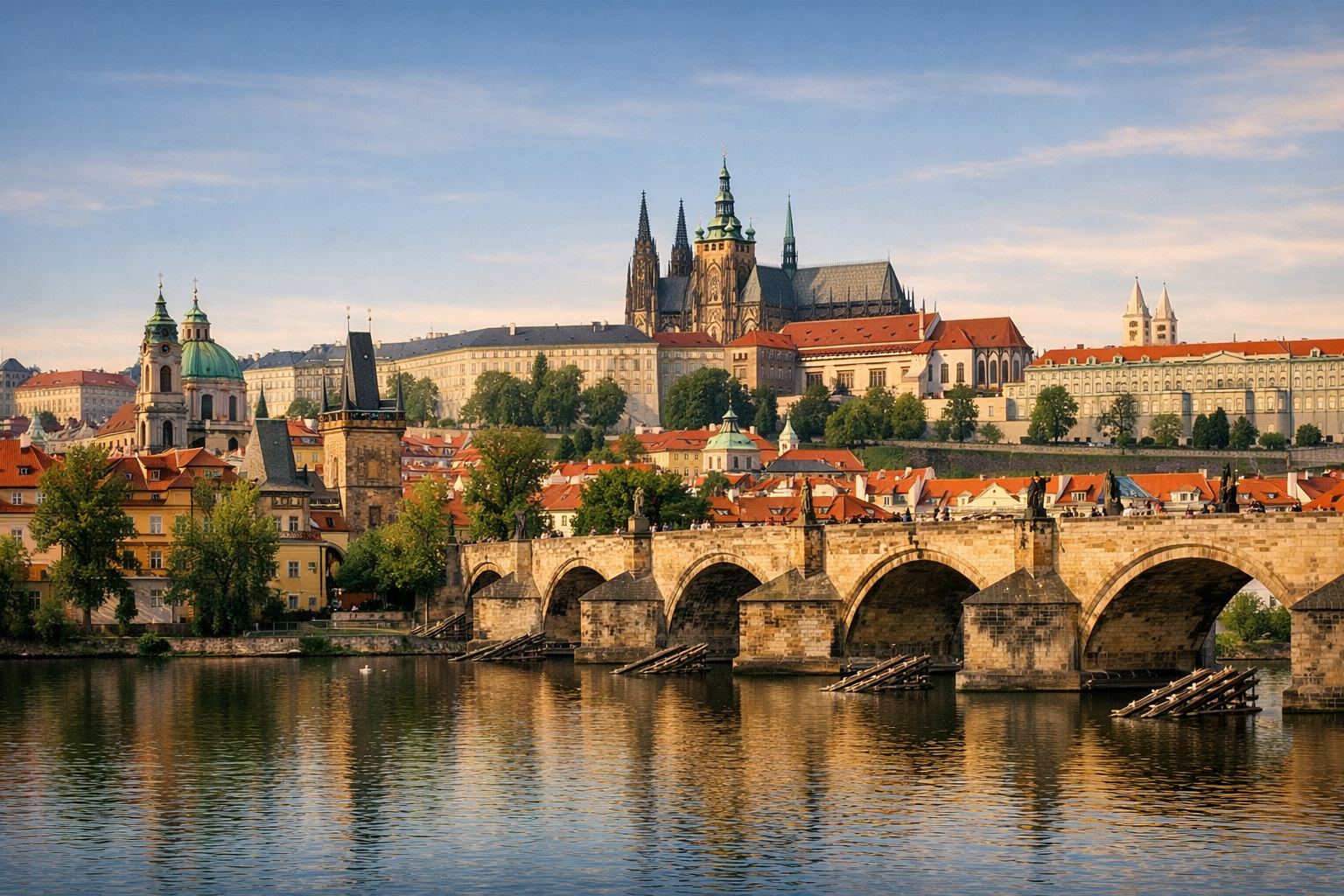
Classic Prague Old Town Charles Bridge and Prague Castle

Classic Prague Old Town Charles Bridge and Prague Castle

Wander from Prague’s storybook Old Town across the statues of Charles Bridge into the charming lanes of Malá Strana, then climb to the grandeur of Prague Castle. It’s a timeless walk through gothic spires, baroque facades, and some of Europe’s most memorable views.

🧭 DAY-BY-DAY ROUTE

Ready-made country and city routes with daily plans, sights, transport and accommodation. Buy PDF guides for independent travel.

🧭 DAY-BY-DAY ROUTE


Day 1 — Old Town: Old Town Square, the Astronomical Clock, and the Jewish Quarter

  • 🚶 It’s best to dedicate the first day to the image of Prague that stays in your memory forever: narrow cobbled streets, Gothic towers, arches, courtyards, and squares that suddenly open up before you. Start at Old Town Square and give yourself time not just to “tick it off,” but to look closely at the details: the facades here do not compete with one another, but come together into an almost theatrical set of old Europe. The Orloj astronomical clock, Týn Church, the town hall, and the dense web of lanes around the square create the feeling of a city that has lived for centuries in the same rhythm, changing eras while keeping its own face. Allow about 2–2.5 hours for the square and nearby streets, with a short coffee stop.

  • 🏛️ Then head toward Josefov, the Jewish Quarter, where Prague becomes quieter, more reflective, and historically deeper. Here the city’s layered character is especially palpable: elegant facades stand next to places of memory, and a walk between the synagogues and the Old Jewish Cemetery changes your perspective after the postcard beauty of the square. If you plan to visit museums, it makes sense to choose 1–2 sites instead of trying to do everything at once: that way the impressions won’t blur together. Set aside about 2 hours for this part, plus 45–60 minutes for a relaxed lunch in the center.

  • 🌆 In the second half of the day, walk to the Clementinum and then on to the Vltava embankments. This stretch works well as a gentle continuation of the day: after a history-filled walk, the city seems to open up, becoming lighter and more airy. If you still have energy, go up to one of the viewpoints or simply walk to Karlova Street to get a feel in advance for tomorrow’s route toward the bridge. It’s best to end the evening without rushing: dinner in the Old Town, a short walk through the illuminated streets, and an early rest. You’ll cover about 6–8 km on foot during the day; at a comfortable pace with breaks, it makes for a full but realistic first day.


Day 2 — Charles Bridge and Malá Strana: towers, Kampa Island, and Baroque Prague

  • 🌉 It’s best to start the morning of the second day early at Charles Bridge — that is when it feels least like a “must-see tourist spot” and most like a living historical stage between two riverbanks. Walk slowly, paying attention to the sculptures, river views, towers, and the way Prague’s perspective changes with every few dozen steps. If you want to add a vivid highlight, climb the Old Town Bridge Tower: from above, the bridge and the roofs of the Old Town come together into that classic Prague silhouette. Allow roughly 1.5–2 hours for the morning walk on the bridge and the nearby views.

  • 🏘️ After the bridge, it makes sense to go deeper into Malá Strana — a district where Prague feels softer and more aristocratic. There is less sense of a “central stage” here and more intimacy: Baroque facades, palaces, stairways, quiet courtyards, church domes, and streets that invite you to walk slowly. Stroll through Malostranské Square to Kampa Island: this is one of the best ways to feel not museum Prague, but a lived-in, poetic Prague. Kampa is perfect for a pause, a short rest by the water, and photos without the rush. This section is worth about 2.5 hours, including a coffee stop or a light lunch.

  • 🎻 In the evening, Malá Strana is especially beautiful: the light grows warmer, the tourist flow thins out, and the facades begin to feel almost like scenery from a historical film. If you want to add a cultural layer, choose a small museum, a concert hall, or simply a leisurely walk along the embankment with views of bridges and towers. It’s best not to overload the day with long transfers: its strength lies precisely in the fact that almost the entire route is done on foot, with only occasional short climbs and a gentle alternation between movement and rest. Total walking distance is about 5–7 km.

Day 3 — Prague Castle and Hradčany: St. Vitus Cathedral, palaces, and panoramas

  • 👑 Dedicate the final day to Prague Castle — not as just one “point on the map,” but as an entire historical world above the city. The most convenient option is to arrive in the morning and start the route from the upper part of the complex, then make your way down without unnecessary fatigue. Prague Castle is not only a residence and a set of separate buildings, but a vast stage of Czech history: St. Vitus Cathedral, the Old Royal Palace, St. George’s Basilica, Golden Lane, and sweeping views over Prague’s red roofs. Even if you do not go into every interior, simply moving through the courtyards and passageways makes a strong impression. It is reasonable to allow 3–4 hours for the main visit to the complex.

  • ⛪ After the main sights, do not rush away: the Hradčany district is appealing precisely because it allows you to slow down. There are many broad vistas, palace facades, and places where the city lies before you as if in the palm of your hand. If you want a museum focus, Lobkowicz Palace or the nearby National Gallery palace exhibitions are good choices. If a walk matters more, go through Hradčany Square and descend toward Malá Strana, stopping at panoramic viewpoints. Allow at least 60–90 minutes for rest and lunch: the final day should feel ceremonial, not like a race up and down staircases.

  • 🌇 It’s best to end the trip with a beautiful descent back into the city, with views of domes, tiled roofs, bridges, and the winding Vltava. From here it becomes especially clear why Prague feels so cohesive — even though it is very different across eras, it comes together into a harmonious, almost musical urban landscape. Leave time for a farewell walk, dinner in Malá Strana or the Old Town, and a calm evening without a packed schedule. In terms of effort, this is the most demanding day of the route: because of the climbs and the large historical complexes, it requires a slower pace and comfortable shoes.

Flight tickets

eSIM for travel

Buy PDF guide

Buy PDF guide — 6.90 USD

PDF — 6.90 USD