
Buy PDF guide

Buy PDF guide — 25.71 USD

PDF — 25.71 USD

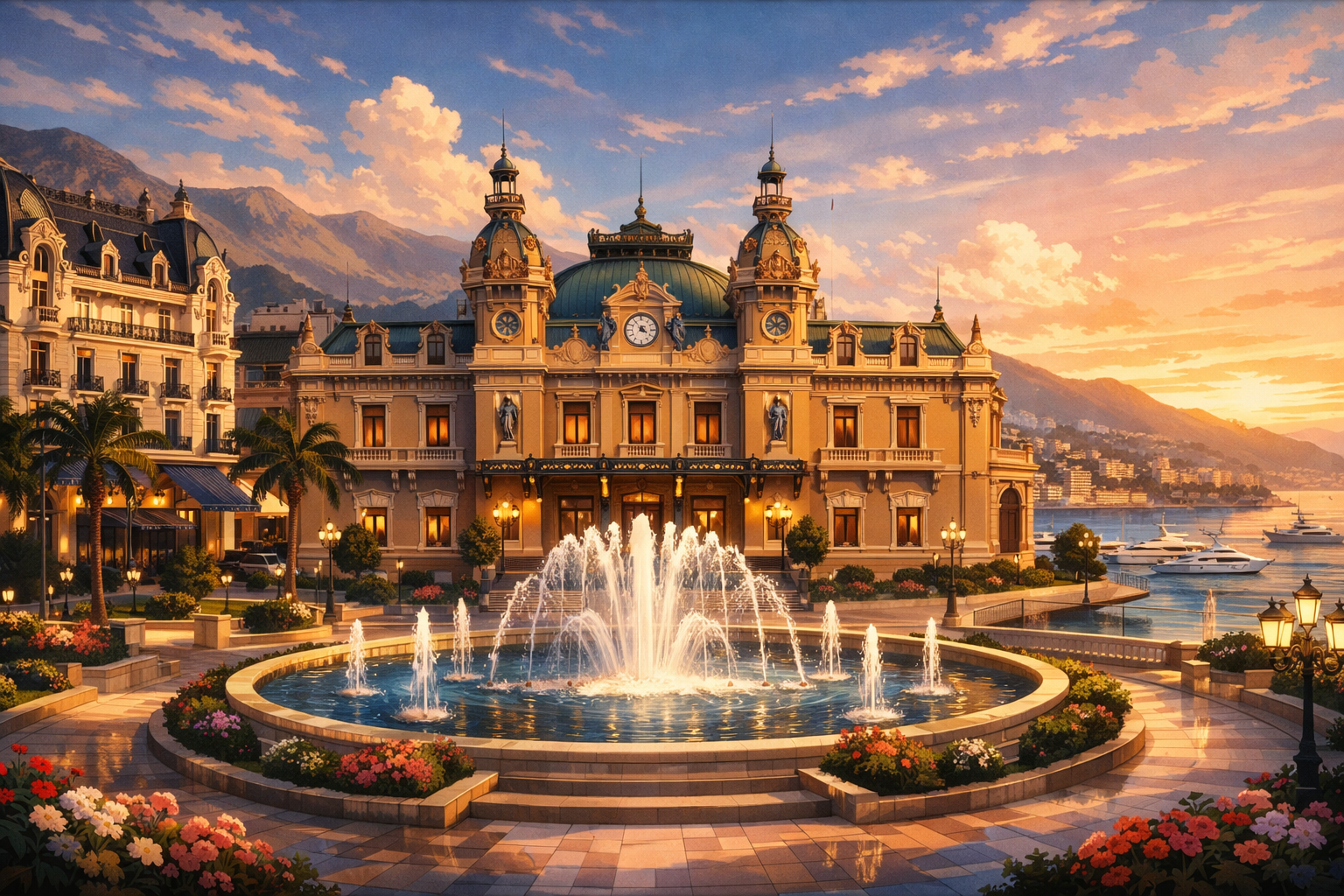
Monte Carlo Casino and Belle Époque

Monte Carlo Casino and Belle Époque

Monaco dazzles with Monte Carlo’s Place du Casino, a yacht-lined harbor, and the cliff-top lanes of Monaco‑Ville on Le Rocher. Use this glittering perch to sweep the Riviera—La Turbie’s Roman trophy, the Ephrussi and Kérylos villas, fragrant Èze and garden-filled Menton—then return for a finale under Monte Carlo’s lights.

🧭 DAY-BY-DAY ITINERARY

Ready-made country and city routes with daily plans, sights, transport and accommodation. Buy PDF guides for independent travel.

🧭 DAY-BY-DAY ITINERARY


Day 1 — Arrival in Nice and transfer to Monte Carlo: first acquaintance with Casino Square

  • ✈️/🚌/🚆 Transfer from Nice Airport (NCE) to Monaco: express bus to Monaco ≈ 45–60 min; if desired — TER to Monaco–Monte-Carlo station ≈ 24–30 min (with a transfer to the tram/on foot to the Saint-Augustin railway station); helicopter — 7 min. Check-in, then an unhurried evening stroll around Place du Casino: shimmering façades, illuminated arcades, and the gleam of shop windows create the perfect “entrance” into the Belle Époque aesthetic.

  • 🚶 Casino Square as an “urban stage”: the Monte Carlo Casino complex, Hôtel de Paris Monte-Carlo, and Café de Paris form a classic luxury triad of the late 19th–early 20th century. Note the flowing stucco, wrought-iron balconies, and the rhythm of the windows—typological markers of the style that you’ll “read” throughout the tour.


Day 2 — Monte Carlo Casino and the Opera (Salle Garnier): a theater of light and gold

  • 🚶 In the morning — exterior viewing and daytime photos of the Casino façade (arch. Charles Garnier): wings, arcades, sculptures, and domes read better in side light. The interiors with stained glass, marble, carved ceilings, and neo-baroque halls show how the Belle Époque turned gaming and leisure into an “art of impression.”

  • 🎭 Then — the Monte Carlo Opera (Salle Garnier), a “jewel box” attached to the Casino: gilded cornices, velvet, mascarons, painted decorations. Compare it with Paris’s Opéra Garnier: a more compact scale, but the same theatrical spatial dramaturgy—the degree of luxury is preserved.

Day 3 — Belle Époque of the Monte Carlo district: Hôtel de Paris, Hermitage, galleries and gardens

  • 🚶 Hôtel de Paris Monte-Carlo and Hôtel Hermitage Monte-Carlo are two benchmarks of Belle Époque hospitality. Outside—refined façades; inside—glass roofs and staircases, where metal and glass (in the spirit of the era’s engineering poetry) highlight marble and wooden details. Step into the Gallery and under the Hermitage conservatory dome—there you can especially clearly see how iron and glass create “airy architecture.”

  • 🌿 The Japanese Garden by the Grimaldi Forum is a brief counterpoint: strict stone composition, ponds, and bridges change the optics after the golden glow of the square. In the evening—panoramas from terraces above Avenue de Spélugues: the soft outline lighting of Belle Époque façades and the Mediterranean Sea.

Day 4 — Monaco-Ville (Le Rocher): the Prince’s Palace, cathedral and Oceanographic Museum

  • 🚶 The Prince’s Palace (Palace Square) is a “living fortress” with layers of eras: from medieval bastions to classical and baroque halls. The Cathedral of Our Lady Immaculate (late 19th–early 20th c., Romanesque-Byzantine style) is an example of the historicist synthesis typical of the Belle Époque.

  • 🌊 The Oceanographic Museum on the cliff edge (1910): a monumental stone “skyline piece”—the façade literally grows out of the precipice, and the exhibition combines science with art. Between the points—walk through the Saint-Martin Gardens: shady terraces, scenic stairways, Mediterranean flora.

Day 5 — La Turbie: Tropaeum Alpium (Trophy of Augustus) and the city’s medieval fabric

  • 🚌 Transfer Monaco → La Turbie (regional ZOU! buses via hairpin roads; travel with stops and ascent ≈ 30–45 min).

  • 🚶 The Trophy of Augustus (Trophée d’Auguste/Tropaeum Alpium) is a powerful Roman monument crowning the ridge above the sea. The scale of the ruins, reconstructions, and Riviera panoramas lets you “collapse” 2,000 years of history into a single view. La Turbie’s old streets with stone arches and stairways are an ideal stage for understanding continuity from antiquity → Middle Ages → Belle Époque on the coast.

Day 6 — Beaulieu-sur-Mer and Saint-Jean-Cap-Ferrat: “antiquity, Belle Époque style”

  • 🚆 TER Monaco → Beaulieu-sur-Mer ≈ 10–13 min, then on foot 10–15 min to Villa Kérylos.

  • 🏛️ Villa Kérylos (1902–1908) is a scholarly-artistic reconstruction of a Greek residence of the Hellenistic era: a peristyle with Carrara marble, mosaics, object-level archaeological accuracy. After that—walk/bus to the Villa Ephrussi de Rothschild (1905–1912): an eclectic Belle Époque “palace-pavilion” with nine gardens (French, Spanish, Japanese, etc.), where the landscape is a full-fledged “architect” of the ensemble.

Day 7 — Èze-Village: a medieval summit and an exotic garden on ruins

  • 🚌 ZOU! to Èze-Village (via hairpin roads; travel from Monaco ≈ 25–40 min including climbs).

  • 🚶 The fortified settlement of Èze on the rock and the Exotic Garden at the top (on the castle ruins) create a dramatic route along narrow streets to viewpoints at 429 m. As at Kérylos, here “antiquity” returns not through walls, but through the panorama and the Mediterranean myth.

Day 8 — Menton: the “winter Riviera” and baroque notes of the old town

  • 🚆 TER Monaco → Menton ≈ 12–18 min. Morning light is good for the hillside façades: the orange-ochre palette of the houses and the bell tower of the Basilica of Saint Michael. Menton’s gardens (in season) add the theme of “botanical Belle Époque”—the art of a winter resort in greenery and terraces.

  • ☕ A short pause on the Garavan promenade before the return trip—the Baltic breeze here changes into a silky southern one.

Day 9 — Nice, Cimiez: the Roman city of Cemenelum and the Archaeology Museum

  • 🚆 TER Monaco → Nice-Ville ≈ 24 min, then bus/on foot to Cimiez. On the plateau—an amphitheater, baths, and streets of Roman Cemenelum. In the archaeology museum near the ruins—pottery, inscriptions, fragments linking the plan of the ancient city to real life. Nearby—the Cimiez monastery garden and panoramas above the Promenade des Anglais.

Day 10 — Antibes/Cannes: forts, promenades, and Belle Époque facades

  • 🚆 TER: Monaco → Antibes ≈ 40–50 min; Antibes → Cannes ≈ 10–15 min (or Monaco → Cannes directly ≈ 55–65 min).

  • 🚶 Antibes: Fort Carré and the old town on the rock — bastioned geometry against the sea horizon. Cannes: La Croisette, historic hotels from the early 20th century — the rhythm of loggias, colonnades, and turrets on facades, where the resort turns into an architectural showcase of the coast’s “golden age”.

Day 11 — Monaco: scientific archaeology and the rock’s botany

  • 🏛️ Museum of Prehistoric Anthropology (by the Exotic Garden): human sites, bones, stone industries — the Riviera’s “deep time”. Plan the Monaco Exotic Garden for after its official opening (reopening announced for the end of March 2026; check current status and hours) — succulent collections, a karst cave viewpoint, and vertical botany at the edge of the cliff.

Day 12 — Finale in Monte-Carlo and departure

  • ☕ Morning loop around Place du Casino: compare your impressions “before” and “after” the route — now the Belle Époque facades read as the conclusion of a long line: antiquity → the Middle Ages → industrial elegance of the late 19th century.

  • 🚌/🚆/🚁 Transfer to Nice Airport: express bus ≈ 45–60 min; TER with a tram connection ≈ 45–60 min; helicopter — 7 min.

Flight tickets

eSIM for travel

Buy PDF guide

Buy PDF guide — 25.71 USD

PDF — 25.71 USD