
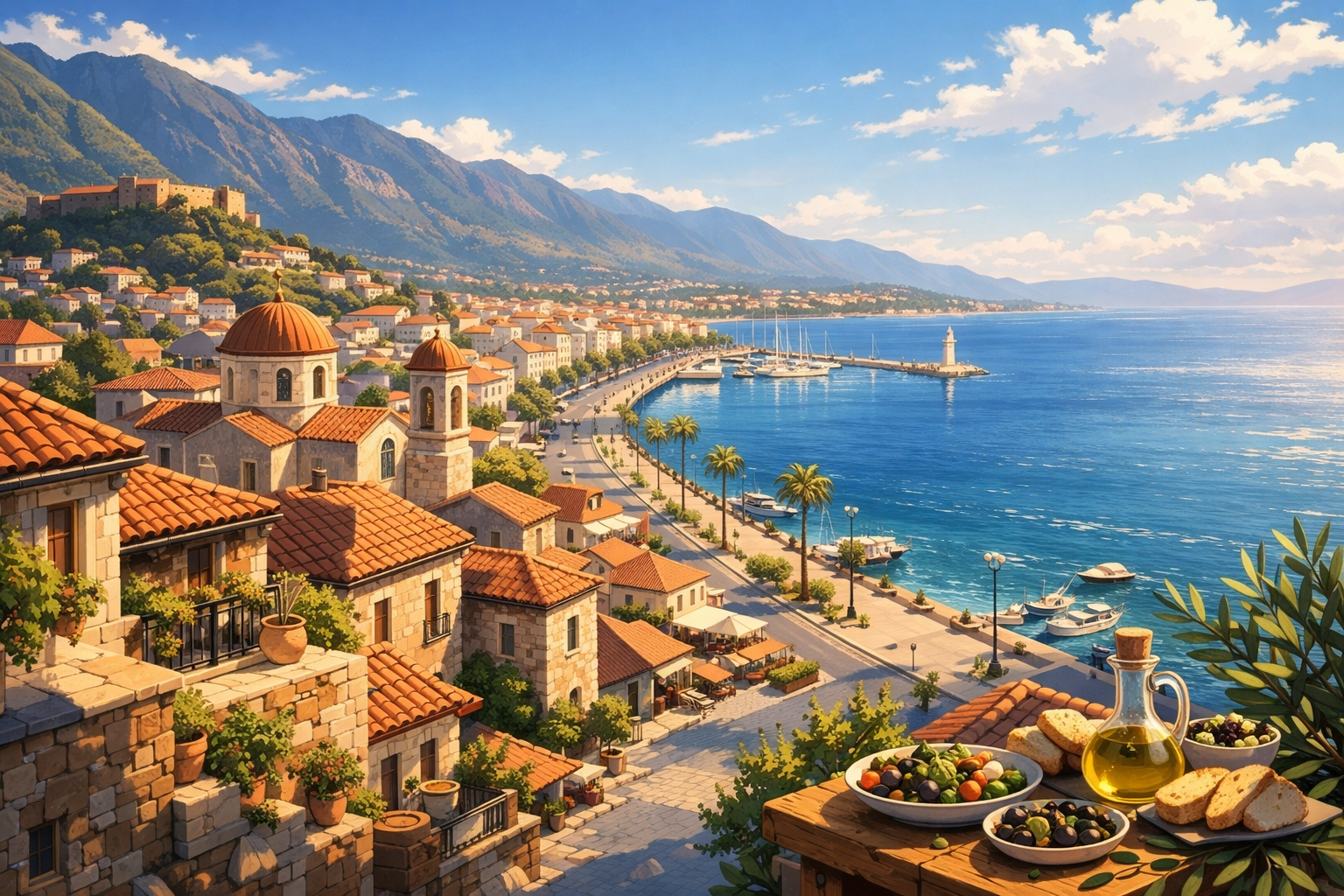
Day 1 — Kalamata Old Town: castle, squares, museum and an evening by the sea
🚶 Start getting to know Kalamata from the old town — this is where the character of Messenia is felt best: stone lanes, stairways, terracotta roofs, warm light on the facades, and the constant sense that the sea is very close, even though city neighborhoods and the hillside with the fortress are already rising around you. The historic core of the city is easy to explore on foot: first head up to Kalamata Castle, located on a low hill at the northeastern edge of the center. From here, you get views over the urban fabric, the plain, and the direction of the sea, while the fortress itself preserves Byzantine and Frankish layers of history. It’s best to allow about 1.5–2 hours for the climb, sightseeing, and photo stops, because this place is less about “ticking a box” and more about atmosphere and panoramas.
🏛️ After the castle, head down into the historic center to the Archaeological Museum of Messinia. It is housed in a restored building of the old municipal market and does an excellent job of explaining why Kalamata is not only a resort by the gulf, but also a gateway to one of the most interesting historical regions of the Peloponnese. The exhibition covers a huge span of time — from prehistoric eras to the Byzantine period — and is organized in a way that even a leisurely 60–90 minute visit feels coherent. Nearby, it is pleasant to simply wander without a strict plan: around you are paved lanes, small cafés, old churches, and calm Mediterranean urban life without the rush of major capitals.
🍽️ Dedicate lunch to your first introduction to Messenian cuisine. Kalamata’s main theme is olives and olive oil, and here this is not a decorative tourist cliché, but the foundation of flavor. Look for dishes where the quality of the oil is truly noticeable: rustic bread with golden local olive oil, Greek salad with rich tomatoes and Kalamata olives, baked vegetables, briam, gigante beans, fresh fish or squid, simple meze where the product is not hidden under heavy sauces. In the old town, it’s worth having a long lunch of about 1.5 hours and not rushing onward.
🚶 In the second half of the day, follow the route old town → central streets → seafront area. From the historic center to Kalamata’s promenade and beach zone, it is generally comfortable to walk in about 30–40 minutes at an easy pace, but if the heat is strong, it’s better to take a taxi for 10–15 minutes or use a city bus. This transition is especially good because it shows the true rhythm of the city: from the hill and old quarters to straighter streets, then to palm trees, sea air, and the long line of Navarinou.
🌅 Spend the evening on your first walk along the Navarinou promenade and Kalamata Beach. This is not a “beach resort outside the city,” but a rare combination of полноценное city space and the sea literally at your feet: sun loungers sit beside cafés, promenade life naturally flows into swimming, and the Taygetos massif is visible in the background. At sunset, it is especially beautiful here: the light becomes softer, the water in the Messenian Gulf takes on a deep blue-steel shade, and the city seems to change its pace. It’s worth allowing 3–4 hours without rushing for a swim, an aperitif, and a relaxed dinner by the sea.