Buy PDF guide

Buy PDF guide — 21.90 USD

PDF — 21.90 USD

Italy, Tuscany. A slow trip staying in one agriturismo, with walks through Florence, Siena, San Gimignano, and the wine villages of Chianti

Italy, Tuscany. A slow trip staying in one agriturismo, with walks through Florence, Siena, San Gimignano, and the wine villages of Chianti

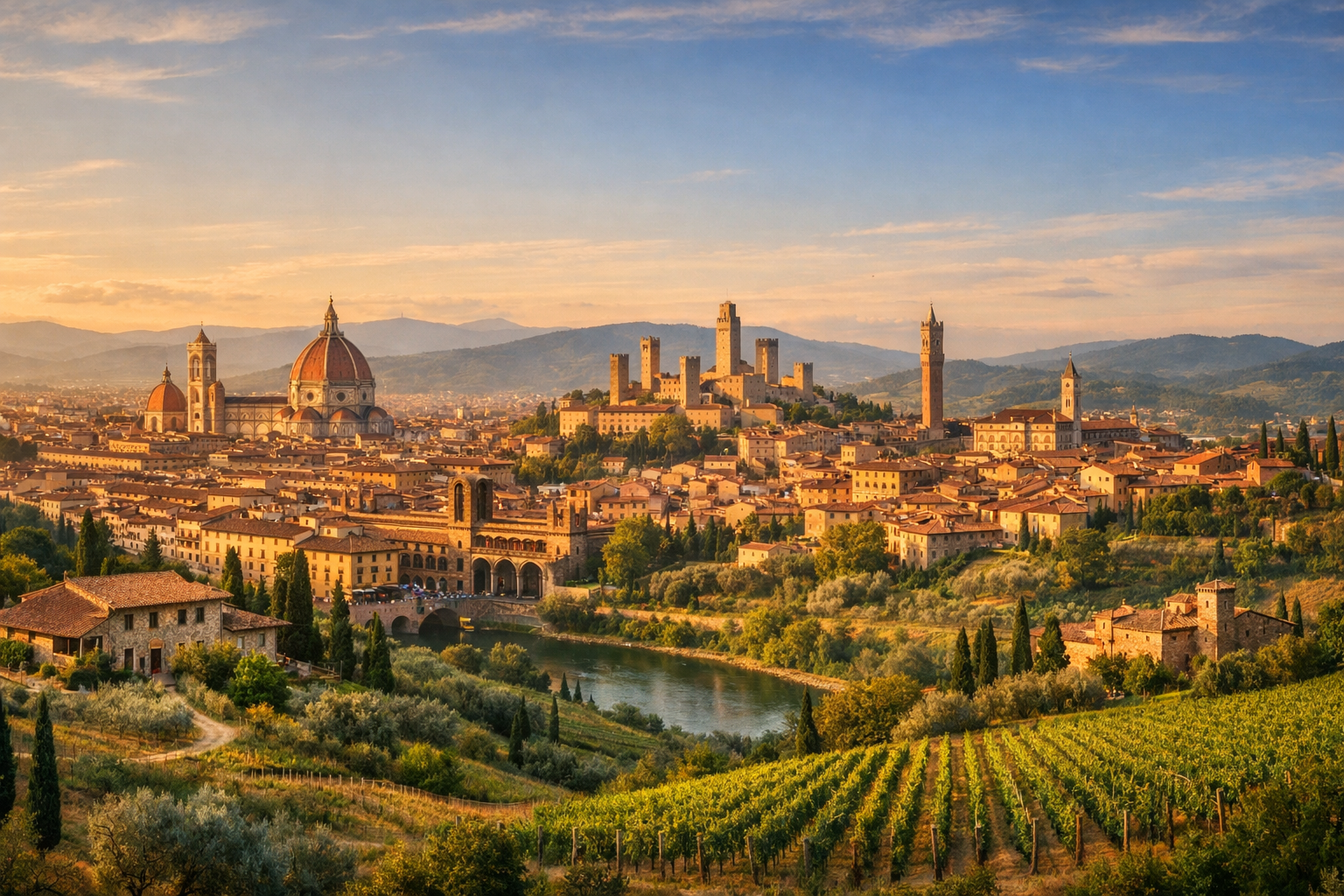
Settle into a Tuscan agriturismo and let the region unfold at an unhurried pace. Wander the art-filled streets of Florence, the medieval lanes of Siena and San Gimignano, then drift through Chianti’s wine villages where cypress-lined roads, vineyards, and long lunches set the rhythm.

🧭 DAY-BY-DAY ITINERARY

Ready-made country and city routes with daily plans, sights, transport and accommodation. Buy PDF guides for independent travel.

🧭 DAY-BY-DAY ITINERARY


Day 1 — Arrival in Chianti: one base and the first slow evening

  • 🚆 Recommended arrival logistics: Florence Airport → city center by T2 tram in about 20 minutes, then an Autolinee Toscane regional bus toward Greve / Panzano / Radda / Castellina depending on your chosen agriturismo. It’s important for this route not to change bases: the whole trip is built around one stay in the rural part of Chianti so the days can pass without suitcase stress and constant repacking.

  • 🏡 Check-in at an agriturismo in the Panzano, Radda, or Castellina in Chianti area is not just an overnight stay, but the central part of the journey itself. Here Tuscany opens up not through a must-see list, but through the rhythm of the day: a cypress-lined drive, terracotta walls, vineyard views, a slow breakfast with homemade pastries, afternoon silence, and a long golden hour before dinner. For couples and travelers 50+, this format is especially comfortable: fewer transfers, more rest, and the freedom to come back early any day and sit by the garden, pool, or terrace with a glass of Chianti Classico.

  • 🚶 In the evening, leave the schedule almost empty: take a short 30–60 minute walk through the nearest village or along a country road between the vineyards, have an early dinner at the agriturismo restaurant or a nearby wine bar, and get to know the local olive oil, pecorino, crostini, and your first glass of sangiovese. This gentle start helps you adapt after the journey and immediately tune in to the main rule of this trip: don’t rush.


Day 2 — Florence: the historic center without the rush

  • 🚌 An early, but not too early, departure for Florence by regional bus via Greve / Strada in Chianti or with a transfer, depending on your base. Allow roughly 1 hr 20 min to 2 hr each way. This is not a box-ticking day, but a city walk with pauses: one great Tuscan capital can easily be experienced as a sequence of beautiful neighborhoods, coffee stops, and moments of watching everyday city life.

  • 🚶 Florence is especially rewarding in a slow format, when you don’t storm every museum but let the city reveal itself through its spaces. Walk from the Santa Maria Novella area to Piazza del Duomo, then to Piazza della Signoria and the Arno embankment. What matters here is not only the cathedrals and palaces, but the very fabric of the city: stone facades, arches, inner courtyards, workshops, bookstore windows, and long street perspectives that suddenly open onto Brunelleschi’s dome. For photographers, this is one of the most generous cities in Europe: from late morning the light falls beautifully on the ochre walls, and by evening the bridges and riverfront facades become almost theatrical.

  • ☕ Instead of an overloaded program, leave time for a market or food breaks: you can stop by Mercato Centrale or choose a quiet café in the Oltrarno area. Couples will enjoy simply wandering the less crowded streets beyond Ponte Vecchio, while travelers 50+ will appreciate alternating 60–90 minutes of walking with proper breaks. If you want a museum, choose just one: for example, the Uffizi or the Duomo Museum, and devote the rest of the time to the city itself.

  • 🚌 Return to the agriturismo in the second half of the day or after an early dinner. Don’t try to squeeze the maximum out of Florence: it’s better to leave feeling “I want more” than to end the day exhausted.

Day 3 — Chianti: a day in place, vineyards, olive groves, local life

  • 🚶 After a city day, it’s especially important to pause and experience Tuscany in a rural rhythm. Today is almost transport-free: a late breakfast, reading on the terrace, a walk around the agriturismo, relaxing by the pool in season, and a small wine or olive oil tasting on site if the property offers one. Slow travel becomes truly real on days like this, when you don’t “go out to see things” but remain inside the landscape.

  • 🌿 The hills of Chianti are not one postcard view, but a complex, endlessly changing landscape: rows of vines stretch across the slopes, stone farmhouses stand between them, cypresses underline the lines of the roads, and villages seem to grow out of the limestone. Even a short walk along the white country roads gives you what people come here for: the smell of sun-warmed earth, silence, the buzzing of insects, the occasional tractor, and slowly shifting light. For photographers, this is one of the best days of the whole route, because there is no need to “keep up” — you can chase clouds, misty mornings, the texture of the vines, shutters, door handles, and an espresso cup on a stone windowsill.

  • 🍷 In the second half of the day, it’s nice to leave time for one unhurried tasting at a nearby winery or wine bar. Better one thoughtful tasting than many: with a story about terroir, grape varieties, aging, and pairings with local food. In Chianti it is especially pleasant not to collect a list of wineries, but to choose one and spend 1.5–2 hours there without rushing.

Day 4 — Siena: a brick city, a theater-like square, and a warm medieval scale

  • 🚌 Trip to Siena by regional bus, usually about 50–80 minutes depending on your departure point in Chianti and the route. Siena is ideal for an unhurried day: the historic center is compact, and the main impressions come not so much from distances as from the atmosphere.

  • 🚶 Siena does not overwhelm with monumentality like some larger Italian cities, but immediately draws you into an intimate, almost chamber-like rhythm. Narrow streets rise and fall, brick dominates over marble here, and that gives the city a particularly warm, grounded feel. Piazza del Campo — one of the most beautiful squares in Europe — is perceived not as a “sight,” but as a huge urban living room. You want not to rush through it, but to sit, watch children kicking a ball, waiters bringing coffee, and the sun slowly moving across the facade of Palazzo Pubblico.

  • ⛪ Then make your way up to the cathedral hill. Siena Cathedral and the space around it make a strong impression precisely through contrast: after the warm brick of the city, you suddenly see intricate marble patterns, black-and-white stripes, carvings, the Piccolomini Library, and the neighboring former hospital of Santa Maria della Scala. If your energy allows, choose one cultural highlight — either the cathedral complex or Santa Maria della Scala — without trying to take in everything at once.

  • 🍝 Leave time for a long lunch or an early aperitivo. Siena is excellent for food lovers: it’s easy to try pici, game, Tuscan soups, local desserts, and wines from the surrounding area. Return to the agriturismo before dark or after a calm dinner in town.

Day 5 — Rest day at the agriturismo: silence, food, a long pause

  • 💤 This day is intentionally left almost empty. In a good slow itinerary, after two city outings there should be a real breather. Allow yourself a late breakfast, no alarm clock, time to reread notes, sort through photos, sit in the garden, order a light lunch of local products, and go nowhere until evening.

  • 🫒 If the agriturismo hosts offer a homemade dinner, mini tasting, cooking class, visit to the wine cellar, or a walk around the estate, this is the perfect day for that kind of experience. The point is not intensity, but contact with the place: hearing someone explain the difference between olive oils, tasting wine right where it is produced, learning how the season affects the grapes, and why photographers love the autumn light on the hills.

  • 🚶 Toward evening, a short 20–40 minute walk is enough. Tuscany’s most memorable moments often happen exactly at this hour: long shadows, the smell of herbs, muffled voices from the neighboring house, the clink of dishes before dinner, and the almost painterly stillness of the hills.

Day 6 — San Gimignano: towers, panoramas, and an unhurried walk through Val d’Elsa

  • 🚌 A trip to San Gimignano usually requires bus logistics via Poggibonsi or Siena, so you should allow about 1 hr 30 min to 2 hr each way from your base in Chianti. Because of this, it’s especially important not to overload the day with extra stops.

  • 🚶 San Gimignano is often called the “town of towers,” but in reality its power is not only in its silhouette. This is a rare Tuscan town where the medieval image is readable at first glance: massive stone volumes, vertical tower lines, arched passages, narrow streets, small squares, and panoramas over the surrounding hills. If you arrive not with the goal of rushing through everything, but simply to walk, the town opens up more gently: you notice how the stone changes in the sun, how fresh pastries smell, and how the tourist noise near the main gate quickly dissolves in the side streets.

  • 📷 For photographers, the early or later hours are especially interesting, when the light emphasizes the texture of the walls and creates long graphic shadows. Couples usually like the combination of viewpoints, small food shops, and a calm lunch with a view. If you want a museum focus, you can choose the civic museums with Torre Grossa, or limit yourself to a walk around Piazza della Cisterna and Piazza del Duomo.

  • 🍷 On the way back, don’t plan any evening activities. A San Gimignano day is beautiful, but logistically longer than the others, so the best ending is dinner near your base and an early rest.

Day 7 — The villages of Chianti: Greve, Panzano, Castellina, or Radda without rushing

  • 🚌 Today is not about one “must-see” town, but a flexible day among the nearby villages of Chianti. Choose a maximum of two locations, not all four at once. For example: Greve in Chianti and Panzano, or Castellina in Chianti and Radda in Chianti. Within the route, rely on short bus rides and walks through the village centers.

  • 🏘️ The point of this day is to see a living, non-museum Tuscany. Greve is easy to experience as the market heart of the area: it has a pleasant main square, gourmet shops, wine stores, and the atmosphere of a small center where people come for errands, not just for photos. Panzano is more intimate and panoramic; Castellina is known for its elongated medieval layout and calm rhythm; Radda feels slightly more reserved and noble, with good views and a strong wine identity. All of them suit a slow itinerary precisely because here you can simply stroll, pop into delicatessen shops, talk to shopkeepers, taste cheeses, and not set yourself the goal of “collecting” sights.

  • 🧀 This is an ideal day for food lovers: buy local pecorino, finocchiona salami, a jar of pâté for crostini, Tuscan biscuits, a bottle of wine, or olive oil directly from small producers. Shopping like this becomes part of the journey and a good way to support local business.

Day 8 — Florence again: Oltrarno, gardens, and a calmer urban layer

  • 🚌 It’s best to devote the second trip to Florence not to repeats, but to a different tone of the city. If the first visit focused on the ceremonial center, today choose Oltrarno, artisan streets, one garden or museum, and a long lunch break.

  • 🚶 The neighborhoods beyond the Arno offer the Florence that is especially suited to slow travel. There is less feeling of an endless flow, and more local life, workshops, small courtyards, and residential texture. You can walk to Palazzo Pitti and Boboli, then slowly make your way down the quieter streets, stopping for coffee, gelato, or a glass of wine. For travelers 50+, this is one of the most comfortable day formats: a little culture, a little gardening, a little sitting on a bench, and a lot of beautiful, not overly demanding walking.

  • 🎨 If you want art, choose only one place: for example, Galleria dell’Accademia for “David,” or Boboli Gardens for air, perspectives, and a break from dense urban development. Don’t forget that Florence is tiring if you try to take it by storm, so it’s better to leave the museum in time and save yourself an hour of doing nothing by the river.

Day 9 — Chianti: contemporary art, wine landscape, and a quiet finale

  • 🚶 It’s best to spend your last full day in the region as gently as possible. If you want a new texture, you can go to Parco Sculture del Chianti or simply choose one short local outing to a neighboring village. But the program should remain light: no early wake-ups, long transfers, or mandatory checklists.

  • 🌄 To end the trip, it is especially pleasant to return to what is most valuable in Tuscany — the landscape and the rhythm. The final day can be devoted to things there is usually no time for on fast trips: revisit your favorite places, return to a wine bar you liked, have a picnic with local products, read in the garden, take your last sunset photos. A slow itinerary should end not in fatigue, but with the feeling that you were truly “inside” the region, not just passing through it.

  • 🍷 In the evening, arrange a beautiful final dinner: seasonal Tuscan dishes, one good glass of Chianti Classico Riserva, or Vinsanto with cantucci for dessert. It’s a good moment to sum things up and leave time simply for pleasure, without the next alarm clock and without rushing.

Day 10 — Departure: a calm morning and the road back

  • ☕ Leave the morning free: breakfast at the agriturismo, a short walk around the grounds, last photos of the hills, and a calm departure. If you are flying out of Florence, allow time for the bus to the city and the T2 tram to the airport. If your transfer is arranged through the hotel or by taxi, confirm it the day before.

  • 🧳 The secret of a good ending in Tuscany is not trying to “squeeze in” one more stop on the way. It’s better to keep the gentle rhythm to the end than to leave in a rush. One base, several deep outings, and plenty of air between them make this route especially comfortable for couples, food lovers, photographers, and everyone who values travel as quality of time rather than the number of points visited.

Flight tickets

eSIM for travel

Buy PDF guide

Buy PDF guide — 21.90 USD

PDF — 21.90 USD