
Buy PDF guide

Buy PDF guide — 14.90 USD

PDF — 14.90 USD

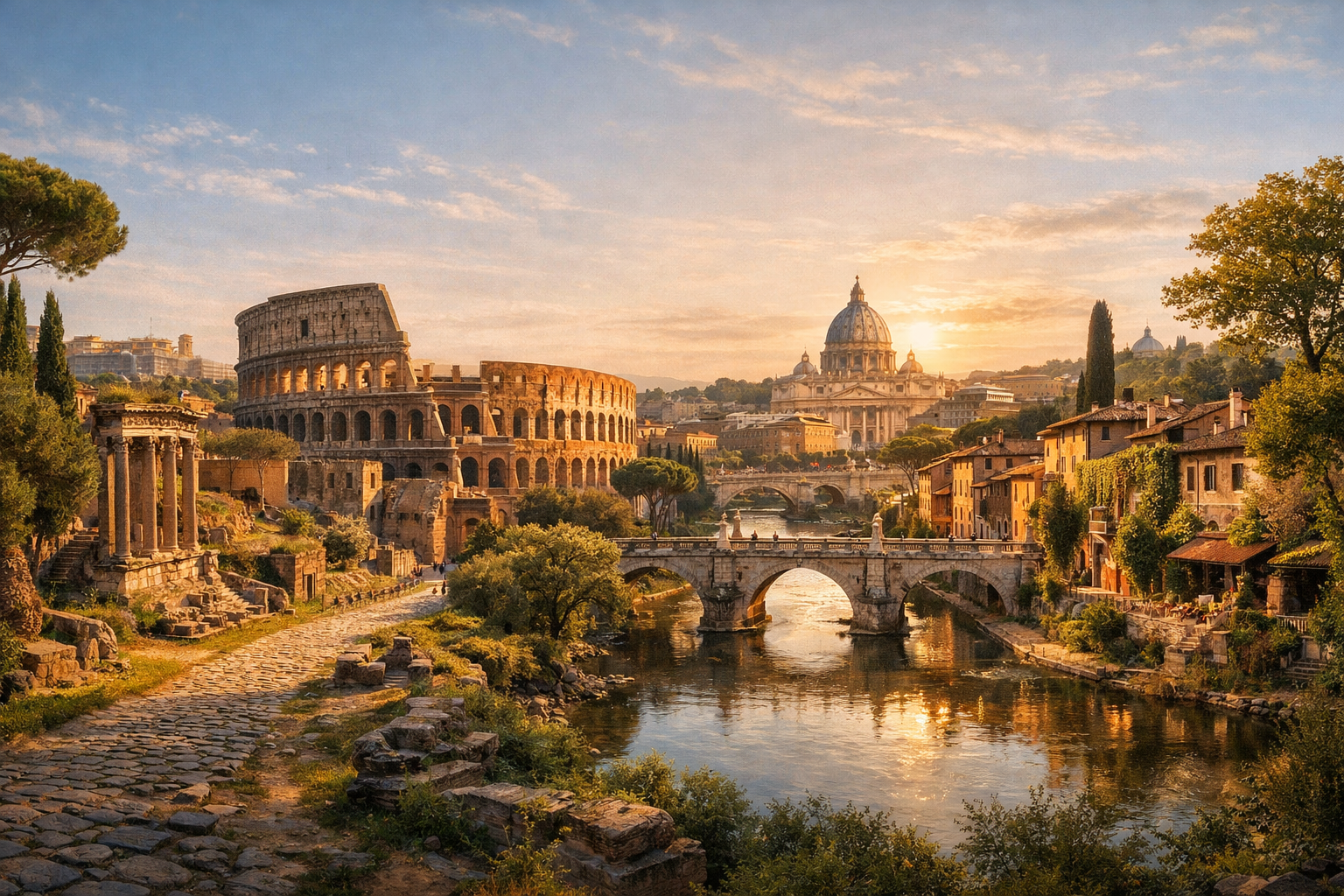
Italy, Rome. A full week in the Eternal City — the historic center, the Colosseum and the Forum, the Vatican, Trastevere, Villa Borghese, the Appian Way, the catacombs, and Rome’s less touristy neighborhoods at a leisurely pace.

Italy, Rome. A full week in the Eternal City — the historic center, the Colosseum and the Forum, the Vatican, Trastevere, Villa Borghese, the Appian Way, the catacombs, and Rome’s less touristy neighborhoods at a leisurely pace.

Spend a full week in Rome and let the Eternal City unfold at a leisurely pace, from the Colosseum and the Forum to the Vatican’s timeless grandeur. Wander through Trastevere, cycle the Appian Way, explore the catacombs, and linger in leafy Villa Borghese before discovering the quieter neighborhoods where everyday Roman life still sets the rhythm.

🧭 DAY-BY-DAY ROUTE

Ready-made country and city routes with daily plans, sights, transport and accommodation. Buy PDF guides for independent travel.

🧭 DAY-BY-DAY ROUTE


Day 1 — Historic center: from Piazza Venezia to the Pantheon, Navona, and the Trevi Fountain

  • 🚶 It’s best to devote the first day to a gentle introduction to Rome through its historic center, so you don’t overwhelm yourself with museums and long lines right after the journey. Start around Piazza Venezia and Capitoline Hill: this is where you especially feel how antiquity, baroque, and everyday city life come together in a single frame. Climb up to Piazza del Campidoglio, designed by Michelangelo, then slowly make your way down toward the streets of the old center. From there, the route naturally leads to the Pantheon — one of the most astonishing monuments of the ancient world, which survived empires, changes of religion, and eras with almost no loss of its power. Its giant dome and famous oculus impress even those who have seen Rome in hundreds of photographs. After the Pantheon, head to Piazza Navona, where the former Stadium of Domitian became one of the city’s most theatrical squares: baroque facades, Bernini fountains, street musicians, long perspectives, and the feeling of an endless open-air stage. It makes sense to end the day at the Trevi Fountain, ideally closer to evening, when the light grows softer and the stone begins to look almost golden. The whole day is very realistic to do on foot, with short stops for coffee, gelato, and rest; in total, the active walk between points will be about 6–8 km at an unhurried pace.


Day 2 — The Colosseum, Roman Forum, and Palatine Hill

  • 🚇 In the morning, it’s convenient to take metro line B to Colosseo or simply walk there if you are staying in the center. This is the day to schedule the main archaeological part of the trip: the Colosseum, Roman Forum, and Palatine form one huge integrated complex, and it is truly worth giving it almost a whole day rather than trying to “rush through” it in a couple of hours. Start with the Colosseum at your pre-booked time slot: the amphitheater we are used to seeing as a symbol of Rome turns out, on site, to be not just a postcard landmark but a powerful architectural body of the city, around which new eras accumulated for centuries. Then move on to the Roman Forum — the place where the political, judicial, and religious life of the ancient world was once concentrated. Among the columns, arches, basilicas, and fragments of temples, it is especially important to go slowly: here Rome reveals itself not as a collection of ruins, but as a complex urban organism. After lunch, climb up Palatine Hill, where, according to legend, the history of the city began and where the imperial palaces later stood. From here you get some of the most beautiful views over the Forum and the surrounding area. Considering lines, security checks, walking across the site, photos, and breaks for water and rest, it’s worth planning for 5–7 hours. For this day, be sure to check official tickets, time slot availability, and current visit options in advance, because entry rules and routes may change.

  • 💤 After the archaeological part, it’s better not to plan a packed evening: a calm walk around Monti or dinner near the hotel is enough. This will help you keep your energy for the whole week.

Day 3 — The Vatican: museums, the Sistine Chapel, and St. Peter’s Basilica

  • 🚇 It’s best to start Vatican day early and, if possible, with an official pre-purchased ticket to the Vatican Museums. The easiest access is metro line A to Ottaviano or Cipro, then on foot. The Vatican Museums are not a single museum in the usual sense, but a vast chain of collections, palaces, galleries, and halls containing works of antiquity, the Renaissance, and church art on an extraordinary scale. The important thing here is not to try to “see everything,” but to accept that the route itself is already a major cultural experience. The Gallery of Maps, ancient sculptures, frescoes, endless corridors, and the growing sense of culmination lead to the Sistine Chapel, where the space suddenly gathers into itself the entire day, the crowd, the anticipation, and the power of Michelangelo’s painting. After the museums, it makes sense to continue the day in St. Peter’s Square and St. Peter’s Basilica. Bernini’s enormous colonnade, the facade, the dome, and the cathedral’s interior create a completely different, more monumental and spiritual rhythm compared with the museum halls. It is reasonable to allocate 6–8 hours for the whole day, taking into account security checks, transfers on foot, lines, a lunch break, and rest. Clothing should be appropriate for religious places, and before the trip you should definitely check entry rules, possible restrictions, and the current schedule.

Day 4 — Trastevere, Tiber Island, and the Janiculum

  • 🚋 After the intensity of antiquity and the Vatican, it’s worth switching to a more lively and human-scale Rome. Start the day in Trastevere — a district many people love not for one specific “main sight,” but for the very fabric of the city: narrow cobbled lanes, warm-toned plaster, windows with green shutters, laundry hanging between buildings, small churches, wine bars, and the feeling of a neighborhood where Rome is not only shown to tourists, but truly lived in. Be sure to stop by the Basilica of Santa Maria in Trastevere, one of the most atmospheric churches in the city, whose square is especially lovely in the morning and again toward evening. Then you can walk to Tiber Island and along the embankment, and after that climb Janiculum Hill. The ascent takes some effort, but the difficulty remains moderate: at a relaxed pace with stops, it is a comfortable route for a reasonably prepared city traveler. From the Janiculum you get wide panoramas of domes, rooftops, and the line of the historic center — one of those views that makes it especially clear why Rome is called the Eternal City. In the second half of the day, leave time for a long lunch or an aperitivo in Trastevere itself. The walking part of the route is usually 5–7 km plus the climb to the viewpoint; if you want to simplify things, part of the route can be done by ATAC tram or bus.

Day 5 — Villa Borghese, Galleria Borghese, and the Pincio / Piazza del Popolo area

  • 🚶 This day is built around a calmer, greener, and more refined side of Rome. Villa Borghese is one of the city’s main parks, where you can give both your legs and your mind a break after several dense historical days. Start with Galleria Borghese if you managed to book a slot in advance: the museum is small in size, but incredibly concentrated in quality. Here you will find works by Bernini, Caravaggio, Raphael, Titian, and other masters, and it is precisely the intimacy of the space that makes the experience so strong — you are not lost in kilometers of halls, but see masterpieces almost at conversational distance. After the museum, don’t rush away: the park itself deserves a full walk. Paths beneath umbrella pines, a boating lake, shady alleys, Roman families on benches, and an almost resort-like feeling in the middle of the big city create a rare contrast for central Rome. Then walk to the Pincio Terrace, which offers the classic view over Piazza del Popolo and the city’s domes. If you wish, you can end the day at the Spanish Steps or on Via del Babuino if you want a beautiful evening finale without museum overload. The logistics here are very comfortable: much of the route is easily done on foot, and if needed, metro line A or a bus can be added without difficulty.

Day 6 — The Appian Way, the catacombs, and early Christian Rome

  • 🚌 This is one of the most special days of the route and one of the best ways to see Rome beyond the postcard image. In the morning, head toward Via Appia Antica — the ancient Appian Way, where the city suddenly changes its voice: the noise of the center recedes, more greenery appears, old stone, cypresses, fragments of tombs, and the feeling of a space where history is not locked inside a museum but lies directly under your feet. You can get there by ATAC bus followed by a short walking section; the exact route is best checked for your travel date, because transport patterns and time restrictions change. In the first half of the day, it makes sense to visit the Catacombs of St. Callixtus or another site on the Appian Way that is open to visitors, but San Callisto remains one of the key and most famous early Christian complexes. This is not a “scary underground tour,” but a very important place for understanding the early history of Christianity in Rome: long underground galleries, burials, the memory of the first communities, and a completely different scale of time. After the catacombs, it is worth leaving time for a walk through the Appia Antica park itself, without rushing and with a break for coffee or a light lunch. The day requires comfortable shoes, water, and attention to the weather: after rain some sections may be less comfortable, and in summer it is difficult here without an early start. Altogether, this is 4–6 hours of active routing plus travel time.

Day 7 — Less touristy Rome: Testaccio, the Aventine, and a modern accent

  • 🚇 It’s best to devote the final day to neighborhoods that let you step out of the mode of obligatory “greatest hits” and feel the city more deeply. A good option is to combine Testaccio, the Aventine, and, if you still have energy and interest, a modern museum accent such as MAXXI in the Flaminio district. Start in Testaccio — historically a working-class area connected with the river port, markets, and Roman gastronomy. There is less grandeur here and more genuine urban texture: local shops, coffee bars, the market, and Roman everyday life without stage sets. Then move on to Aventine Hill, one of the most pleasant and peaceful in the city. It is especially appreciated for its quiet, gardens, and views, and the walk itself gives a gentle ending to the week. You can stop by the Orange Garden, which offers a beautiful view over the city, and the famous keyhole at the Piazza dei Cavalieri di Malta. If you want to end the trip not only with the classics but also with a contemporary layer of Rome, head in the second half of the day to MAXXI — the National Museum of 21st Century Arts, where Zaha Hadid’s architecture and the exhibition spaces provide a sharp but very refreshing contrast after antiquity and baroque. This day is flexible: it is easy to shorten it, make it more food-focused, or, on the contrary, add more museum time. In terms of difficulty, it remains moderate, and the logistics work well with a combination of walking, buses, trams, and metro.

Flight tickets

eSIM for travel

Buy PDF guide

Buy PDF guide — 14.90 USD

PDF — 14.90 USD