Buy PDF guide

Buy PDF guide — 8.90 USD

PDF — 8.90 USD

Spain, Valencia. An accessible route through the City of Arts and Sciences, Turia Park, the historic center, and the accessible part of the city beach.

Spain, Valencia. An accessible route through the City of Arts and Sciences, Turia Park, the historic center, and the accessible part of the city beach.

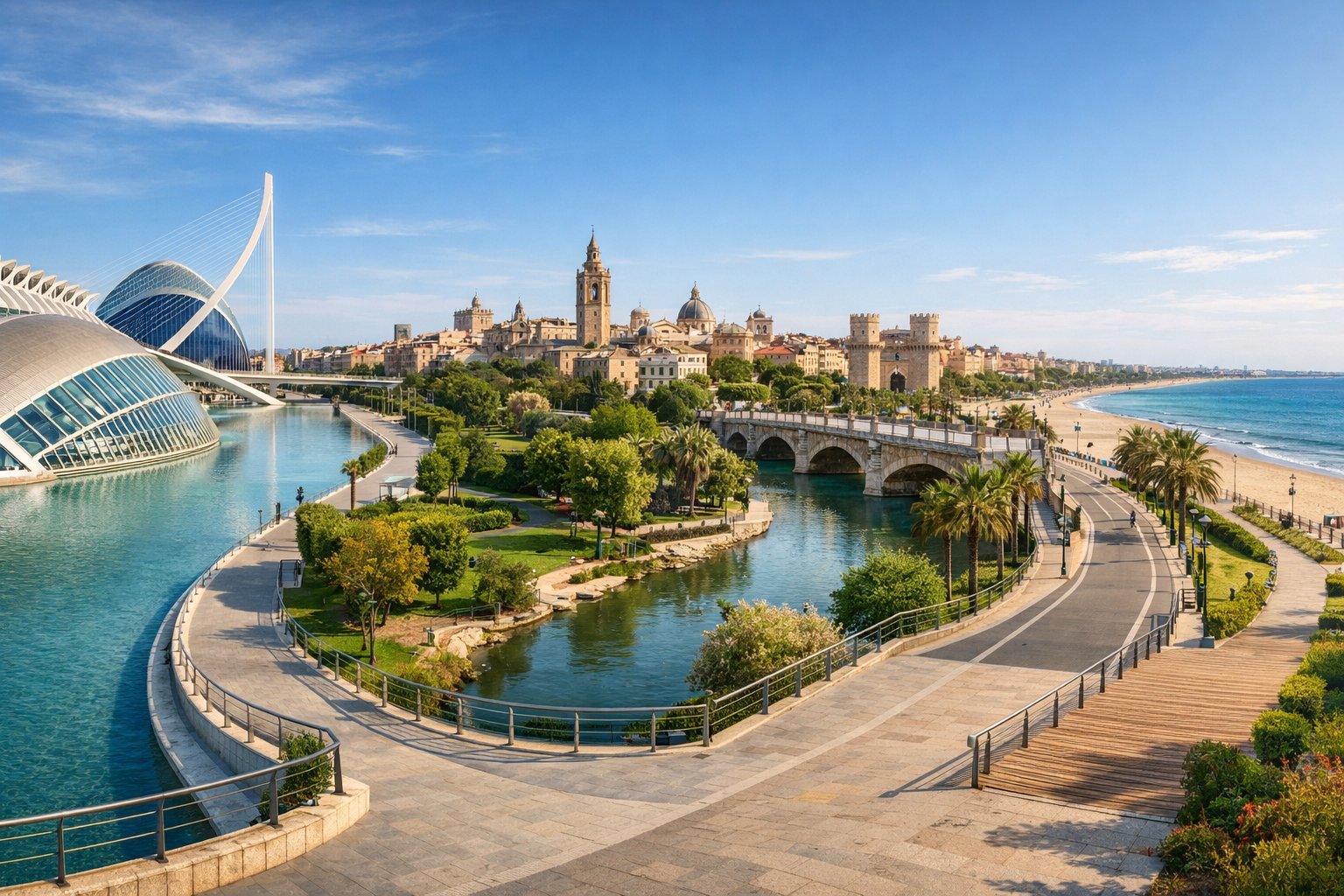
Discover Valencia on an easy, accessible route that flows from the futuristic City of Arts and Sciences through the green ribbon of Turia Park into the character-filled historic center. End by the sea on the city’s accessible beach, where broad promenades and Mediterranean light give the journey a relaxed finish.

🧭 DAY-BY-DAY ROUTE

Ready-made country and city routes with daily plans, sights, transport and accommodation. Buy PDF guides for independent travel.

🧭 DAY-BY-DAY ROUTE


Day 1 — Valencia: arrival, adapted check-in, and the City of Arts and Sciences

  • 🚕 After arriving at Valencia airport, it is best to allow for a calm adaptation day without overload. If you need the most predictable start possible, book a transfer or taxi in advance and note wheelchair use, luggage volume, the need for boarding assistance, and escort service to the hotel reception desk. An alternative is the metro from the airport, but for travelers with heavy luggage, sensitivity to noise, or a need for precise assistance during transfers, a pre-arranged transfer is usually more convenient. For the trip to the City of Arts and Sciences area, it is usually reasonable to allow about 25–40 minutes by car depending on traffic, and a bit more for a combined metro + bus or tram journey.

  • 🏨 Choose accommodation in the Ciudad de las Artes y las Ciencias area: it is convenient for flat walks, more modern than the historic center, and logical for a short itinerary. When booking, be sure to ask not just for an “accessible room,” but for confirmation of specifics: door width, step-free shower or one with a minimal threshold, grab bars by the toilet, space to turn a wheelchair, elevator availability, and the possibility of early check-in or storage for medical equipment. For hard-of-hearing travelers, it is worth clarifying visual alarm signals in advance, and for blind travelers, the possibility of escort from reception to the room.

  • 🚶 In the second half of the day, head to the City of Arts and Sciences — one of the most photogenic and at the same time almost essential complexes for an adapted route in Valencia. What impresses here is not only Santiago Calatrava’s futuristic architecture, but also the logic of the space itself: wide passages, large open views, long gentle transitions, and plenty of places where you can take short breaks without feeling rushed. However, it is important to remember that the area is very extensive, and in summer the open sections heat up a lot, so on the first day it is better to limit yourself to an outdoor walk and one main site rather than trying to see everything at once.

  • 🔬 The best main visit for today is Museu de les Ciències, Av. del Professor López Piñero, 7, 46013 València. The museum is interesting because it combines striking modern architecture with an interactive presentation of science, making it suitable not only for “seeing” but also for a measured sensory introduction to the space. According to the complex’s accessibility information, entry and movement through the museum are supported by adapted elevators; some routes require interaction with staff, so wheelchair users should tell employees at the entrance right away that they need the most direct accessible route to the exhibitions. For people with low vision, the large, readable scale of the space can be helpful, but tactile navigation is not present everywhere, so blind visitors are better off planning an independent visit with a companion or pre-arranged support.

  • 🌆 After the museum, spend 45–60 minutes on a very slow walk along the outer platforms near Hemisfèric and Palau de les Arts. The white structures, mirror-like water, and smooth lines of the bridges create the feeling of an almost cinematic city of the future. For wheelchair users, many of the main surface areas here are comfortable, but in places there are long stretches without shade and some slopes, so it is better to plan a short loop in advance with the option to quickly return to the hotel or a café. For visitors with low vision, the open contrasting forms are easy to read, though at dusk some surfaces may glare.

  • 🍽️ Dinner is best planned near the hotel or the Aqua/El Saler shopping complex, where it is easier to find a modern building with an elevator, level entrance, and adapted restroom than in the old urban fabric. A practical rule for Valencia: before entering, ask not only whether a place is “accesible,” but also whether there is a step on the terrace, how wide the toilet door is, and whether a chair can be moved if you use a wheelchair. On the first evening, this is especially important so you do not waste energy looking for a backup option.


Day 2 — Valencia: Oceanogràfic, a section of Turia Park, and a calm evening

  • 🐠 Start the morning at Oceanogràfic, 46013 València, the city’s largest marine complex and the most impression-rich point of the route. You should set aside at least 3–4 hours for the visit, and for travelers with special needs, even up to 5 hours with breaks. The complex’s official information states that the buildings are adapted with ramps and/or elevators, which greatly облегчает movement for wheelchair users. This is a major advantage for a short trip: you can see a lot without constantly encountering stairs. But the territory is large, so it makes sense to choose 4–5 priority zones in advance and not try to cover the entire park “following the arrows.”

  • ♿ For wheelchair users, Oceanogràfic is usually convenient thanks to modern passageways, elevators, and adapted restrooms, although some routes may be longer than they seem on the map. It is useful to arrive at opening time or during the first hours of the day: there are fewer queues, it is easier to keep a calm pace, and simpler to ask staff for help. For blind and low-vision visitors, acoustics, temperature transitions between pavilions, and the possibility of accompaniment are important; much of the experience here is highly visual, so a companion or personal commentary significantly improves the visit. For deaf and hard-of-hearing visitors, comfort is greater in halls with calm lighting and readable signs than at crowded shows and demonstrations.

  • 🌿 After lunch, continue the day in the adjacent section of Jardín del Turia — a huge linear park stretching across the whole city along the former riverbed. For this route, it is better not to take the whole park, but a segment between the City of Arts and Sciences complex and Palau de la Música, or simply walk only as far as is comfortable for your group. Official accessibility descriptions note numerous ramp entrances, mostly flat routes, accessible bridges with handrails, and adapted toilets along the length of the park approximately every 600 meters. This makes Turia one of Valencia’s best “long walking axes.”

  • 🌳 Despite how friendly it is, the park should not be romanticized as perfectly problem-free. The surface changes: concrete, stone, in places compacted earth and sections of cobblestones; tactile guiding paths are not everywhere, and bike lanes often run next to pedestrian zones. For visitors with low vision, this means the need for increased attention in shared areas, and for manual wheelchair users, planning energy for long stretches. A good strategy is to move in short segments of 20–30 minutes with a mandatory stop in the shade and water checks, especially from late spring to early autumn.

  • 🎧 If you want a cultural accent without overload, as a backup option you can keep only the outer promenade instead of part of the park and return to a museum setting or a café. For travelers with sensory sensitivity, such a flexible day often works better: Oceanogràfic itself already provides a powerful flow of impressions, and there is no need to overload it with too long a walk.

  • 🌙 In the evening, it is nice to have an early rest with a short outing to the illuminated platforms of the complex. At night, the white structures, bridges, and reflections in the water look almost unreal in their beauty, and the distances seem shorter than during the day. But for visitors with low vision, some passageways may feel more difficult after sunset because of the contrast of light and shadow, so it is better to choose only a familiar section of the route that you have already walked.

Day 3 — Valencia: the historic center at an adapted pace

  • 🏛️ The third day is devoted to the historic heart of Valencia, but not in a “rushing through monuments” format — rather as a carefully adapted walk that takes old paving, tourist density, and real limitations into account. It is more convenient to get to the center by EMT bus: the city bus network is officially stated to be 100% accessible for passengers with reduced mobility, with low floors, a kneeling function, and a ramp. This is especially valuable for groups that include wheelchair users or people for whom it is hard to walk a long way to the first point of the route.

  • ⛪ Start in the area of Plaza de la Virgen, Plaza de la Almoina, and Valencia Cathedral. Valencia’s historic center is beautiful precisely because of its layered nature: Roman traces, medieval squares, baroque, Gothic, the noise of street cafés, and golden stone that by evening seems warm to the touch even with your eyes. But this is also where there are the most potential obstacles: cobblestones, local slopes, crowded narrow sections, and old entrances. So it is better to plan a short loop with several stops rather than a long marathon through the whole Ciutat Vella.

  • 🕍 At the cathedral, it is important to consider real rather than assumed accessibility. The main entrance is not considered accessible; the accessible entrance is on the Plaza de la Almoina side, and to use it you need to speak with staff/at reception so they can help open it and organize entry. Inside, there are some level changes, and access to the Chapel of the Holy Grail passes through a section with a ramp on a very steep incline; the path to the museum area also narrows further. This means the cathedral should be viewed as a partially accessible site: suitable for a meaningful visit with preparation, but not as a guaranteed trouble-free stop for every group.

  • 🧭 For blind and low-vision travelers, the historic center is good for its rich textures, the sounds of bells, the smells of markets and cafés, the lively atmosphere of the squares, and short transitions between important points, but it is not ideal for navigation. Tactile infrastructure is not present everywhere, and the density of passersby in the middle of the day can be tiring. So it is better to arrive in the morning, before the peak tourist influx, and, if possible, book an adapted tour. The city has guides offering routes for people with reduced mobility and for hard-of-hearing travelers, but such services should preferably be booked in advance.

  • 🏺 As a calmer backup site in the second half of the day, it is convenient to include Jardí Botànic de la Universitat de València, C/ Quart, 80, 46008 València. The garden lies right on the edge of the historic area and offers a gentle break after the stone squares. It is noted for having a flat accessible approach, an adapted toilet at the entrance, clear pictograms, and access for guide dogs. This is a good option for those who need a quiet, green, and less noisy end to the day, especially if the old center turned out to be too sensorily intense.

  • 🍊 Dedicate the evening to dinner in a modern indoor space near a large square or a transport stop, rather than in the tightest medieval alley. There are many beautiful terrace spots in the center, but terraces are often exactly what turns out to be less convenient: a single step, a narrow passage, difficult restroom access. It is safer to ask in advance for a table inside at entrance level and to clarify the route to the adapted toilet.

Day 4 — Valencia: accessible city beach and departure

  • 🌊 It is best to make the final day as bright and relaxed as possible: no long museums or complicated transfers, just a trip to the accessible part of the city beach. La Malvarrosa or Cabanyal work well for this route — both areas are included in Valencia’s list of accessible beaches. Seasonality matters here: beach assistance and specialized equipment operate during the summer swimming season on a schedule that changes by season, so amphibious chairs, crutches for entering the water, lifting devices, bathing assistance, and accessible service points need to be checked and, if possible, booked in advance.

  • 🏖️ The city’s accessible beaches provide designated areas for people with disabilities, adapted toilets, guiding navigation to accessible points, ramps, boardwalk passages, and barrier-free sections across the sand. An additional plus is the contrasting side stripes on some boardwalks and the logical access to showers, foot-washing stations, kiosks, and first-aid points. For wheelchair users, this is one of the most pleasant ways to end the trip: not to “fight” with the natural environment, but to use specially organized infrastructure.

  • ☀️ But even an adapted beach requires sensible planning. Sand, wind, reflected light, noise, heat, and the distance from the stop to the needed point can be tiring. It is better to arrive in the morning, bring an umbrella or canopy, check the location of the medical post in advance, and not plan swimming right before leaving for the airport. If your group is traveling in spring or autumn, the beach on this day may be primarily for walking: along the flat promenade, with sea views, without any obligation to go into the water.

  • ℹ️ Near the beach area, the Visit Valencia tourist office by the beach is known as a convenient support point: it has an accessible counter, an induction loop for people with hearing impairments, assistance for visitors with reduced mobility, a magnifying glass, maps with pictograms, and materials with routes adapted for people with visual and hearing impairments. This is especially useful on the last day if you need to quickly adjust the plan according to weather, transport, or how you feel.

  • 🚌 After the beach, return to the hotel for your luggage with plenty of extra time. If you need public transport, rely on EMT low-floor buses; if the flight is early, late, or the group is tired after the beach, it is wiser to book a taxi/transfer to the airport in advance. Travelers who require carrier assistance or escort service in the terminal should arrange such support the day before, not at the last minute.

  • 💙 This four-day route through Valencia is good because it does not try to cover too much. It combines futuristic architecture, a green urban corridor, historical depth, and the sea — but does so at a pace where rest, accessibility, and the ability to change the plan are not seen as a compromise, but as the very foundation of comfortable travel.

Flight tickets

eSIM for travel

Buy PDF guide

Buy PDF guide — 8.90 USD

PDF — 8.90 USD